

















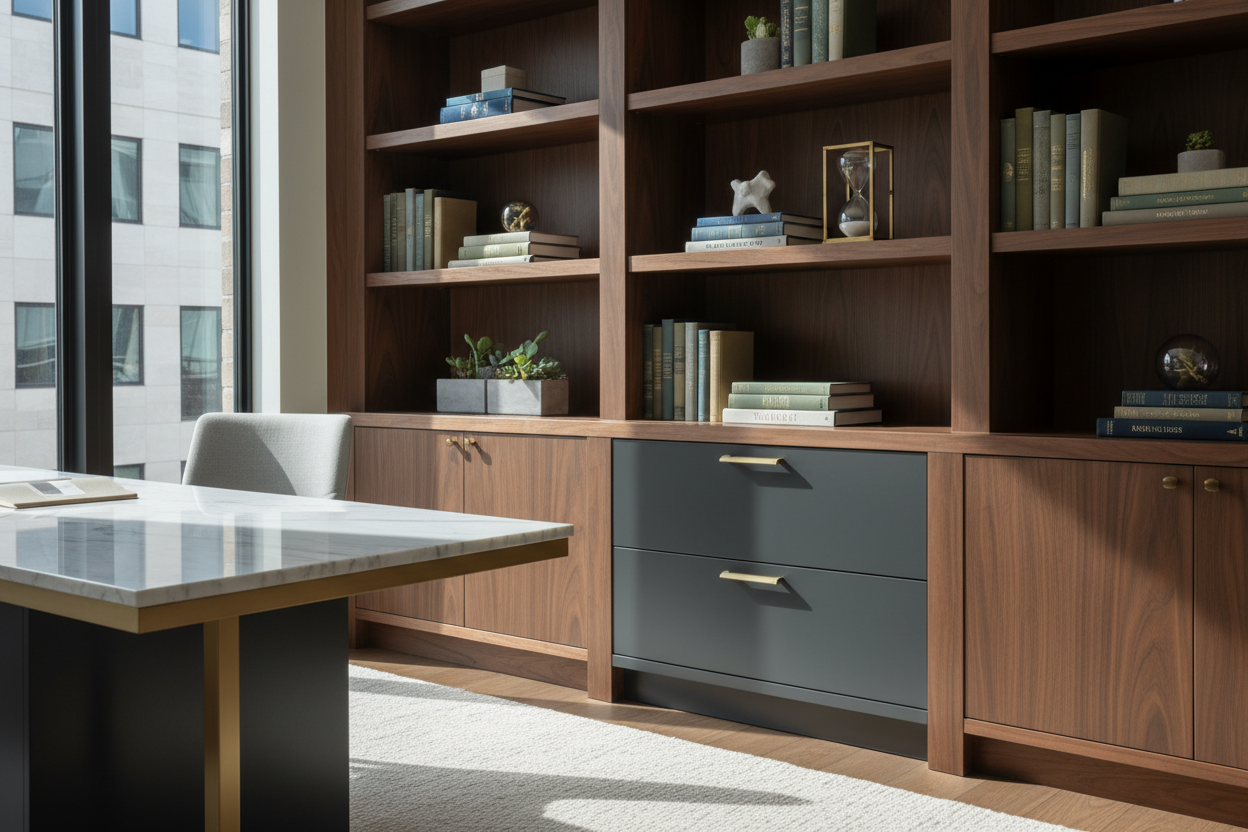
One of the most persistent design dilemmas in home offices is the tension between the need for utilitarian storage and the desire for a sophisticated library aesthetic. We often find ourselves choosing between ugly metal towers that hold paperwork and elegant shelving that holds very little else. The solution lies in a hybrid piece that anchors the room while hiding the clutter: the bookcase with filing cabinet.
Key Features to Consider Before Buying
- Depth Discrepancy: Ensure the base unit is deeper (approx. 18-22 inches) than the upper shelving (12-14 inches) to prevent top-heaviness and accommodate standard file folders.
- Drawer Extension: Look for full-extension ball-bearing slides; partial extensions make accessing rear files in a file drawer bookcase frustrating.
- Material Integrity: Avoid particle board for the drawers. Files are heavy; you need solid wood or high-grade plywood construction to prevent bowing.
- Safety Mechanisms: A bookshelf with locking file cabinet is essential for sensitive documents, and anti-tip hardware is non-negotiable for tall units.
Choosing the Right Silhouette for Your Space
When selecting a filing cabinet and bookcase combination, the silhouette dictates the room's flow. In my design practice, I categorize these into two main profiles: the vertical tower and the lateral expanse.
The Vertical Tower: Tall Bookcase with File Drawers
For tighter corners or narrow wall segments, a tall bookcase with file drawers maximizes vertical real estate. These units typically feature a bookcase with file cabinet base, where the bottom 30 inches function as storage and the upper section remains open for display. This creates a visual anchor, drawing the eye upward while keeping the heavy visual weight of paperwork near the floor.
The Lateral Expanse: Lateral Filing Cabinet with Bookshelf
If you have the wall width, a lateral filing cabinet with bookshelf on top offers a more substantial, built-in look. These units allow for side-by-side file storage, which is ergonomically superior for active referencing. A bookshelf and filing cabinet in this configuration often serves as a credenza, providing a surface ledge that breaks up the cabinetry and offers a spot for ambient lighting or art.
Materiality and Visual Balance
The finish you choose determines whether the piece feels like office furniture or a curated antique. A white bookcase with filing cabinet is a staple for coastal or transitional interiors; it reflects light and makes a massive unit feel less imposing. However, ensure the finish is a catalyzed lacquer rather than a simple paint to withstand the daily abrasion of opening and closing drawers.
For a more executive feel, a bookshelf with file drawer components in walnut or mahogany adds warmth. When styling a bookshelf and file cabinet, I always advise clients to balance the dense, closed storage of the bottom with 'breathing room' on the shelves. Do not pack the upper shelves with filing cabinet bases full of books; intersperse them with sculptural objects to lighten the visual load.
Functionality: The Hidden Details
A true office bookcase with file drawers must perform as well as it looks. Pay close attention to the hardware. A bookshelf with filing drawers should have heavy-duty handles that are easy to grip; tiny knobs are insufficient for the torque required to pull open a fully loaded file drawer. Furthermore, if you are looking at a modular system—essentially a filing cabinet with bookshelf on top—verify that the hutch is securely bolted to the base, not just resting there by gravity.
Lessons from My Own Projects
I learned a hard lesson about the filing bookcase early in my career while furnishing a study for a client in a historic brownstone. We ordered a beautiful, custom bookshelf with filing cabinet base. It looked stunning in the showroom.
However, once we loaded the file storage bookcase with the client's archival legal papers, we realized a critical flaw: the unit wasn't leveled perfectly before loading. The sheer weight of the paper caused the chassis to rack slightly, making the bookshelf filing cabinet drawers bind every time they were closed. We had to unload three hundred pounds of paper, shim the base specifically for the uneven historic floors, and reload. Now, I always tell clients: a file cabinet bookcase is a living thing. It settles. Place it, level it, load it, and then level it again a week later. Also, never underestimate the 'tip factor'—when those top drawers slide out, the center of gravity shifts dangerously forward. Wall anchoring isn't optional; it's mandatory.
Conclusion
Integrating a bookcase with filing drawer capability into your home office eliminates the need to sacrifice style for organization. By selecting the right scale, material, and hardware, you turn a utilitarian necessity into a beautiful focal point. Treat your storage like architecture, and your workspace will feel less like a cubicle and more like a sanctuary.
Frequently Asked Questions
Can I place a bookshelf on top of my existing filing cabinet?
Technically, yes, but be careful. A standard filing cabinet with bookshelf on top often looks mismatched due to depth differences. Filing cabinets are usually 18-25 inches deep, while bookshelves are 12 inches. If you do this, pull the bookshelf forward to align with the cabinet face for a built-in look, and secure it firmly to the wall.
What is the difference between a standard drawer and a file drawer?
A bookshelf with file drawer has deeper dimensions and specific hardware (rails) to hold hanging folders (Letter or Legal size). A standard drawer lacks the height and heavy-duty slides required to support the weight of dense paper storage.
How much weight can a file cabinet bookcase hold?
This depends on the construction. A high-quality bookshelf with filing cabinet base should support 75-100 lbs per drawer. Always check the manufacturer's load rating, especially for lateral filing cabinet with bookshelf units, as wider drawers carry more weight and are more prone to sagging.


Leave a comment
This site is protected by hCaptcha and the hCaptcha Privacy Policy and Terms of Service apply.