

















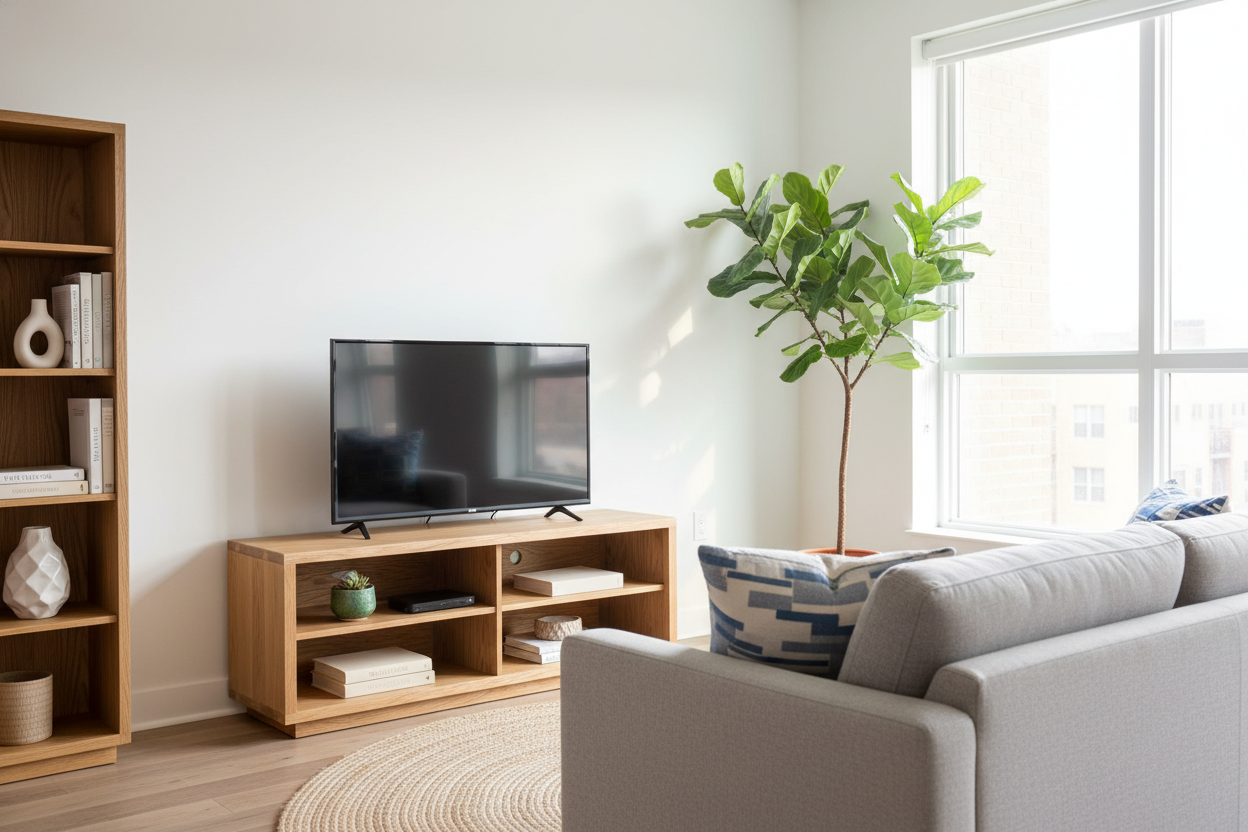
I spent three years living in a studio apartment where the media console was so wide I had to shimmy sideways just to get to my window. It was a massive, dark particle-board beast that looked like a leftover from a 90s bachelor pad. My 50-inch screen sat in the middle of it, looking like a postage stamp on a billboard. Finally, I got fed up and swapped it for one of those small wood tv stands and I swear the room grew four feet overnight.
We have this weird habit of thinking we need a wall-to-wall wooden tv entertainment stand to justify a large television. We don't. In fact, most of us are just filling that extra shelf space with dust and old HDMI cables we will never use again. If you are tired of your living room feeling like a Best Buy clearance aisle, it is time to scale down.
Quick Takeaways
- Stop buying consoles wider than your TV plus 6 inches; you are wasting floor space.
- Avoid the 'black hole' of solid-door armoires in tiny rooms.
- Real timber beats MDF every single time for durability and soul.
- Legs create visual floor space, making a cramped room feel airy.
Your Massive Media Console Is Choking the Room
Most standard wooden tv units are built for suburban basements, not city apartments. When you drop a 72-inch console into a 12-foot wide living room, you aren't just losing square footage—you are killing the flow. These oversized units create a 'black hole' effect. Because they are so heavy and dominant, your eyes are immediately sucked toward the tech setup rather than the windows or the art on your walls.
I have seen so many people try to fix a small room by buying more storage, thinking a massive wooden tv armoire will hide the clutter. It won't. It just moves the clutter inside a giant wooden box that takes up half the room. A compact wooden tv table stand does the opposite. It forces you to be intentional about what you keep. It lets the floorboards show, and in a small space, seeing more floor is the oldest trick in the book to make a room feel larger. You don't need a monument to your Netflix habit; you just need a sturdy place for the screen to live.
The Visual Magic of Small Wood TV Stands
There is a specific kind of coldness that comes with modern electronics. Between the glass screen and the plastic casing, a TV is a very 'hard' object. This is why I always advocate for a wooden tv console stand over metal or glass. The organic grain of real timber—whether it is a warm honey oak or a deep walnut—acts as a visual buffer. It softens the harshness of the screen.
When I finally made the switch, I realized I had been living with a sagging MDF console for a TV stand in wood that actually had some character. The difference was night and day. A small wood tv stands footprint allows the corners of the room to stay open. If you choose a piece with tapered legs, the light can pass underneath it. It sounds like a small detail, but when you can see the floor extending all the way to the baseboard, your brain registers the room as 'open' rather than 'occupied.'
The 'Breezy' Effect: Why a Wood Shelf TV Stand Works
Storage is the biggest hurdle in a small apartment, but don't fall for the trap of 'closed' storage. A heavy, blocky wooden tv armoire feels like a brick in the room. Instead, look for a wood shelf tv stand. Open shelving is your best friend when you are dealing with limited real estate. It provides a spot for your PlayStation or a few books without the visual weight of cabinet doors.
A wooden tv stand with shelves allows you to style the area so it doesn't look like a tech station. Put a ceramic bowl on one shelf, maybe a small plant on the other. This breaks up the 'electronics' vibe. I’ve found that a wooden tv table stand with a single open shelf feels incredibly light. It keeps the room from feeling claustrophobic because you aren't staring at a solid wall of wood. You are seeing through the furniture, which maintains the sightlines of the room.
Can a Giant Flat Screen Actually Sit on a Tiny Wooden Console?
The most common question I get is: 'Won't it look top-heavy?' It’s a fair point. You don't want your 65-inch screen looking like it’s teetering on a toothpick. The rule of thumb for wood tv stands for flat screens is to ensure the stand is at least 2 to 4 inches wider than the base of the TV, but it doesn't have to be wider than the screen itself if you style it right.
If you are worried about the proportions, try styling a black wood TV stand to help the screen blend in. Darker woods or black finishes help the 'black box' of the TV disappear when it is turned off. If you have a massive screen on a wooden tv table stand, keep the surrounding wall clear. Don't crowd it with heavy art. Let the wood do the heavy lifting visually. I once put a 55-inch OLED on a 40-inch mid-century bench, and because the bench was solid teak, it looked like a deliberate design choice rather than a mistake.
Ditching the Dorm Vibe: Finding Unique Wood TV Stands
We have all owned that one $40 particle-board stand from a big-box store. It’s a rite of passage, but it also screams 'starter apartment.' If you want to grow up your space, you need to look for unique wooden tv stands that have some soul. Look for details like fluted wood panels, hand-turned legs, or interesting grain patterns like bird's-eye maple or reclaimed heart pine.
A wooden tv console stand shouldn't just be a utility item. It should be a piece of furniture you actually like looking at. I personally love unique wood tv stands that use joinery instead of just screws and cam-locks. They last longer, they don't wobble when you walk past them, and they hold their value. If you are ready to stop settling for 'disposable' furniture, I highly recommend browsing a curated collection of TV stands to find something that actually fits your floor plan and your personality.
My Personal Take: The Wobbly Vintage Mistake
I once bought a gorgeous 1960s sewing cabinet to use as a small TV stand. It was stunning—solid cherry with these delicate spindly legs. I loved it until I actually put my TV on it. Every time I walked across my creaky apartment floor, the TV would wobble like it was in a 6.0 earthquake. I learned the hard way: check the weight rating. Just because a piece of wood is 'solid' doesn't mean the legs are braced for a modern 40-pound screen. Now, I always look for a wider leg base or a center support leg. Lesson learned.
Frequently Asked Questions
How much wider should a TV stand be than the TV?
Ideally, you want about 2-3 inches of 'breathing room' on either side of the TV's frame so it doesn't look like it's falling off. However, if the TV is wall-mounted, the stand can be any size you like.
Is solid wood better than high-quality veneer?
Solid wood is more durable and can be refinished, but a high-quality wood veneer on a plywood core is actually more stable in humid environments and won't warp as easily as solid planks.
How do I hide cables on an open-shelf wood stand?
Use adhesive cable clips along the back of the legs or a matching wood cable management box. You can also use 'velcro' ties to bundle cords behind one of the vertical supports so they stay out of sight.


Leave a comment
This site is protected by hCaptcha and the hCaptcha Privacy Policy and Terms of Service apply.