

















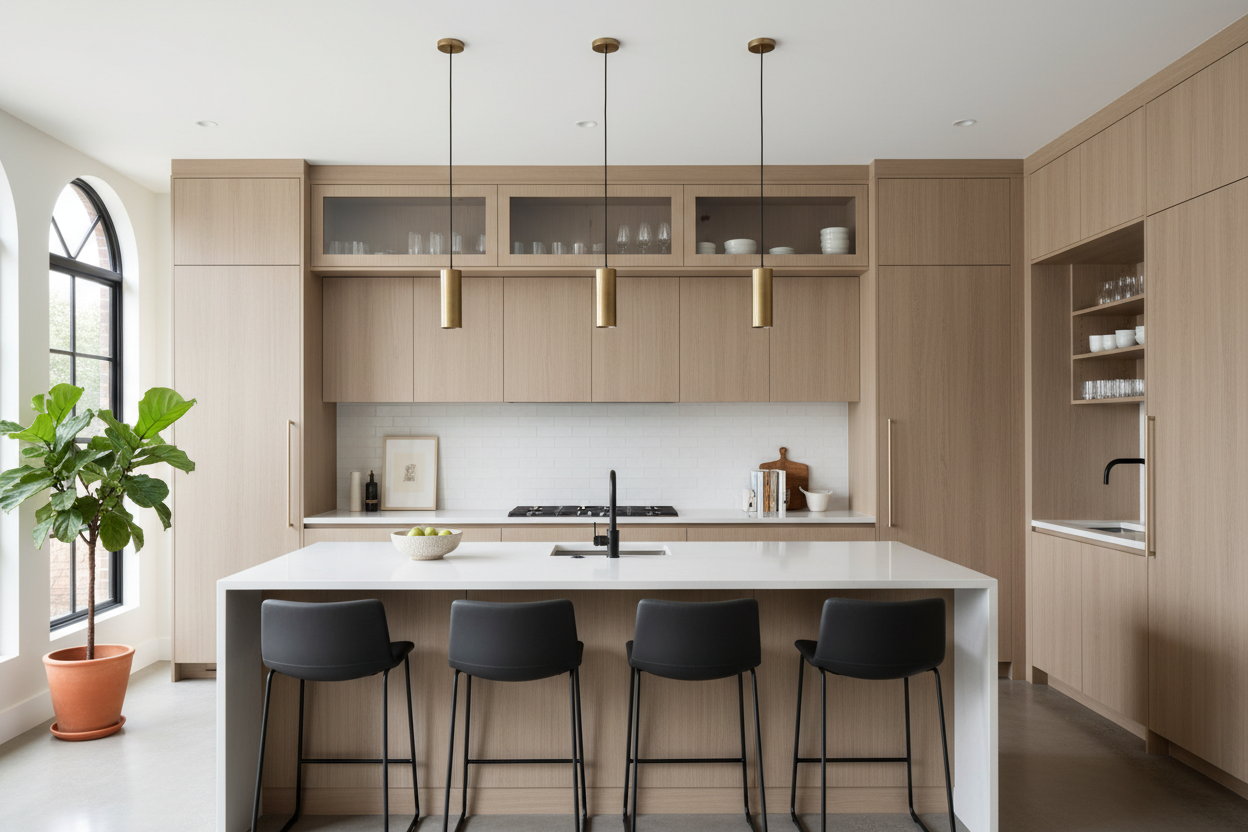
I spent my Saturday morning on a shaky step ladder, scrubbing a layer of sticky, grey fuzz off the top of my fridge. It wasn't just dust; it was a decade of aerosolized bacon grease and cat hair that had formed a sentient carpet in that useless 12-inch gap above my kitchen wall cabinets. If you are currently staring at that weird empty space between your uppers and the ceiling, I am here to tell you: it doesn't have to be this way.
- Eliminate the Dust Trap: Ceiling-height cabinets mean no more greasy hidden ledges to clean.
- Visual Height: Taking cabinets to the top makes your ceilings look two feet higher than they actually are.
- Storage for the 'Once-a-Years': Use the top tier for the Thanksgiving turkey platter and the Christmas cookie tins.
- Custom Look for Less: You can fake a high-end built-in look using stock boxes and a little clever molding.
The 'Floating Upper' Trend Is Just a Dust Trap
Why do we keep leaving that awkward 12-to-18-inch gap above our kitchen wall cupboards? Most builders do it because it’s cheap. It allows them to use one standard cabinet size across every house in the development without worrying about whether the floor is level or the ceiling is straight. But for the person actually living there, it’s a maintenance nightmare. That space is a magnet for kitchen grime that is nearly impossible to reach without a dedicated afternoon and a lot of elbow grease.
We’ve all seen the attempt to 'style' this gap. Someone puts a row of dusty wine bottles or a trail of fake ivy up there, thinking it adds personality. In reality, it just adds visual clutter. A wall cabinet design for kitchen spaces should feel intentional, not like you ran out of money halfway up the wall. When you close that gap, you create a clean, architectural line that draws the eye upward, making even a cramped 10x10 kitchen feel like it has some breathing room.
How Faking Custom Kitchen Wall Cabinets Actually Works
You don't need a $50,000 renovation budget to get full-height storage. The secret is the 'stacked' method. Instead of ordering one massive, custom-sized box, you use standard kitchen wall units and stack a smaller 'bridge' cabinet on top. For a standard 8-foot ceiling, a 30-inch cabinet with a 12-inch or 15-inch unit on top usually does the trick. This is the best way to get quality without the designer markup because you’re using mass-produced sizes to create a custom silhouette.
The real magic happens with the crown molding. You don't just nail a thin strip to the top. You use a 'riser'—a flat piece of trim that extends from the top of the cabinet to the ceiling—and then wrap your crown molding over that. This hides any gaps caused by an unlevel ceiling. It turns a collection of individual boxes into a seamless wall of cabinets kitchen enthusiasts will actually envy. If you're worried about the seam where the boxes meet, a simple piece of decorative 'shingle' molding can cover the horizontal line perfectly.
But Wait, Won't My Kitchen Feel Top-Heavy?
This is the number one pushback I get. People think that taking modern kitchen wall cabinet layouts all the way up will make them feel like the walls are closing in. If you have a tiny galley kitchen and you install solid, dark navy doors all the way to the ceiling, then yes, it might feel a bit heavy. But the solution isn't to leave a dust-gap; the solution is to change the material.
Try using glass inserts for the very top row of cabinets. It acts like a window, reflecting light and giving the illusion of depth. I often suggest adding a high-contrast accent, like a black cabinet with glass doors, to break up a long run of white or wood uppers. Pair this with under-cabinet lighting to keep the countertops bright, and suddenly that 'top-heavy' fear disappears. You get the storage, the height, and the style without the claustrophobia.
The 'Full Wall' Alternative for Maximum Storage
Sometimes, the best wall kitchen cabinet ideas involve getting rid of the middle ground entirely. If you have a wall that doesn't need to be a primary prep zone, skip the backsplash and the countertop. A full wall kitchen cabinet design—essentially a massive, floor-to-ceiling pantry block—is a storage powerhouse. By combining standard bases with long kitchen wall cabinets, you create a monolithic look that hides everything from the microwave to the stand mixer.
When researching tall kitchen cabinet ideas, look for ways to integrate 'in wall cabinet ideas' like recessed shelving or pull-out larders. This approach works incredibly well in open-concept homes where you want the kitchen to look more like furniture and less like a laboratory. It’s the ultimate way to maximize every square inch of vertical real estate, especially in apartments where floor space is at a premium.
3 Measurements You Cannot Mess Up
If you're ready to pull the trigger on new kitchen cabinet wall units, you need to be obsessive about the math. First: check your ceiling level. Measure from the floor to the ceiling in four different corners. If there is more than a half-inch difference, you’ll need to account for that with your riser trim. Second: the 18-inch rule. Your uppers should sit exactly 18 inches above your countertop. Any lower and your coffee maker won't fit; any higher and you'll need a stool just to reach the salt shaker.
Finally, consider the depth. Standard wall units are 12 inches deep, but if you're stacking them or building a full wall, you might want to mix in some 15-inch or even 24-inch deep cabinets for the upper-uppers. Just make sure you aren't creating a head-bumping hazard over your main prep sink. Get these three numbers right, and your 'fake' custom cabinets will look like they were designed by an architect.
My Honest Take: The Time I Ignored the Level
I once helped a friend install a 'wall of cabinets' in a 1920s craftsman house. We were so excited to get the boxes up that we didn't properly shim the first unit. By the time we got to the fourth cabinet, the 'level' line was off by nearly an inch. Because we were taking them to the ceiling, that inch gap was glaringly obvious. We had to take three cabinets down and start over. Lesson learned: the ceiling is always lying to you. Use your level, not your eyes.
Frequently Asked Questions
Are ceiling-height cabinets more expensive?
Yes, because you are buying more material and the installation is more complex. However, the added home value and the fact that you'll never have to clean cabinet tops again usually makes the ROI worth it for most homeowners.
How do I reach the top cabinets?
You don't—at least not every day. The top tier is for seasonal items like holiday platters, large stock pots, or that fondue set you use once a year. Keep a stylish library ladder or a slim folding stool tucked in a nearby closet.
Can I add onto my existing cabinets?
Absolutely. If your current cabinets are in good shape, you can buy matching 'add-on' boxes to fill the gap. The hardest part is matching the paint or stain, which is why many people choose to paint the entire set a new color once the top boxes are installed.


Leave a comment
This site is protected by hCaptcha and the hCaptcha Privacy Policy and Terms of Service apply.