

















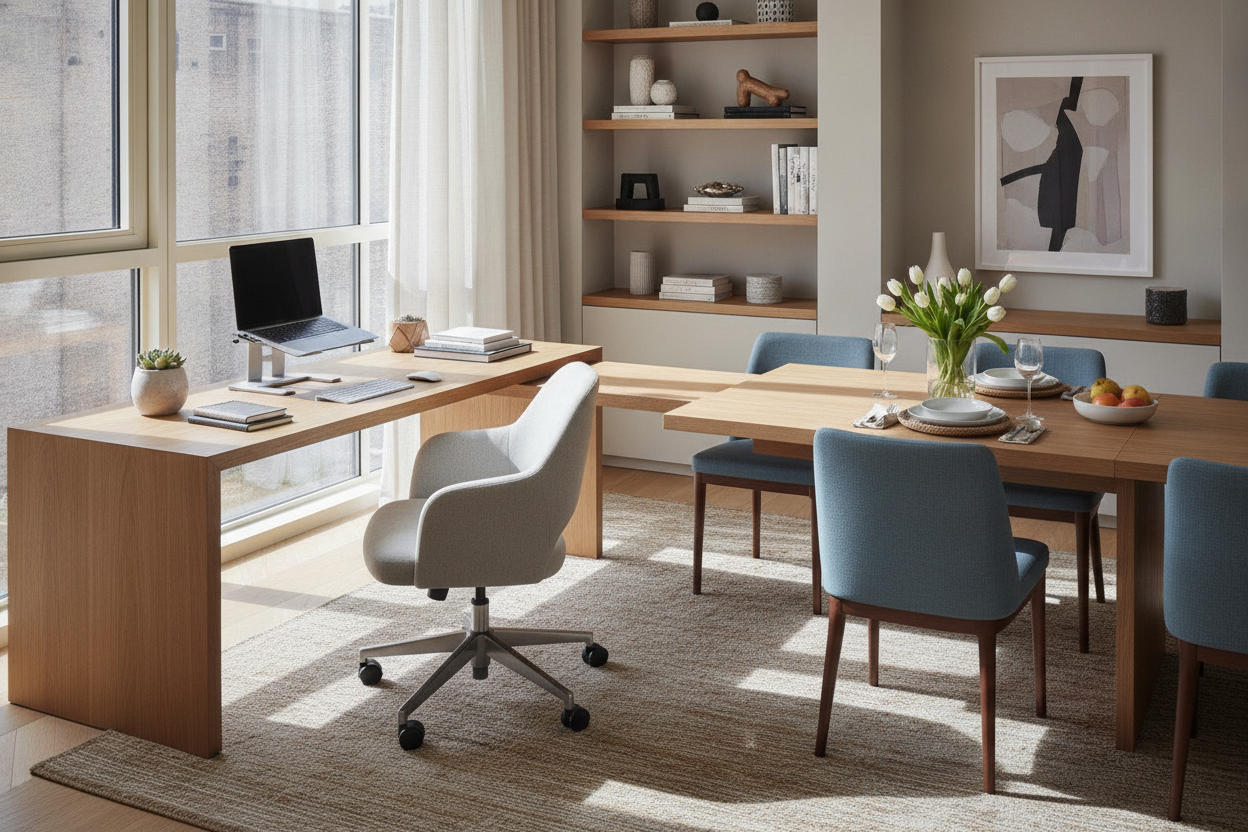
I spent three years in a 400-square-foot studio where my 'office' was also my 'bistro.' There is nothing quite like trying to enjoy a glass of wine while staring at a Slack notification that just popped up on your monitor three inches away. It is a recipe for a low-grade anxiety that never really goes away until you physically change your environment. That is why I finally caved and bought a convertible dining table desk.
- Mental Separation: Physically changing the furniture helps your brain switch from 'boss' mode to 'bistro' mode.
- Mechanism Quality: Pneumatic or motorized lifts beat manual hinges every single time for daily use.
- Surface Durability: Look for heat-resistant laminates or sealed hardwoods that can handle a hot bowl of ramen.
- Stability: Avoid the 'scissor-lift' style if you value your coffee not spilling every time you type.
The Psychological Toll of the 'Everything Surface'
When your desk is your dining table, you never truly leave the office. I used to think I was being efficient by working from my dining chair, but after six months, I realized I was developing a pavlovian stress response to my dinner. I would sit down to eat, look at the spot where my laptop usually sits, and my heart rate would spike thinking about an unread email. This is the burnout of the 'everything surface.' Your brain needs physical cues to transition between roles, and a static piece of wood just cannot provide that.
A desk that converts to dining table acts as a hard boundary. When the table is at desk height, your brain is in productivity mode. When you collapse it, fold it, or expand it into a dining configuration, you are performing a physical ritual that tells your nervous system it is okay to relax. It is not just about saving space in a cramped apartment; it is about protecting your mental health. I found that once the monitors were tucked away and the surface was lowered to a dining height, the room actually felt like a home again instead of a cubicle with a bed in the corner.
Why a True Transformer Beats a Static Hybrid
For a long time, I tried to make a desk dining room table work by simply using a large, fixed-height table for both. It was a disaster. At 29 inches high, it was slightly too low for comfortable typing and slightly too high for relaxed dining. Plus, the clutter never left. A true 'transformer' piece of furniture—one that mechanically changes its footprint or height—forces you to clear the decks. You cannot convert the table without moving the work gear, and that is a feature, not a bug.
The physical act of transformation is the most important part. Whether it is a gate-leg table that expands or a height-adjustable surface that drops down, the movement signals a shift in the environment. Static hybrids usually end up looking like messy desks 24/7. When you have a table that turns into a desk, you are forced to curate your space. You become more intentional about what stays on the surface. I noticed that my productivity actually went up because I knew I had a 'deadline' to clear the desk and turn it back into a dining space by 7:00 PM.
What to Look For in a Table That Turns Into a Desk
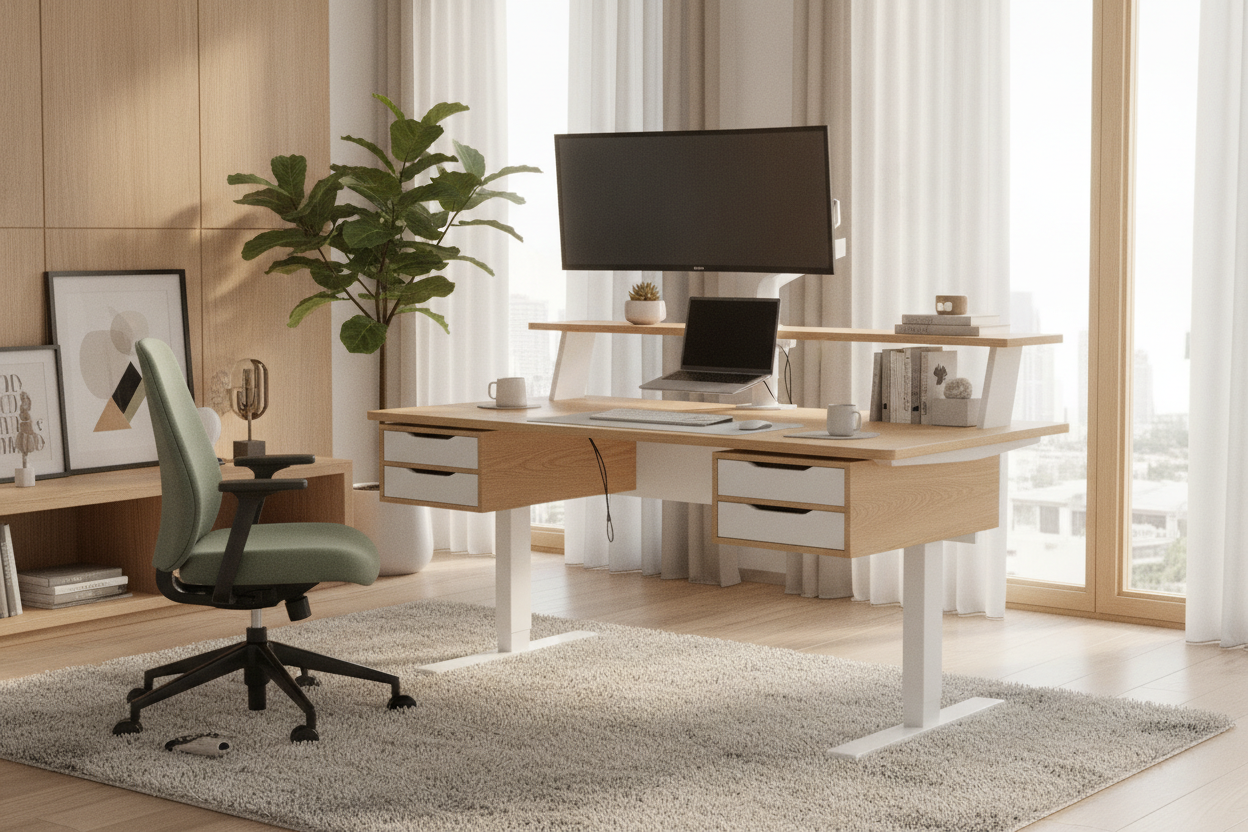
If you are shopping for a desk that converts to dining table, do not get blinded by how cool it looks in a 30-second TikTok. You need to look at the guts of the thing. First, check the lift mechanism. Pneumatic lifts are great because they are smooth and do not require a power outlet, but they have weight limits. If you have a heavy 32-inch iMac and a stack of books, a cheap pneumatic lift might struggle to stay up. Motorized versions are sturdier but require cord management, which can be a nightmare in the middle of a room.
Second, consider the weight capacity. Most cheap convertible tables are rated for about 50 pounds. That sounds like a lot until you realize a sturdy monitor, a laptop, a lamp, and your leaning body weight can easily exceed that. I always look for something rated for at least 100 pounds. You also need to think about the finish. A desk needs to be smooth for writing, but a dining table needs to be scratch-resistant and heat-resistant. I prefer a high-pressure laminate or a thick, polyurethane-coated solid wood. Avoid cheap veneer; it will bubble the first time you set down a sweaty glass of iced tea.
The Wobble Factor (And Other Annoyances to Avoid)
Here is the truth: most convertible furniture is flimsy. If the table relies on a single center pedestal or thin 'scissor' legs, it is going to wobble. There is nothing more frustrating than trying to type a sensitive email while your monitor shakes like it is in a minor earthquake. I once bought a manual folding table that felt like it was made of toothpicks. I ended up returning it after three days because I was terrified it would collapse if I cut a steak too vigorously.
If you want real stability, look for a four-leg configuration or a heavy steel T-frame. Some people find that a heavy-duty motorized dining table frame is the only way to go if you want zero movement. These frames are built for office environments and can handle the weight of a full dinner service without creaking. Also, watch out for 'leaf gaps.' If the table converts by adding leaves, make sure the locking mechanism is tight. An uneven surface is fine for a laptop, but it is a nightmare when you are trying to balance a wine glass.
My 5-Minute 'End of Workday' Transition Ritual
To make this work, you need a system. At 6:00 PM, I start my transition. First, the laptop goes into a dedicated felt sleeve and slides into a nearby basket—out of sight, out of mind. I use a wireless keyboard and mouse, which also get tucked away. This is crucial: if you can see your work tools, you are still at work. I then use a simple cable management tray under the table to keep the power bricks from dangling like ugly vines.
Once the surface is clear, I give it a quick wipe with a damp cloth to get rid of the 'office dust.' Then comes the magic: I trigger the mechanism to lower or expand the table. I lay down a pair of linen placemats and a candle. It takes exactly five minutes, but the transformation is total. The room smells like sandalwood instead of electronics, and the 'desk' is officially gone. It is the only way I have found to keep my sanity while living and working in the same four walls.
FAQ
Can I use a regular standing desk as a dining table?
Technically yes, but most standing desks are too narrow (usually 24-30 inches). For a comfortable dining experience for two people, you really want a depth of at least 30-36 inches so you aren't knocking knees.
Are these tables hard to assemble?
The mechanisms come pre-assembled usually, but the frames are heavy. Expect to spend about 45 minutes on assembly, and definitely have a second person help you flip it over so you don't bend the hinges.
How do I hide the cables when it's in dining mode?
Use a cable management 'spine' or a mesh tray that attaches to the underside of the tabletop. Avoid let-down cables; use a single power strip mounted to the frame so only one cord runs to the wall.

Leave a comment
This site is protected by hCaptcha and the hCaptcha Privacy Policy and Terms of Service apply.