

















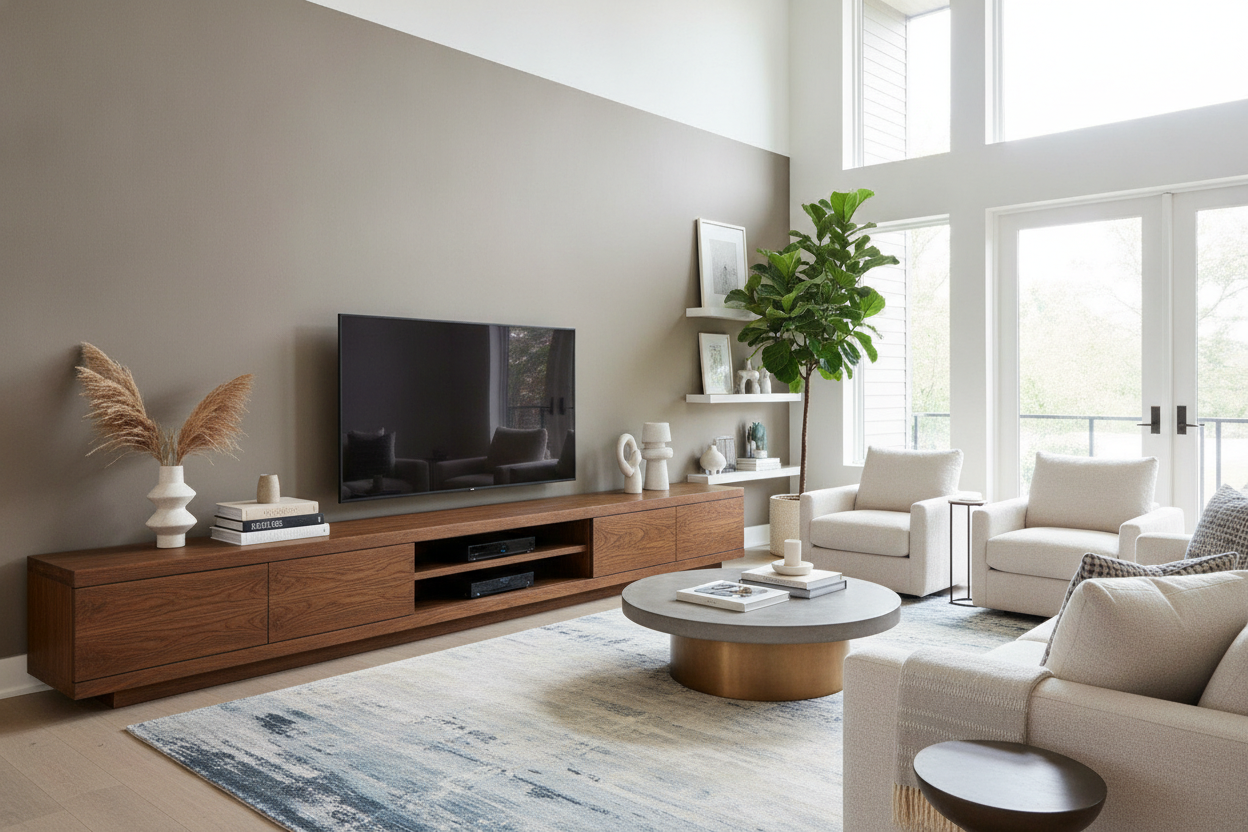
I remember my first 'adult' apartment, standing in the middle of a big-box store staring at a $60 media console. It looked sleek in the fluorescent light, and the price felt like a heist. I hauled it home, spent three hours fighting with cam-locks, and proudly set my 55-inch TV on top. Within a month, the top shelf had a visible, gut-wrenching curve. Staring at tv stand discount furniture online is a dangerous game because you can't feel the density of the board or the flimsiness of the legs through a screen.
- Always look for a fifth support leg in the dead center.
- Avoid anything made of 1/2-inch MDF for TVs over 50 inches.
- Check the weight rating; if it's under 100 lbs, it's a bookshelf, not a TV stand.
- Prioritize metal frames for any unit longer than 60 inches.
The Siren Song of the Clearance Aisle
We've all been there. You're scrolling through a clearance section, and you see a 'Mid-Century Modern' unit for $89. Your brain immediately ignores the fact that the entire box weighs thirty pounds. You think you've won, but you've actually just bought a temporary platform for your electronics. Cheap media units are often the most overpriced things in your house because they have a shelf life of about one move. Once you disassemble that particle board, it never goes back together the same way.
The Sag Test: Why So Many Cheap Consoles Fail
The physics are simple: if you have a wide span of compressed sawdust without a center support, gravity wins. Most big tv stands for sale that hit those ultra-low price points skip the middle leg to save on shipping costs and parts. When you're browsing properly engineered media console collections, you'll notice they use thicker top panels—usually at least an inch thick—or integrated steel supports. If you can push down on the center of the stand with one hand and see it flex, it's not going to hold your 75-inch OLED for long.
Who Has TV Stands on Sale for Real? (And Who is Faking It)
Retailers are notorious for the fake markdown. They’ll list a 'regular' price of $500 for a stand that cost them $40 to manufacture, then 'discount' it to $150. You feel like you got a 70% discount, but you actually paid a premium for junk. To find the real deals, I've had better luck using weird local search terms on secondary markets. That’s where you find the people who bought high-quality wood units and just need them gone because they're moving. That's how you find who has tv stands on sale without the corporate markup fluff.
The Long Console Illusion
The longer the stand, the higher the risk. I see people buying a long tv stand for sale that spans 70 or 80 inches with only four spindly legs at the corners. It looks airy and modern in photos, but in reality, the middle will dip within weeks. If you’re going big, you need structural integrity. I usually point people toward sturdy 70 inch wide models because they incorporate vertical dividers that act as load-bearing walls. Without those internal 'ribs,' a long console is just a very expensive bridge waiting to collapse.
Why I Stopped Buying the Open Shelf Variations
I used to think a tv shelf for sale was a great way to show off my consoles and coffee table books. I was wrong. Unless you enjoy dusting your PlayStation every three days, open shelving is a nightmare. Plus, unless your cable management is professional-grade, those open gaps just highlight the 'cable spaghetti' nightmare happening behind the scenes. I’ve talked before about why open shelving visually clutters a room, and in a small apartment, that visual noise makes the whole place feel messy. Get something with doors; your sanity is worth the extra cost.
When to Just Sell Your Old Unit and Start Over
If you’re currently looking at a console that’s leaning or bowing, don’t wait for it to snap. There is no 'fixing' blown-out particle board. It’s time to cut your losses. You can try to sell tv stand components like the glass doors or the hardware on local forums to recoup a few bucks, but don't pass a dangerous unit onto someone else as a 'sturdy' piece. Invest in something with a kiln-dried wood frame or a solid metal base. Your TV (and your floor) will thank you.
Is particle board always bad?
Not always, but for TV stands, it's risky. High-density fiberboard (HDF) is okay, but the cheap, airy particle board found in $100 units will sag under any real weight. Look for 'solid wood' or 'veneer over plywood' instead.
How much weight should a TV stand hold?
Check your TV's weight first, but I always look for a stand rated for at least 1.5x that weight. If your TV is 60 lbs, get a stand rated for 90 lbs or more to account for 'creep'—the slow bending of materials over time.
Do I really need a center support leg?
If the stand is wider than 48 inches, yes. Without a center leg, the middle of the unit is essentially floating, and gravity will eventually pull it down, especially if you have heavy components like a receiver or center-channel speaker.

Leave a comment
This site is protected by hCaptcha and the hCaptcha Privacy Policy and Terms of Service apply.