

















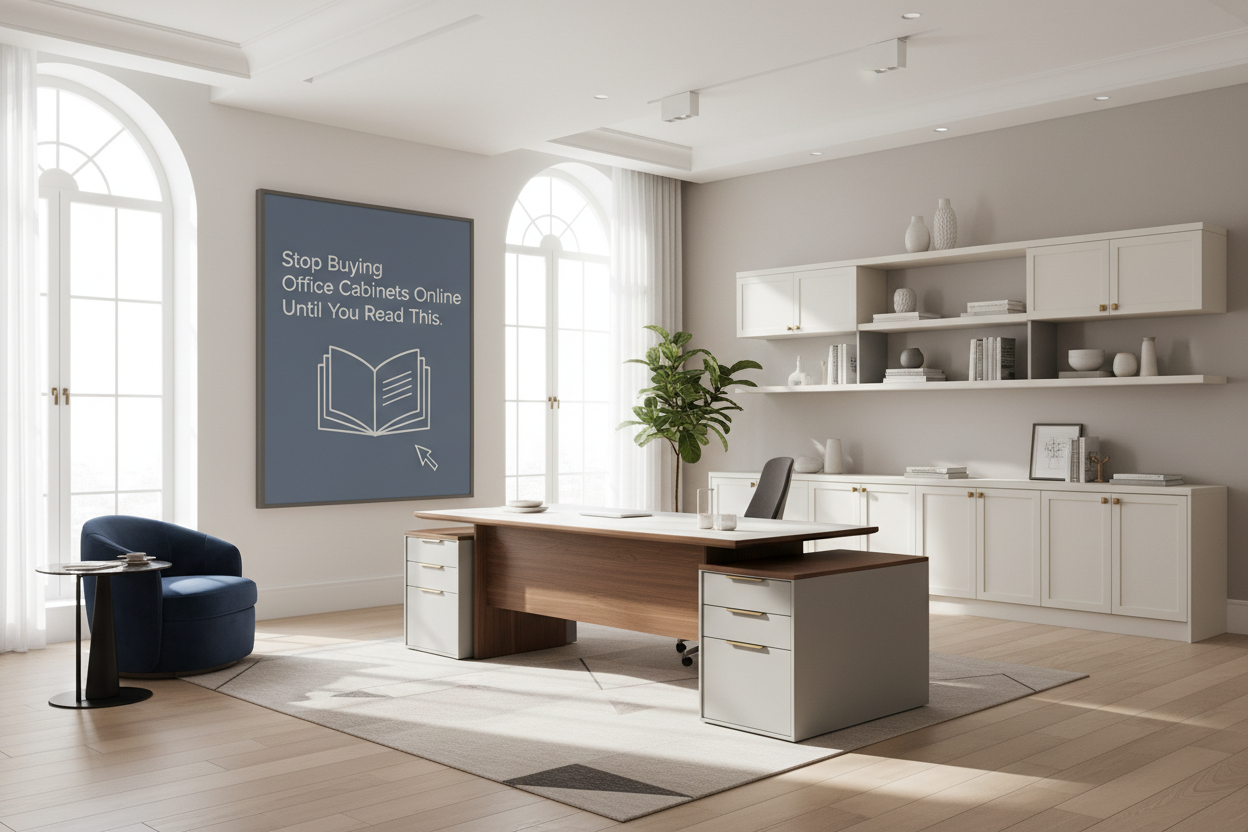
There is a specific anxiety that comes with sourcing furniture digitally. You cannot run your hand along the finish to check for smoothness, nor can you test the drawer glides for that satisfying, soft-close resistance. Yet, sourcing office cabinets online remains the most efficient way to access a global inventory of styles that local showrooms simply cannot stock. The design dilemma isn't availability; it is quality control. Without a physical inspection, you are relying on specifications and imagery that are often rendered rather than photographed.
If you are tired of clutter disrupting your workflow but fear investing in storage that looks cheap or fails within a year, you are in the right place. This guide cuts through the marketing noise to help you identify structural integrity and aesthetic value from behind a screen.
Quick Decision Guide: What Matters Most
If you are skimming for immediate answers, use this checklist to evaluate potential purchases. These are the primary factors that determine longevity and satisfaction:
- Construction Type: Distinguish between RTA (Ready-to-Assemble) cam-lock systems and factory-assembled units with dovetail joinery.
- Substrate Density: Look for commercial-grade particle board (45lb density) or plywood cores rather than standard MDF for load-bearing shelves.
- Hardware Specifications: Ensure hinges are European-style adjustable and drawer slides are full-extension ball-bearing types.
- Finish Durability: Thermofused laminate (TFL) resists scratches better than standard paper foil laminates.
- Dimensional Accuracy: Always account for door swing clearance and baseboard heater obstructions, not just the cabinet width.
Navigating the RTA vs. Prefab Dilemma
When you browse home office cabinets online, you will generally encounter two categories: RTA and Prefab. Understanding the distinction is vital for your budget and your patience.
The Reality of RTA Home Office Cabinets
Ready-to-Assemble (RTA) units are flat-packed for shipping efficiency. While cost-effective, the structural integrity relies entirely on your assembly skills. High-quality rta home office cabinets utilize metal-to-metal cam lock connections, whereas budget options use plastic dowels. From a design perspective, RTA cabinets often have visible drill holes on the interior, which can disrupt the visual cleanliness of open shelving.
The Appeal of Prefab Desk Cabinets
If your budget allows, prefab desk cabinets are superior for longevity. These units are assembled at the factory using industrial presses and glue, creating a rigid box that resists "racking" (wobbling side-to-side) much better than screws ever will. For a luxury aesthetic, prefab units often feature seamless corners and integrated toe-kicks that give the furniture a built-in, architectural look.
Materiality and Visual Weight
In a home environment, office furniture must harmonize with your existing decor, not compete with it. The material choice dictates both the durability and the "visual weight" of the piece.
Solid wood is rare in office cabinetry due to humidity fluctuations causing warping. Instead, look for high-quality veneers applied over stable plywood. This offers the warmth and grain of timber without the instability. For high-traffic zones, high-pressure laminate (HPL) is the industry standard. Unlike the peeling paper finishes of the past, modern HPL can mimic the texture of wood grain or concrete with remarkable accuracy.
Consider the silhouette. In a small room, a floor-to-ceiling cabinet in a dark finish will feel oppressive. Opt for floating cabinets or units with raised legs to expose more floor area, tricking the eye into perceiving the room as larger.
Lessons from My Own Projects
I learned the hard way about the nuances of ordering storage online during a project for a client in a historic brownstone. We ordered a stunning set of lateral files that looked perfect in the renders. When they arrived, the aesthetic was spot on, but I missed a crucial detail in the spec sheet: the drawer suspension.
The unit used standard friction slides rather than ball-bearing slides. Once the client loaded the drawers with heavy legal files, the friction made opening them a two-handed, physical struggle. Furthermore, the laminate edge banding was "unglued"—meaning it was just taped on, not heat-fused. Within six months, the edges near the handles started peeling back from daily contact.
Since then, I always zoom in on the edge banding in product photos. If you see a dark line between the face of the drawer and the edge, it’s a sign of lower-quality construction. I also insist on seeing a photo of the drawer box itself. If the bottom of the drawer is a flimsy 1/8-inch panel held in by a groove, I pass. It will eventually bow and pop out. True quality is silent and seamless.
Conclusion
Curating your workspace is about balancing function with form. By scrutinizing the construction methods and materials of office cabinets online, you can secure pieces that serve as the backbone of your productivity rather than a source of frustration. Measure twice, check the hardware specs, and invest in storage that respects the design integrity of your home.
Frequently Asked Questions
How do I match new cabinets with my existing desk?
You don't need an exact match. In fact, trying to match wood grains from different manufacturers often results in a "near-miss" that looks unintentional. Instead, aim for contrast. If your desk is a warm walnut, consider matte black or charcoal cabinets to create a sophisticated, layered look.
Are metal cabinets better than wood for home offices?
Metal offers superior durability and a thinner profile, which is excellent for industrial or modern aesthetics. However, metal can be noisy when closing drawers and may feel cold in a residential setting. Wood (or laminate) absorbs sound better, contributing to a quieter acoustic environment.
What is the standard depth for office cabinets?
Base cabinets typically range from 18 to 24 inches deep. For printer storage or lateral files, you generally need at least 20 inches of depth. Wall-mounted overhead cabinets are usually shallower, around 12 to 14 inches, to prevent you from bumping your head while seated at the desk.

Leave a comment
This site is protected by hCaptcha and the hCaptcha Privacy Policy and Terms of Service apply.