




In a tight bedroom, a small nightstand 15 to 20 inches wide and about 16 inches deep or less keeps the walkway clear and still puts a lamp, a phone and a glass of water within reach. To choose one, measure the space between the bed and the nearest wall, door or dresser, match the top to your mattress height, and pick a drawer plus a shelf (or a few slim drawers) for the things you actually keep at night.
Below are those checks with real measurements, then three narrow picks from the FUFU&GAGA nightstands collection, all under 20 inches wide.
Key takeaways
- Width: 15 to 20 inches suits a small room. One reference puts twin-bed nightstands at 16 to 20 inches and notes a tight space beside a king may only fit a slim 20-inch stand.
- Space beside the bed: nightstand width plus a gap of about 2 inches to the bed must fit before the wall or door.
- Height: the top should sit near the top of your mattress, within about 2 inches.
- Storage: one drawer and an open shelf, or three slim drawers, hold more than a bigger empty top.
- Safety: small does not mean tip-proof. Anchor any nightstand in a home with young children.
What size counts as a small nightstand?
There is no official size for a small or narrow nightstand. A practical way to define it is by the bed it serves. Sizemarker's nightstand dimensions guide suggests width at roughly one-quarter to one-third of the mattress width, which works out to:
| Mattress | Mattress width | Suggested nightstand width |
|---|---|---|
| Twin | 38 in | 16 to 20 in |
| Full | 54 in | 18 to 24 in |
| Queen | 60 in | 20 to 26 in |
| King | 76 in | 22 to 28 in |
The guide calls this a starting point rather than a law, and says most nightstands are 16 to 20 inches deep. In a small bedroom the room usually decides first: a queen in a narrow room often ends up with a nightstand from the twin row.
For this guide, "small" means about 20 inches wide or less and 16 inches deep or less. A "15 inch nightstand" usually means the width, but listings sometimes lead with the depth, so read the full W x D x H before you buy.
How to measure the space beside your bed
Make the bed, then measure from the side of the bed frame to the nearest wall, door frame, radiator or dresser. That space has to hold the nightstand plus a small gap to the bed.
How big a gap? Dimensions.com suggests placing a bedside table about 2 inches from the edge of the mattress or frame, close enough to reach the top from bed. Designers quoted by Homes & Gardens put it at about 2 to 6 inches, and 6 inches or less. Using a 2-inch gap, the widest nightstand that fits is simple subtraction:
| Space from bed frame to wall or obstacle | Minus a 2-inch gap | Widest nightstand that fits |
|---|---|---|
| 16 in | 16 - 2 | 14 in (consider a wall shelf instead) |
| 18 in | 18 - 2 | 16 in |
| 20 in | 20 - 2 | 18 in |
| 22 in | 22 - 2 | 20 in |
| 24 in | 24 - 2 | 22 in |
Keep the walkway beside the bed
The nightstand sits at the head end of the strip of floor beside the bed, and the rest of that strip is how you get into bed. The Homes & Gardens guide gives 18 to 24 inches on each side of a twin or full bed (18 inches as a minimum) and 24 to 30 inches beside a queen. The Sleep Foundation suggests about 24 inches on each side to avoid a cramped feeling. If one side of your bed has less than about 18 inches, treat it as the "wall side": put the narrowest nightstand or a wall shelf there and get in from the other side.
Check where the drawer opens
Nightstand drawers pull out along the side of the bed, into that walkway. A 15.7-inch-deep nightstand with a 14-inch-deep drawer open reaches about 15.7 + 14 = 29.7 inches from the wall behind it. If a door swings or a dresser stands within that distance, the drawer will hit it. An open shelf has no such problem, which is one reason drawer-and-shelf nightstands suit tight rooms.
How tall should a small nightstand be?
Match the top to your mattress, not to the size of the room. Measure from the floor to the top of the made mattress; the nightstand top should land within about 2 inches of that number. Our nightstand height guide has a full chart by bed type.
A low platform bed calls for a low nightstand. The two 3-drawer picks below are 20.8 and 21.3 inches tall, which fits a mattress top around 19 to 23 inches. A taller bed needs a taller nightstand, such as the drawer-and-shelf pick, which is listed in the mid-20s (see its note on height).
Drawer, shelf or both: plan for what you keep at night
A narrow top fills up fast, so the storage below matters more. List what you keep at the bedside, then choose the layout that fits it.
| Storage layout | Holds well | Watch for |
|---|---|---|
| 1 drawer + 1 open shelf | Phone, glasses and lip balm in the drawer; books, a basket or a box of tissues on the shelf | The shelf is on show, so keep it tidy |
| 2 drawers | Small items split into two zones | Drawer depth when open |
| 3 slim drawers | Chargers, medicine, papers, skincare sorted by drawer | Shallow drawers (about 4 inches inside on a 21-inch case) |
A drawer about 4 inches high inside holds a phone, glasses, chargers, a paperback and skincare, but not folded clothes. If your small nightstand also has to stand in for a dresser, look at a wider unit instead and compare it with our 3 drawer nightstand guide.
Read the weight ratings too. Where our narrow picks give a clear figure, it is 15 lb per drawer on one and 28.7 lb for the drawer on the other: plenty for night-time things, but not for a stack of hardbacks.
Floating vs legged nightstands in a small room
A floating nightstand is a wall-mounted shelf or box with no legs. It frees the whole floor under it, which makes a small room feel bigger and makes cleaning easy. The trade-offs: it has to be fixed to the wall securely (into studs or with anchors rated for the load and your wall type), its height is fixed once it is up, it usually holds less, and renters may not be allowed to drill.
A legged nightstand gives some of the same openness: floor shows underneath, so it reads lighter than a solid base, there is room to vacuum, and it moves with you. A solid-base cube holds the most for its footprint but looks heavier.
Lamps on a small top
A 16- to 20-inch top has room for a lamp, a phone and a glass, but not a large lamp base. Interior designers quoted by Ideal Home suggest the lamp's widest point should be around a third of the table's width, and that the shade should not stick out past the edge of the table. For a 19.7-inch nightstand that is about 19.7 / 3 = 6.6 inches of base or widest point.
The same article suggests candlestick-style lamps on taller bases for narrow bedside tables, and a floor lamp or wall light when there is little room at all.
Pairs of small nightstands in a small room
Two matching nightstands make a small room look calm and ordered, but they need wall length. Add the bed width, two nightstands and two 2-inch gaps (mattress widths from the Sleep Foundation; bed frames are often a little wider, so measure yours):
| Mattress | Width | Two 16-inch nightstands | Two 19.7-inch nightstands |
|---|---|---|---|
| Twin | 38 in | 38 + 32 + 4 = 74 in | 38 + 39.4 + 4 = 81.4 in |
| Full | 54 in | 54 + 32 + 4 = 90 in | 54 + 39.4 + 4 = 97.4 in |
| Queen | 60 in | 60 + 32 + 4 = 96 in | 60 + 39.4 + 4 = 103.4 in |
If the wall is too short for two, use one nightstand and a wall shelf, or two different widths in the same color and hardware with the tops at about the same height so lamps line up. With a twin or full against a side wall, one nightstand is enough.

Do small nightstands need to be anchored?
Small and light does not mean stable: a child can pull out drawers and climb them. The Anchor It campaign says anchoring all furniture with drawers, doors and shelves to the wall prevents tip-over injuries and deaths. The CPSC's Anchor It safety tips also advise storing heavier items low and avoiding keeping things kids want, such as toys and remotes, where they may climb to reach them.
The federal tip-over rule for clothing storage (16 CFR part 1261) applies to free-standing units made after September 1, 2023 that are at least 27 inches tall, weigh at least 30 pounds and have at least 3.2 cubic feet of enclosed storage, according to the CPSC's business guidance on clothing storage units. Covered units must come with an anti-tip device that meets ASTM F3096. The guidance names dressers and chests, not nightstands, and none of the picks below meets all three thresholds as listed. None lists a tip restraint either, so with young children at home, buy an anti-tip kit and use it. Our guide on how to anchor furniture to the wall shows the method.
Small nightstand buying checklist
- Side space: measure bed frame to wall or obstacle; nightstand width plus about 2 inches must fit.
- Walkway: keep about 18 inches or more beside the bed on the side you get in.
- Depth: 16 inches or less keeps the walkway clear; add the drawer depth to check where an open drawer reaches.
- Height: within about 2 inches of your mattress top.
- Storage: a drawer for small things, a shelf or more drawers for books and boxes.
- Top: enough room for a lamp with a base about a third of the top's width, plus a phone and a glass.
- Back finish: if the back will show, check that it is finished.
- Anchoring: plan a tip restraint for any nightstand in a home with young children.
- Assembly: one or two people, as listed. Our flat-pack assembly guide covers the basics.
Our picks: three small nightstands under 20 inches wide
All sizes and ratings come from each product's listing. These three are the narrow nightstands we can recommend right now; browse the collection for more sizes and finishes.
19.7" Nightstand with 1 Drawer and 1 Open Shelf
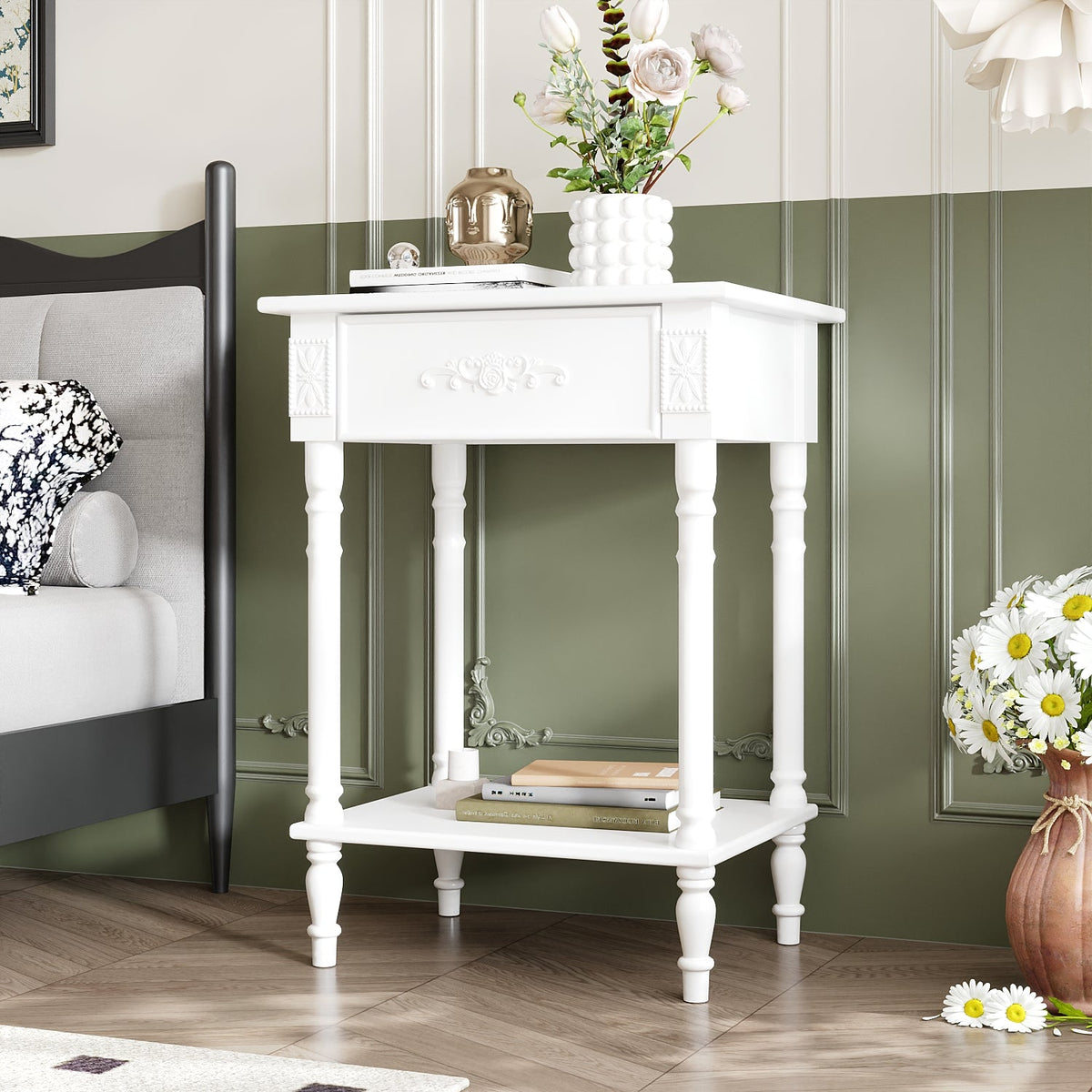
The drawer-and-shelf layout this guide recommends for tight rooms. One drawer on metal slides holds the small things, and the open shelf below, 19.7" W x 15.7" D, takes books, a basket or a tissue box. The listing title leads with 15.7 inches, which is the depth; the overall size is 19.7" W x 15.7" D. Legs lift the case 5.1" off the floor, so the floor shows underneath and the piece looks light. The drawer and the shelf are each rated for 28.7 lb and the top for 77 lb, the highest ratings among these picks, and the unit weighs 24.2 lb. It has a solid and manufactured wood frame, an MDF top, a wood handle and a chip-resistant finish, in white or black.
Best for: a standard-height bed in a small room, and anyone who reads at night and wants books on a shelf rather than piled on the top.
Skip it if: you need an exact height before you buy (the specs say 27 inches tall, but the dimension drawing in the listing shows 25, so measure against both), you have a low platform bed, or the back will be on view: the specs list the back as unfinished.
19.7" White 3-Drawer Nightstand with Metal Legs
Three drawers in a 19.7" W x 15.7" D x 20.8" H case, on four flared, tapered metal legs. Each drawer is about 4" high, 16" wide and 14" deep inside: a good size for a phone, glasses, chargers, a paperback and skincare, sorted by drawer. The gold handles are removable, the back is finished, and the finish is listed as water and chip resistant. The case is fir and particle board, it weighs 30 lb, and one person can assemble it.
Best for: a low or platform bed in a small room, where three slim drawers keep small things sorted and out of sight.
Skip it if: your mattress top is well above its 20.8-inch top, you want drawers for folded clothes, or you need a firm drawer weight rating: the specs and the dimension drawing in the listing give different load figures, so keep heavy items out of the drawers.

19.6" 3-Drawer Nightstand with Gold Metal Legs
The color choice among these picks: black, white or navy blue, in a gloss finish with gold handles and 4.9" gold metal legs. It measures 19.6" W x 15.9" D x 21.3" H. The three drawers run on full-extension metal slides with safety stops, so each opens all the way without pulling out, and they are rated at 15 lb each; the top holds 40 lb. It is MDF on a metal frame, water resistant, with a finished back, and weighs 35 lb.
Best for: a dark or bold nightstand beside a platform or low bed, where full-extension drawers make the most of a shallow case.
Skip it if: you have a tall bed (a 21.3-inch top), or you want the inside drawer size in the specs before buying: the listing's specs do not give it.
Compare the picks
| Pick | W x D x H (in) | Storage | Ratings | Legs | Best for |
|---|---|---|---|---|---|
| 19.7" drawer + shelf | 19.7 x 15.7 x 27 (drawing: 25) | 1 drawer, 1 open shelf | 28.7 lb drawer and shelf, 77 lb top | 5.1 in | Standard beds, readers |
| 19.7" white 3-drawer | 19.7 x 15.7 x 20.8 | 3 drawers, about 4 x 16 x 14 inside | Disputed in listing | Flared metal | Low beds, sorting small items |
| 19.6" gold legs | 19.6 x 15.9 x 21.3 | 3 drawers, full-extension slides | 15 lb drawers, 40 lb top | 4.9 in gold | Color choice, platform beds |
FAQ
What size is a small nightstand?
Usually about 15 to 20 inches wide and 16 inches deep or less. One sizing guide suggests 16 to 20 inches for a twin bed and notes a tight space beside even a king may only fit a 20-inch stand. Measure the space beside your bed and subtract about 2 inches for the gap to the bed.
Is a 15 inch nightstand too small?
Not if it holds what you need. A 15- to 16-inch top fits a slim lamp, a phone and a glass of water; use a drawer or shelf below for the rest, or a wall light to free the top.
What can I use instead of a nightstand in a very small bedroom?
If there is less than about 16 inches beside the bed, a wall-mounted shelf or floating nightstand keeps the floor clear, and a wall light frees the top. Fix it securely to the wall, into studs or with anchors rated for your wall and the load.
Ready to compare more widths, heights and finishes? Browse every bedside table in the nightstands collection.

Leave a comment
This site is protected by hCaptcha and the hCaptcha Privacy Policy and Terms of Service apply.