

















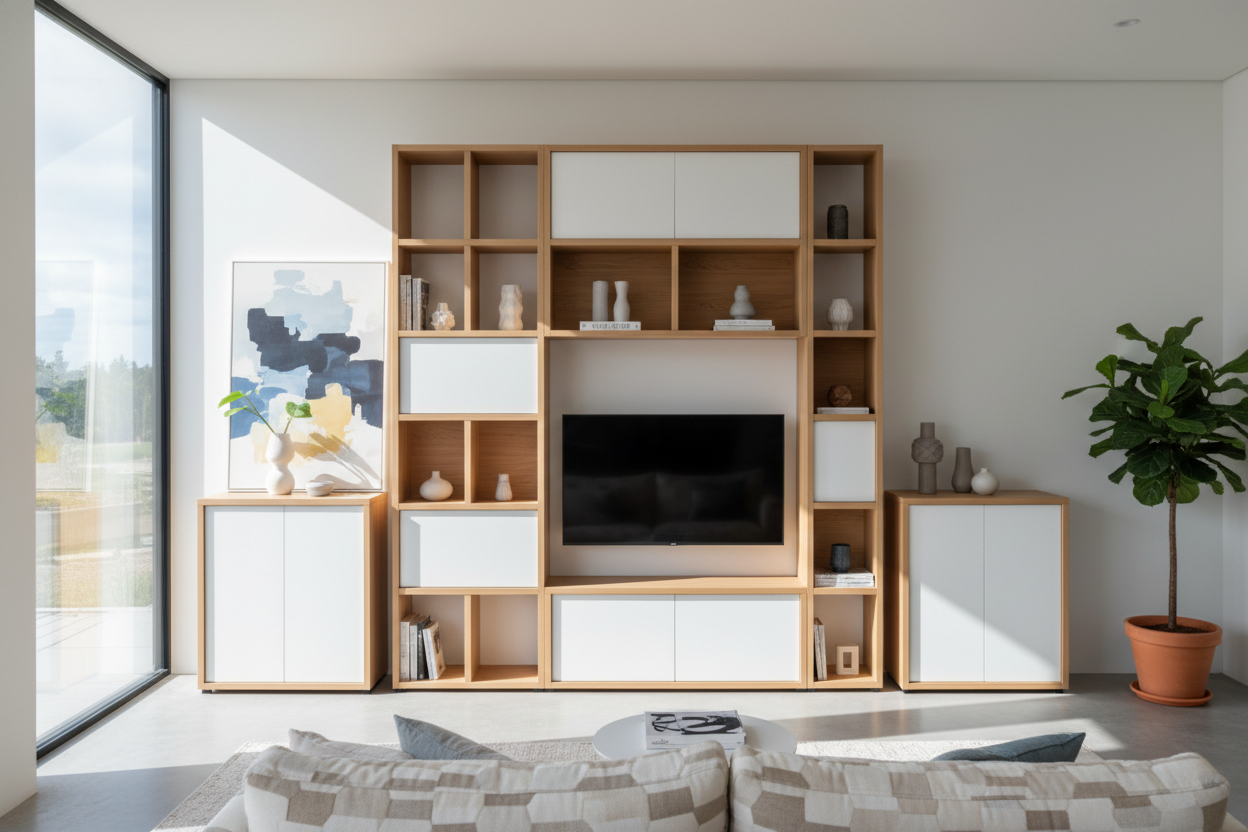
We have all seen those perfectly curated open shelves on social media. But in a real North American home—where we actually need places to put board games, router boxes, and ugly paperwork—pure open shelving quickly turns into a chaotic mess. That is exactly why shelves with storage cabinet bases are my go-to recommendation for living rooms and home offices alike. They offer the perfect compromise: a place to display what you love, and a place to hide what you need.
Quick Decision Guide
- Look for adjustable interior shelving behind the doors to accommodate taller items like vases or binders.
- Prioritize soft-close, concealed hinges; cheap hardware is the first thing to fail on heavy-use cabinets.
- Maintain visual balance by keeping the lower cabinet section to about one-third of the unit's total height.
- Always secure these units to the wall; the combination of a heavy base and upper shelves creates a serious tipping hazard.
Space Planning and Layout
Managing Visual Weight
When you introduce a solid base into a room, it carries significant visual weight. If you are working with a standard 8-foot ceiling, avoid units that go all the way up unless they are built-ins. Leaving 12 to 18 inches of negative space above the unit prevents the room from feeling top-heavy and cramped.
Clearance for Doors
Do not forget the swing radius. When specifying storage shelf units with doors for tighter spaces, I always leave at least 36 inches of clearance in front of the unit. This ensures you can fully open the doors and squat down to retrieve items without backing into a coffee table or a sofa.
Material Choices and Build Quality
The Veneer vs. Solid Wood Debate
Solid wood is incredibly durable but prone to warping with seasonal humidity changes in North American climates. High-quality wood veneer over an MDF core is often the smarter choice for a utility shelf with doors, as it resists bowing and keeps the cabinet doors perfectly aligned over time.
Hardware is the True Test
You can disguise cheap wood, but you cannot fake good hardware. Check the hinges. If you are buying utility shelves with doors for a high-traffic mudroom or family room, look for six-way adjustable European hinges. If the doors sag after a year of heavy use, these hinges allow you to easily realign them with a simple screwdriver twist.
Styling Your Open and Closed Storage
The One-Third Rule
The biggest mistake I see is over-styling the open shelves. Treat the upper shelving as a curated gallery. Group objects in odd numbers and leave at least 30 percent of the shelf surface empty to allow the eye to rest. Let the lower cabinet do the heavy lifting for your actual, messy storage needs.
Lessons from My Own Projects
Early in my career, I specified a beautiful, matte black arched unit for a client's 1920s Tudor home. It looked incredible in the rendering. But I learned a hard lesson about older homes: the floors are rarely level. Because the unit had a flush, solid plinth base rather than adjustable feet, the cabinet doors would not close properly, scraping against the frame. We had to hire a carpenter to scribe the base to the uneven floor.
Now, I never buy a freestanding cabinet-base unit without checking for adjustable levelers hidden in the feet. Also, I will be completely honest—dusting the open sections of these units is a weekly chore. If you hate dusting, stick to fully closed storage. The aesthetic is great, but the maintenance is very real.
Frequently Asked Questions
How deep should the bottom cabinet be?
A standard depth for the lower cabinet is 15 to 20 inches, while the upper shelves should be shallower (usually 10 to 12 inches) to keep the unit from feeling physically imposing in the room.
Can I use these units as a TV stand?
Yes, provided the center section is wide enough to accommodate your screen and the cabinet height puts the TV at eye level when seated. This is usually around 24 to 30 inches off the floor for standard living room seating.
Are they safe around children?
Any tall furniture piece is a tipping risk, especially when the bottom cabinet is loaded with heavy items and the top is lighter. Wall anchoring is absolutely non-negotiable, regardless of how stable the piece feels on the showroom floor.

Leave a comment
This site is protected by hCaptcha and the hCaptcha Privacy Policy and Terms of Service apply.