







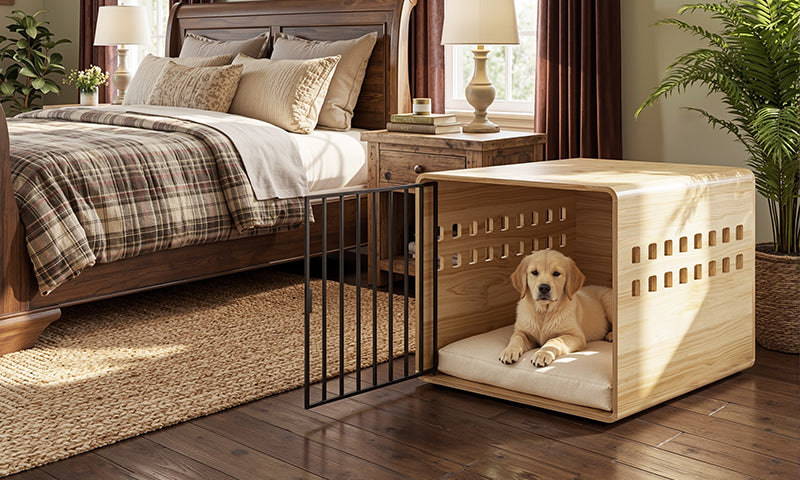

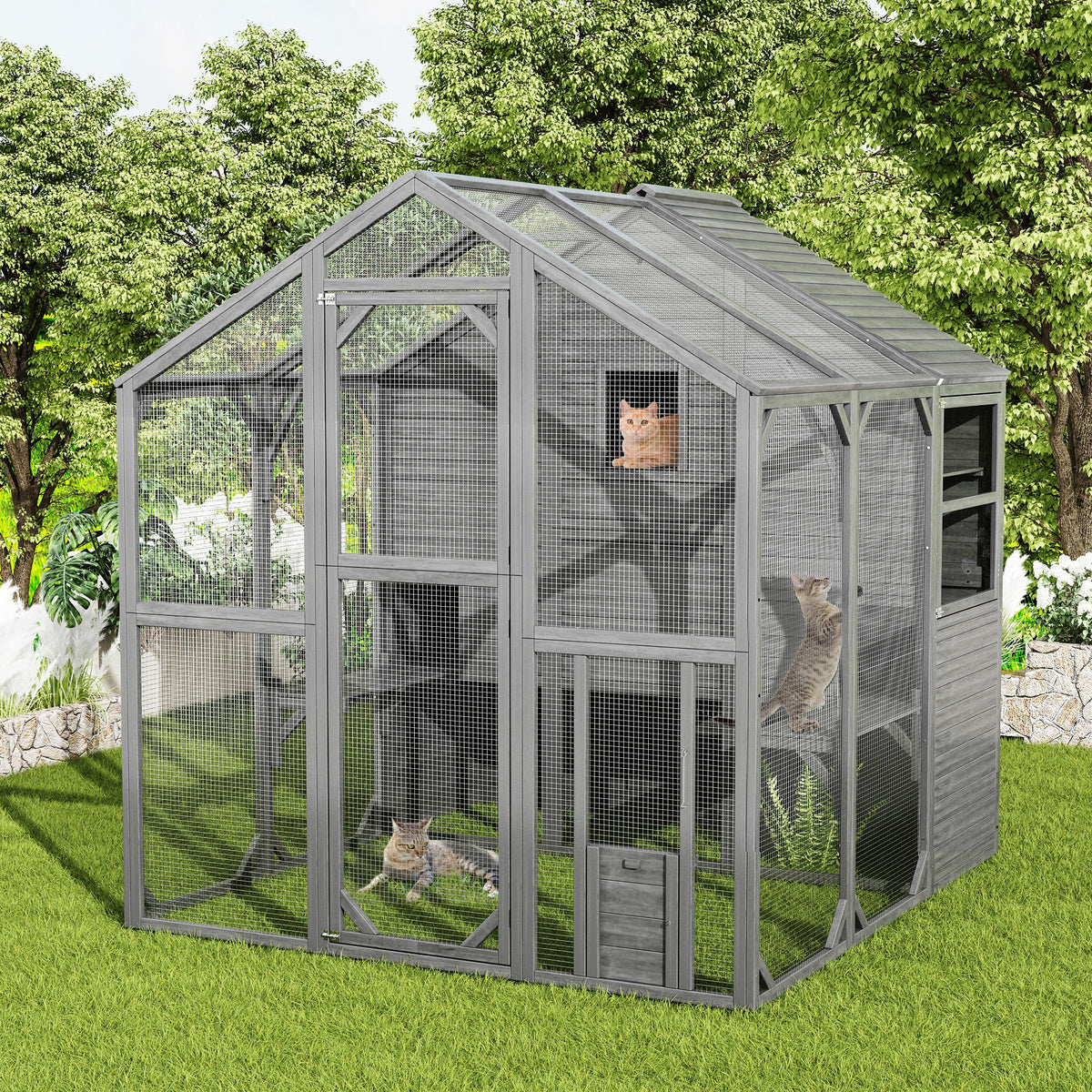
An outdoor cat enclosure, or catio, is a fully enclosed outdoor space, usually wire mesh on a wood or metal frame, that lets indoor cats get fresh air, sun and things to watch without roaming free. A good one has a secure top, no gaps a cat can squeeze through, shade, water and somewhere to rest, and it is sized so you can reach in or walk in to clean it. Cats should still be supervised, given shade and water on hot days, and not left out in a stand-alone catio in very cold weather.
This guide covers the main types of catio, how big to go, roof, mesh and floor, shade and shelter, toxic plants and placement, then compares two walk-in enclosures from the FUFU&GAGA cat furniture collection.
Key takeaways
- Why people use one: cats enjoy fresh air and sunshine away from cars and predators, and birds and other wildlife in the neighborhood stay safe from cats.
- Close every side, including the top: cats climb and dig, so a catio needs a top and a secure base, not just walls.
- Height matters as much as floor space: shelves and perches let cats climb, and a walk-in height makes cleaning much easier.
- Shade, water and a way back inside: every catio needs a shady spot, fresh water and access to a litter box.
- Check every plant: lilies are dangerous to cats, so check plants against the ASPCA list before you add them.
What is a catio, and why use an outdoor cat enclosure?
VCA Animal Hospitals describes a catio, or cat patio, as a secure outdoor enclosure designed to let your cat enjoy nature, and says it keeps your cat safe from cars, predators and other hazards while also protecting local wildlife (VCA Animal Hospitals). Humane World for Animals calls catios screened porches designed for cats that give indoor cats fresh air and new sights, smells and sounds.
The safety case is strong. The American Bird Conservancy notes that outdoor cats face cars, antifreeze poisoning and predator attacks, have higher rates of injury, parasites and disease than indoor cats, and tend to live shorter lives. It also cites an estimate that cats kill about 2.4 billion birds a year in the US, which is why it recommends keeping cats indoors or supervised outdoors (American Bird Conservancy). A catio gives indoor cats more room to explore and stretch without that risk to the cat or to birds.
A catio is not a complete health plan. VCA points out that it does not protect against fleas, ticks or heartworm on its own, so keep your cat on the preventives your veterinarian recommends.
Types of outdoor cat enclosures
There are many types of catio, from a small window box to a walk-in room with a floor, roof and furniture. They can be freestanding in the yard or attached to a window or door, and you can create one yourself from DIY plans, assemble a kit, or buy a pre-built unit. These are the common options:
| Type | How it works | Best for | Watch out for |
|---|---|---|---|
| Window box | A small mesh box mounted outside a window | Apartments, small homes, one cat | Little room to climb; window security |
| Door or wall-attached | Built onto the house, entered through a cat flap or door | Cats that come and go during the day | Needs a separate outside door for cleaning |
| Freestanding walk-in | A standalone enclosure in the yard, tall enough for a person | Multi-cat homes and yards with space | Cats must be carried or walked out to it |
| Cat run or tunnel | A long enclosure, or tunnels linking the house to an enclosure | Active cats that like to patrol | Tunnel joints and gaps must be secure |
| Patio, deck or balcony turned catio | Screening or netting added to a space you already have | Existing patios and fenced yards | Every opening, including overhead, must be closed |
VCA suggests a window-mounted catio when space is limited and a freestanding or tunnel-connected enclosure for larger yards, with a cat door so your cat can come and go. Best Friends Animal Society adds that if your cat enters the catio through a window, the catio also needs a door to the outside for cleaning, maintenance and emergencies (Best Friends Animal Society).
How big should a cat enclosure be?
There is no official minimum size for a catio, and none of the animal welfare and veterinary guides we checked give one. They focus on usable space instead:
- Human height: Best Friends notes that cleaning the catio and spending time in it yourself is much easier if it is built to human height.
- Vertical space: VCA says cats love vertical spaces and suggests shelves, perches, high platforms or a cat tower, which provide room for climbing, exercise and lounging.
- Room for each cat: more cats need more perches and resting spots so no one has to share the only high shelf.
- Room for you: Humane World suggests a human-sized door and seating if you want to spend time with your cats in it.
To compare enclosures, work out the footprint from the listed length and width. For example, an enclosure measuring 66.5 by 72.6 inches covers 66.5 x 72.6 = 4,828 square inches, and 4,828 / 144 = about 33.5 square feet. Then count the levels: each shelf or sleeping box adds usable space above the floor.
Roof, mesh and floor: keeping cats in and other animals out
A catio must be closed on every side. Best Friends says an outdoor catio needs a top, not necessarily a solid roof, but something that keeps the cats in and everything else out, and suggests chain link, hardware cloth or strong shade cloth securely attached to the sides. Humane World adds that because cats climb and dig, the enclosure should have no gaps a cat could squeeze through, including on top (Humane World for Animals).
- Base: Best Friends recommends a firm base, hardware cloth at least, on the floor. Some freestanding catios stand directly on the ground, so plan a base if your cat digs or if animals could dig in. Humane World lists floor options from grass, sand or dirt, which some cats may treat as a litter box, to a constructed floor.
- Frame: use wood, metal or other sturdy, nontoxic materials, with every panel firmly attached.
- Snags: avoid features that could catch a collar.
- Predators: Humane World warns that where coyotes or bears live, a catio may not be suitable unless it is very sturdy. No enclosure should be treated as predator-proof, which is one more reason to supervise.
- Inspections: check latches, mesh and joints regularly, and after storms.
Humane World also notes that the roof must be strong enough for local snowfall, and that renters and some homeowners may need landlord, city or HOA approval, so check local law and community rules before construction starts.
Shade, shelter, water and weather
Comfort decides whether cats use a catio. Best Friends says to make sure the catio has a shady area so your cat doesn't get too hot in summer, and not to leave your cat out in a stand-alone structure in very cold weather. Humane World recommends ventilation for warm days and a cozy retreat from cold, rain and sun.
- Shade: a solid roof section or shade cloth over part of the top.
- Shelter: a covered sleeping box where cats can relax out of wind and rain.
- Water: fresh water at all times, especially on warm days. Best Friends suggests sheltering food and water areas.
- Litter: a covered litter box in the catio or easy access to the indoor one.
- Light: Humane World suggests lighting if your cat will use the catio at night.
If your cat reaches the catio from the house and the indoor litter box sits by that door, a litter box cabinet keeps it tidy; our litter box furniture buying guide covers sizing and ventilation.
Plants and other hazards
Plants make a catio more interesting, but check every one against the ASPCA list of plants toxic and non-toxic to cats before you add it. The list includes common garden plants such as lilies, azalea, oleander, sago palm, tulips and daffodils, and even some herbs, so check plants you might assume are safe.
Lilies deserve special care. The US Food and Drug Administration warns that every part of true lilies and daylilies is toxic to cats, and that eating a small piece of leaf or petal, licking pollen off fur or drinking vase water can cause fatal kidney failure in less than three days (FDA). Keep lilies out of the catio and out of reach of the mesh, and call your vet at once if you suspect exposure.
The American Bird Conservancy lists antifreeze poisoning among the risks outdoor cats face, so site the catio away from driveways and garage spills.
Placement, supervision and getting your cat used to it
- Somewhere you can see: Humane World recommends building the catio where you can see it from your home and supervising your cat whenever it is in there. That also gives you peace of mind that nothing has got in or out.
- A view, from outside: VCA suggests placing the catio near bird feeders or a garden for your cat to watch. Best Friends advises keeping feeders outside the catio, not in it.
- Level, firm ground: a level base keeps doors and latches lining up, and a firm floor stops digging.
- Close to a door: the shorter the trip from the house, the easier daily use is.
- Go slowly: Humane World suggests introducing the catio at a quiet time, letting your cat explore at its own pace, and scattering treats to encourage a shy cat.
Build or buy a catio?
A DIY catio suits handy owners: VCA notes that online DIY guides and kits make building simpler, and a DIY build can be shaped to an odd space. Pre-made enclosures come in a variety of sizes and styles, and a pre-built walk-in cat enclosure arrives with its doors, latches and shelves already designed. Either way, the same rules apply: closed top, secure base, shade, water and supervision.
How to choose an outdoor cat enclosure: buying checklist
- Space: measure the site and leave room around the enclosure to open the doors and reach every side.
- Height: a walk-in door if you want to clean and sit inside without crouching.
- Top: mesh or a roof over the entire enclosure, with a solid or covered section for shade and rain.
- Base: a plan for the floor, such as hardware cloth, pavers or a deck, if cats dig or the ground is soft.
- Mesh and latches: no gaps, firmly attached panels and doors that lock.
- Levels: at least one shelf or perch per cat, plus a covered sleeping spot.
- Access: a cat door you can connect to a pet door, window or tunnel if the catio sits against the house.
- Materials: weather-resistant wood and coated or galvanized metal, and a check of the care instructions.
- Assembly: check how many people the listing recommends and read the manual before you start.
Our picks: outdoor cat enclosures from FUFU&GAGA
Two walk-in enclosures in our range fit this guide, plus one indoor piece for the litter box by the catio door.
70.9" Large Outdoor Cat Enclosure with Multi-Level Resting Platforms

A nearly square, walk-in catio with a gabled mesh roof over the play area and a covered section over the two sleeping rooms. The 70.9 inches in the name is a nominal size; the spec sheet gives the real dimensions, 74.1" H x 66.5" W x 72.6" L, or about 33.5 square feet of footprint. A 60.6-inch walk-in gate lets you step inside to feed, clean and play, and a lift-up cat door can be connected to a pet door or cat flap.
Key facts: cedar frame and galvanized iron mesh (per the description), three levels with two sleeping rooms and an activity area, windows on the sleeping rooms, sliding bolt lock, gray or yellow, 150 lb, assembly by two people with a screwdriver. The listing describes it as rust-, water-, UV- and weather-resistant. The photos show it standing on grass with no floor panel, and the spec lists no tipping prevention. The listing does not mention ground stakes or anchors, so in an exposed or windy spot fix the frame to a base or the ground.
Best for: a medium yard, or a catio placed against the house with the cat door linked to a pet door.
Skip it if: your cats dig or the ground is soft and you don't plan to add a base, or you need a longer run for very active cats.
73.9" Modern Gray Large Cat Run Wooden Cat House Outdoor Enclosure

A longer, run-style catio with bridges, cat walks and sleeping houses built in, so cats can climb, cross and nap at different heights. A removable waterproof, UV-protective cover sits over part of the mesh roof, and two small lift-up doors on the sides give cats their own way in and out. The listing's dimension photo shows a 59-by-22-inch walk-in door and a height of about 74 inches.
Key facts: solid cedar frame and galvanized iron mesh, removable waterproof top cover, two lift-up side doors, bridges, cat walks and sleeping houses, gray, assembly required with detailed instructions. Parts may arrive in two parcels, so wait for both before starting. As with any tall freestanding catio, fix it to a base or the ground in a windy spot. This listing has no full spec sheet, so confirm the footprint with customer service before you prepare the site.
Best for: multi-cat homes and active climbers that like to patrol a longer space.
Skip it if: you need exact dimensions or weight from the listing before buying, or your cats dig and you don't plan to add a base.
31.5" Modern Natural Cat Litter Box Enclosure with Lock Sisal Doors (indoor)
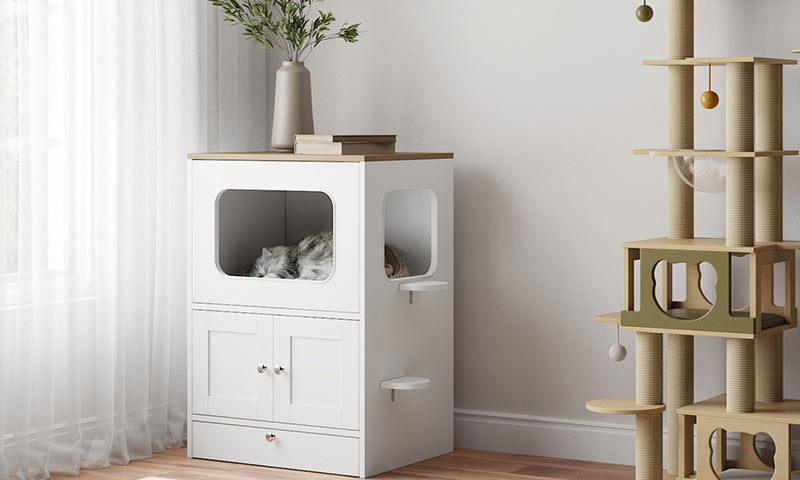
Not a catio, but useful by the door your cat uses to reach one. It hides the litter box in a cabinet with two cat doors, ventilation holes, a lock and an adjustable internal shelf, and the top holds up to 22 lb.
Key facts: 35.4" H x 31.5" W x 19.7" D, interior 31" wide, sisal-faced doors for scratching, wood, black or white. The description notes the wood panels themselves can't withstand scratching.
Best for: a tidy litter spot beside the door your cat uses to reach the catio.
Skip it if: your litter box is wider than 31 inches, or you want something for outdoor use.
Compare the picks
| Pick | Size (from the listing) | Standout feature | Best for |
|---|---|---|---|
| Large outdoor cat enclosure | 74.1" H x 66.5" W x 72.6" L | Two sleeping rooms, cat door for a pet door | Medium yards, catios against the house |
| Gray cat run | About 74" tall, 59" x 22" door (photo) | Bridges, cat walks, removable cover | Several active cats |
| Litter box enclosure | 35.4" H x 31.5" W x 19.7" D | Lock, sisal doors, vents | Indoors, by the catio door |
FAQ
Do vets recommend catios?
Many veterinary and welfare groups support them. VCA Animal Hospitals says a catio keeps cats safe from cars, predators and other hazards while giving them stimulation, and Humane World for Animals and the American Bird Conservancy point to catios as a safe way for indoor cats to spend time outside. Ask your vet about parasite prevention before your cat starts using one.
Can cats be happy with a catio?
A catio gives indoor cats fresh air and new sights, smells and sounds, which Humane World for Animals and VCA describe as enrichment. Happy cats in a catio usually have shelves to climb, a comfortable covered spot to rest and a view of birds outside the mesh. Introduce it at a quiet time, let your cat explore at its own pace, and use treats to encourage a shy cat.
Can a cat live in an outdoor enclosure?
A catio is designed for supervised time outdoors, not as a cat's full-time home. Humane World recommends supervising cats in the catio, and Best Friends advises against leaving cats in a stand-alone structure in very cold weather. Keep its home base indoors, make sure the catio has shade and water on hot days, and add lighting if your cat will use it after dark.
What are some good things to put in a catio?
VCA suggests shelves, perches or a cat tower, toys, scratch mats, beds and cushions, and cat grass; Best Friends adds logs or posts for scratching. Add fresh water and a covered sleeping box. Check every plant against the ASPCA list, keep lilies out completely, and give your cat access to a litter box.
Is it cheaper to build or buy a catio?
Humane World for Animals notes that kits and pre-built catios cost more than building your own, but they suit owners without carpentry skills. Building suits handy owners and odd-shaped spaces. Compare the full cost, including a base, shade and any pet door, before you decide.
Our cat furniture collection has both outdoor enclosures and indoor pieces.

Leave a comment
This site is protected by hCaptcha and the hCaptcha Privacy Policy and Terms of Service apply.