

















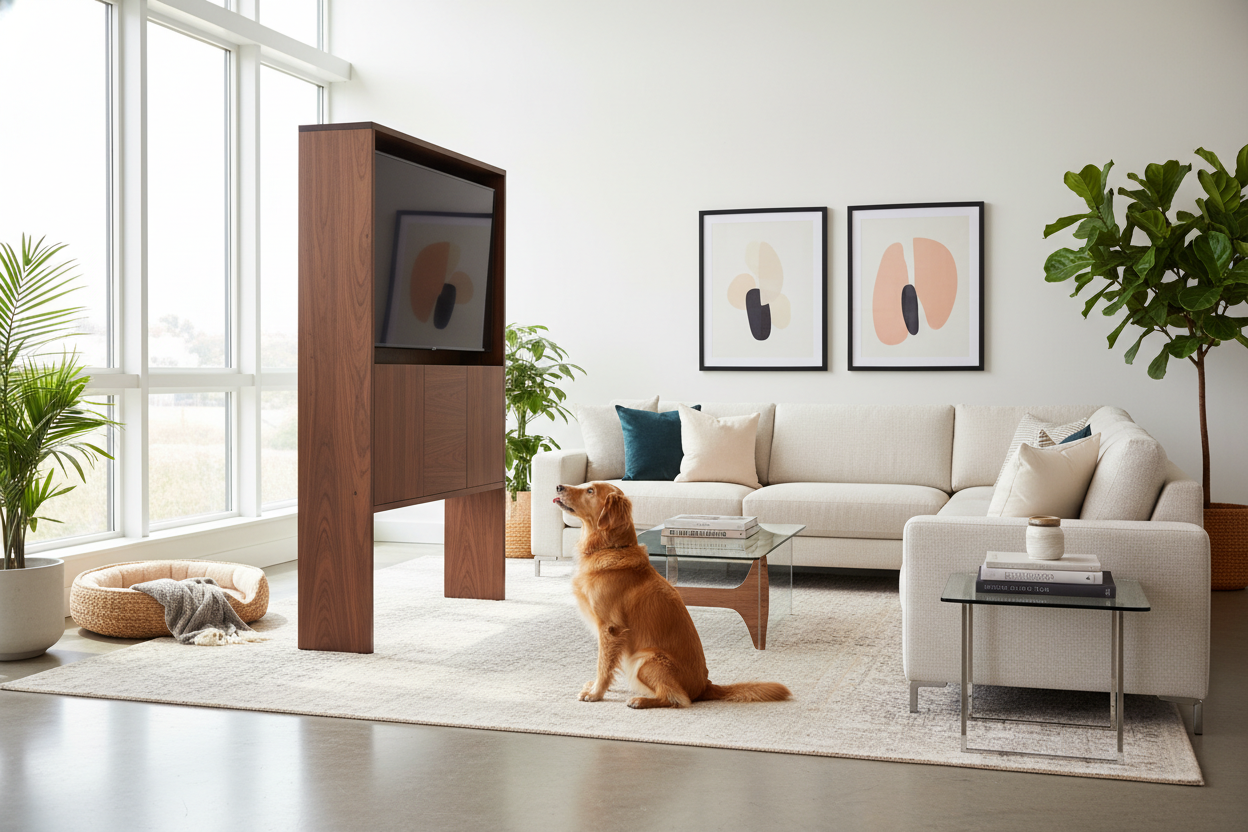
I spent way too much money on an OLED screen just to have it look like a frosted glass window by Tuesday morning. My dog, Barnaby, has a weird obsession with the local news—specifically, he likes to lick the weather map. After the third time I had to buff out a slobber streak with a microfiber cloth, I realized my trendy, mid-century modern console was basically a dog-level buffet. I needed an extra high tv stand to save my tech from his wet nose.
- Height: Look for 35 to 45 inches to clear the 'slobber zone.'
- Stability: Anything over 30 inches tall needs a wide footprint and heavy base.
- Storage: Taller units offer significantly more cabinet space for bulky gear.
- Mounting: A tall stand is the best workaround for renters who can't drill holes.
The Day the Tail Wagged the Flat Screen
It wasn't just the licking. Barnaby is a seventy-pound Golden Retriever with a tail that functions like a motorized whip. I came home one afternoon to find my screen tilted at a precarious 45-degree angle because he'd done a 'happy dance' too close to the low-profile media unit. Standard consoles sit about 18 to 22 inches off the ground. That is exactly the height of a wagging tail, a toddler's sticky fingers, or a stray tennis ball.
When your TV is that low, it's constantly in the line of fire. I realized that if I didn't find a way to get my extra tall tv stand situation sorted, I was going to be buying a new screen within the month. The low-profile look is great for minimalist lofts, but it's a nightmare for anyone living with a creature that sheds, drools, or runs indoors at full speed.
Why I Completely Ruled Out Wall Mounting
The standard advice is 'just mount it on the wall.' I tried that in my last place. I ended up with four massive holes in the drywall and a security deposit that I never saw again. Now, I'm in a house with 1920s plaster walls. If I try to drill into those, half the wall might come down with the TV. Plus, wall mounting feels so permanent. I like to move my furniture around every six months when I get bored with the layout.
I started looking for heavy-duty freestanding TV stands that could give me the height I needed without the commitment of a wall bracket. I wanted something that felt like a piece of furniture, not a piece of gym equipment bolted to the studs. A tall flat screen tv stand was the only middle ground that made sense for my 'no-drill' rental policy and my need to keep things flexible.
Enter the Extra High TV Stand: My Living Room Savior
I eventually landed on a unit that sat nearly 40 inches high. It sounds massive, but in a room with standard eight-foot ceilings, it actually fills the vertical space much better than a tiny sliver of wood on the floor. I finally abandoned the low-profile trend and I'm never going back. Raising the screen just 15 inches higher than my old unit moved it completely out of the dog's reach.
Using a very tall tv stand also improved my viewing angle. I’m not slouching on the sofa anymore to see the bottom of the screen. If you're looking for an extra tall tv stand for bedroom use, this height is even more critical so you can see over your feet while lying down. It’s a functional shift that makes the whole room feel more organized and less like a chaotic dog park.
How to Make Sure a Tall Flat Screen TV Stand Isn't Tipping Hazard
I’ll be honest: I was worried about the 'top-heavy' factor. A tall tv stand for flat screen setups can feel a bit sketchy if the base is too narrow. When you're shopping for an extra tall tv stand for 65 inch tv, you have to look at the weight distribution. I looked for a model with a wide base with dual side cabinets to keep the center of gravity low.
I learned the hard way with a cheap tall shelf for tv I bought off a clearance site—it wobbled every time someone walked past. I ended up returning it and spending the extra $100 on a model with a heavier frame. Pro tip: always use the anti-tip hardware that comes in the box. Even if the stand feels solid, a 65-inch tall tv is a lot of glass to have falling forward. You want some mass at the bottom to counteract the height of the tv shelf tall top.
The Unexpected Bonus: Hiding All the Ugly Dog Gear
The best part I didn't anticipate? The storage. A taller unit naturally creates more vertical real estate. My old console had one tiny drawer that barely fit a remote. My new modern TV stand with cabinets has enough room to hide Barnaby's leashes, a giant bag of treats, and those neon-orange tennis balls that usually clutter up the rug.
It’s rare that a furniture upgrade solves a pet problem and an aesthetic problem at the same time. My living room looks cleaner, my neck feels better, and most importantly, the meteorologist is finally safe from Barnaby’s tongue. If you're living in a high-traffic home, go high or go home.
FAQ
How tall should a TV stand be for a bedroom?
For a bedroom, you usually want something taller than a living room unit—around 35 to 45 inches. This ensures you can see the screen clearly over the footboard of your bed without straining your neck while lying down.
Is a tall TV stand stable for large screens?
Yes, provided it has a wide base. If you are putting a 65-inch or 75-inch TV on a tall stand, make sure the stand's width is at least equal to the TV's width to prevent it from being wobbly. Always use wall anchors for extra safety.
Will a tall TV stand make my room look smaller?
Actually, it often does the opposite. By drawing the eye upward, it can make low ceilings feel a bit higher, especially if the stand has clean lines and isn't overly bulky or dark-colored.


Leave a comment
This site is protected by hCaptcha and the hCaptcha Privacy Policy and Terms of Service apply.