

















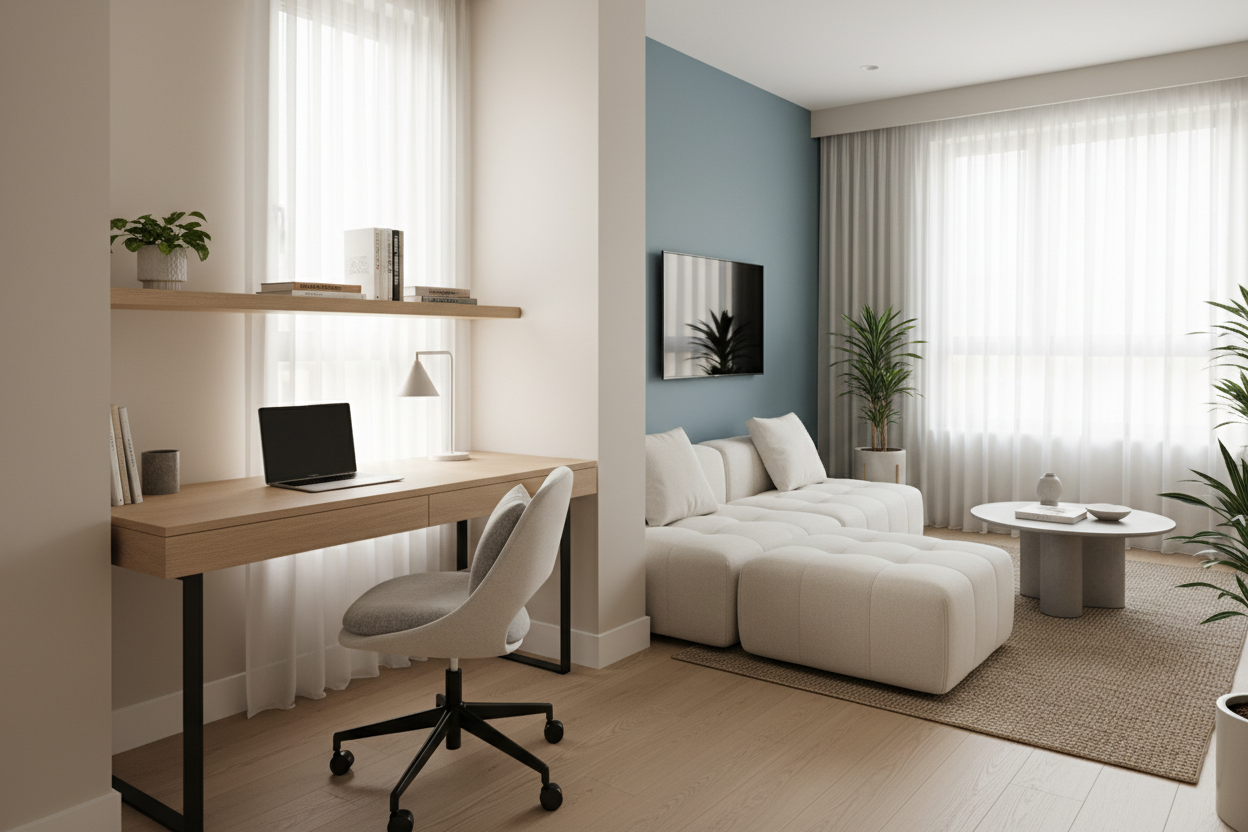
One of the most frequent dilemmas I encounter in city apartments is the battle between relaxation and productivity. You want a workspace that performs, but you don't want your sanctuary to feel like a corporate cubicle. Successfully executing small living room office ideas requires a shift in perspective: stop treating the office as a separate entity and start treating it as a piece of joinery that contributes to the room's overall architecture.
Key Features for a Cohesive Workspace
- Visual Weight: Opt for desks with slender legs or floating mounts to keep the floor visible, making the room feel larger.
- Material Continuity: Select wood finishes or metals that match your existing media unit or coffee table to avoid a chaotic aesthetic.
- Lighting Temperature: Ensure your task lighting matches the Kelvin rating (warm vs. cool) of your living room ambient light (aim for 2700K-3000K).
- Dual-Purpose Functionality: Prioritize furniture that can transition from 'work mode' to 'leisure mode' effortlessly.
Strategic Zoning: The Layout Foundation
When implementing a small living room office layout, the placement is just as critical as the furniture itself. In compact floor plans, floating a desk in the middle of the room rarely works—it interrupts flow. Instead, look for "dead zones." Alcoves beside chimney breasts, the space behind a floating sofa, or even a transition wall near a hallway can be utilized.
For a seamless look, consider the "console strategy." A narrow console table (around 18-20 inches deep) placed behind a sofa can serve as a desk during the day and a display surface for lamps and books at night. This effectively creates a small home office in living room setups without sacrificing square footage.
Materiality and Furniture Selection
As a specialist, I advise against buying generic office furniture for a living area. The materials often clash with residential textures. When exploring small office ideas in living room settings, look for materials that age well. A solid walnut desk brings warmth and hides dust better than glass or black laminate.
The Chair Dilemma
Nothing ruins a living room aesthetic faster than a bulky, plastic ergonomic chair. For a small home office living room blend, look for "resimercial" chairs. These offer ergonomic support (lumbar adjustments, swivel bases) but are upholstered in high-performance fabrics like bouclé, velvet, or leather rather than standard office mesh.
Visual Balance and Tech Management
To maintain a luxury feel, the technology must be invisible when not in use. Small office space in living room designs fail when cables are visible. Invest in a desk with a hidden cable tray or modify a vintage piece by drilling grommets into the back. Use wireless peripherals to reduce clutter. If you are tight on horizontal space, utilize verticality with shelving units that include a drop-down desk component—a modern take on the secretary desk.
My Personal Take on Small Living Room Office Ideas
In my years designing compact urban lofts, I’ve learned that the "touch points" matter more than the look. I once designed a small home office in living room ideas project where we prioritized a stunning, reclaimed wood desk with a raw, textured finish. It looked incredible in photos.
However, three weeks later, the client called me. The texture was so rough that writing on a single sheet of paper was impossible without a clipboard, and the mouse snagged on the wood grain. We had to install a custom leather inlay to fix it. Another detail often overlooked is the monitor clamp. I once clamped a heavy dual-monitor arm onto a cheap particle-board desk with a veneer finish; within six months, the weight crushed the honeycomb core, leaving a permanent dent and a leaning screen. Lesson learned: if you plan to clamp gear, ensure the desk edge is solid wood or reinforced metal.
Conclusion
Integrating a workspace into your relaxation zone doesn't mean compromising on style. By focusing on material continuity, smart layouts, and hiding the "tech," you can curate a space that inspires productivity by day and peace by night.
Frequently Asked Questions
What is the minimum depth for a functional living room desk?
For laptop work, you can get away with 18 inches (45cm). However, if you use an external monitor and keyboard, aim for at least 22-24 inches (55-60cm) to maintain proper focal distance and wrist support.
How do I hide my computer when I have guests?
The most elegant solution is a "cloffice" (closet office) or a secretary desk that closes up. Alternatively, use a laptop vertical stand to tuck the device behind a decorative vase or books when not in use.
Can I use a dining chair as a desk chair?
For short bursts (1-2 hours), yes. However, dining chairs lack the lumbar support and seat angle adjustment needed for a full workday. If space is tight, use a lumbar pillow or invest in a visually light task chair that complements your dining set.

Leave a comment
This site is protected by hCaptcha and the hCaptcha Privacy Policy and Terms of Service apply.