

















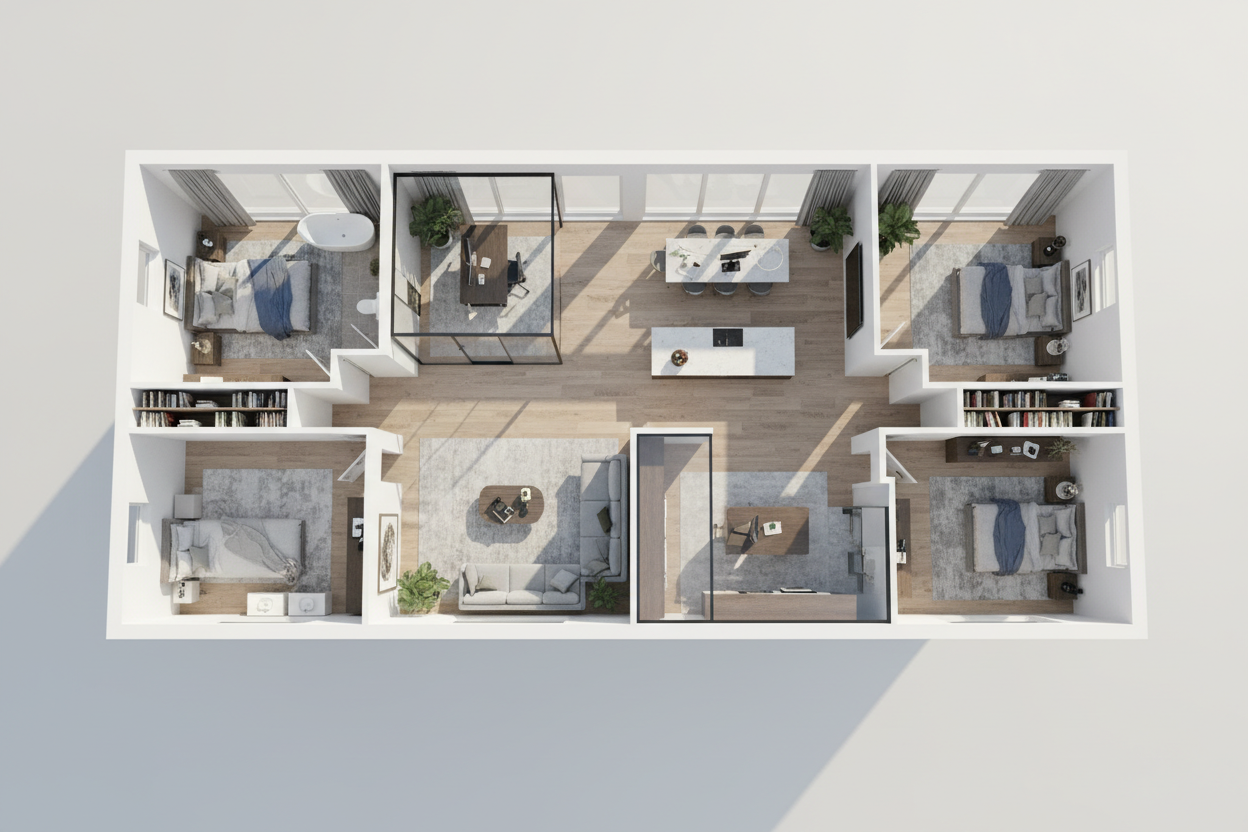
The era of the makeshift workspace is over. As an interior designer, I constantly see clients struggle with layouts that treat the workspace as an afterthought—a desk shoved into a guest room corner or a dining table takeover. The secret to a productive environment isn't just the furniture; it’s the architecture. A well-conceived floor plan with home office integration considers acoustics, traffic patterns, and light just as heavily as square footage.
Key Features to Look For
- Acoustic Buffering: Look for layouts where closets or hallways act as sound barriers between the workspace and high-traffic living areas.
- Traffic Flow & Privacy: Determine if the office requires a secluded position (deep work) or proximity to the kitchen/entry (monitoring family/deliveries).
- Fenestration (Window Placement): Ensure windows allow for natural light without creating direct glare on monitors; North-facing windows provide the most consistent ambient light.
- Tech Infrastructure: Verify the blueprint accounts for floor outlets and dedicated circuits to avoid cable clutter and power overloads.
Strategic Zoning: Location Matters
When evaluating home plans with office potential, the first consideration is adjacency. Where the office sits in relation to the rest of the home dictates its functionality. For clients who host client meetings, house plans with separate office entrance are non-negotiable. This architectural detail maintains the sanctity of your private residence while offering a professional threshold for visitors.
Conversely, for parents who need to supervise homework while finishing emails, a house floor plan with office located off the kitchen or great room—often separated by French doors or pocket doors—provides necessary visual connection without total auditory exposure.
The Rise of the Dual Workspace
One of the most frequent requests I receive now is for house plans with two home offices. The dynamic of two working partners requires distinct zones to prevent cross-talk during video conferences. You don't necessarily need a massive footprint for this.
Separation Strategies
In house plans with two offices, I often recommend placing them on opposite ends of the home or on different levels—a concept often seen in a two story home office layout. This physical distance acts as a natural noise dampener. If you are looking at house plans with 2 offices on a single level, ensure there is a "buffer room" (like a bathroom or laundry room) between them.
One-Story Living and Ranch Layouts
There is a specific elegance to 3 bedroom with office ranch house plans. In a single-story layout, the office often replaces the formal dining room or sits adjacent to the foyer. The challenge here is ensuring the office doesn't feel like a fishbowl. When reviewing a home office blueprint for a ranch style, look for designs that set the office back slightly from the main hallway to reduce visual distraction from passing foot traffic.
Luxury and Scale: The Executive Suite
In larger footprints, such as a mansion home office, we move beyond simple utility into the realm of the library-office. Here, the floor plan should accommodate floating furniture arrangements—where the desk sits centrally rather than against a wall. These homes with offices often include en-suite amenities like a coffee bar or a private powder room, requiring plumbing considerations early in the design phase.
Lessons from My Own Projects: The "Echo" Effect
I learned a hard lesson about volume early in my career while designing a house plan with home office for a tech executive. We selected a stunning location with double-height ceilings and floor-to-ceiling glass—visually breathtaking.
However, once the client moved in, the reality set in. The hard surfaces and vast vertical volume created an echo chamber. Every keyboard click sounded amplified, and audio quality on calls was terrible. I had to retroactively install acoustic paneling disguised as art and heavy drapery to dampen the sound. Now, when I look at houses with home office designs featuring high ceilings, I immediately calculate the "soft surface" ratio. It’s a detail that doesn't show up on a 2D blueprint, but it makes or breaks the daily experience of the room.
Conclusion
Whether you are drafting a custom build or renovating an existing space, remember that the best layout serves your workflow, not just your aesthetic. A thoughtful floor plan is the invisible foundation of your productivity. Choose a layout that respects your need for focus while integrating seamlessly with the rhythm of your home life.
Frequently Asked Questions
What is the minimum size for a functional home office?
While you can fit a desk in a closet, a functional standalone office should be at least 70 to 100 square feet. This allows for a standard 60-inch desk, a task chair with room to swivel, and a storage unit without feeling claustrophobic.
Can I convert a bedroom into a home office without hurting resale value?
Yes, provided you keep the closet. In real estate terms, a room needs a closet and a window to be listed as a bedroom. If you remove the closet to expand the workspace, you are technically reducing the bedroom count of the home.
How do I handle lighting in a windowless office plan?
If the floor plan forces the office into an interior room, you must layer your lighting. Combine recessed can lights (ambient) with a high-quality architectural task lamp and, crucially, accent lighting (like LED strips in shelving) to create depth. Flat, singular overhead lighting causes eye strain and fatigue.

Leave a comment
This site is protected by hCaptcha and the hCaptcha Privacy Policy and Terms of Service apply.