

















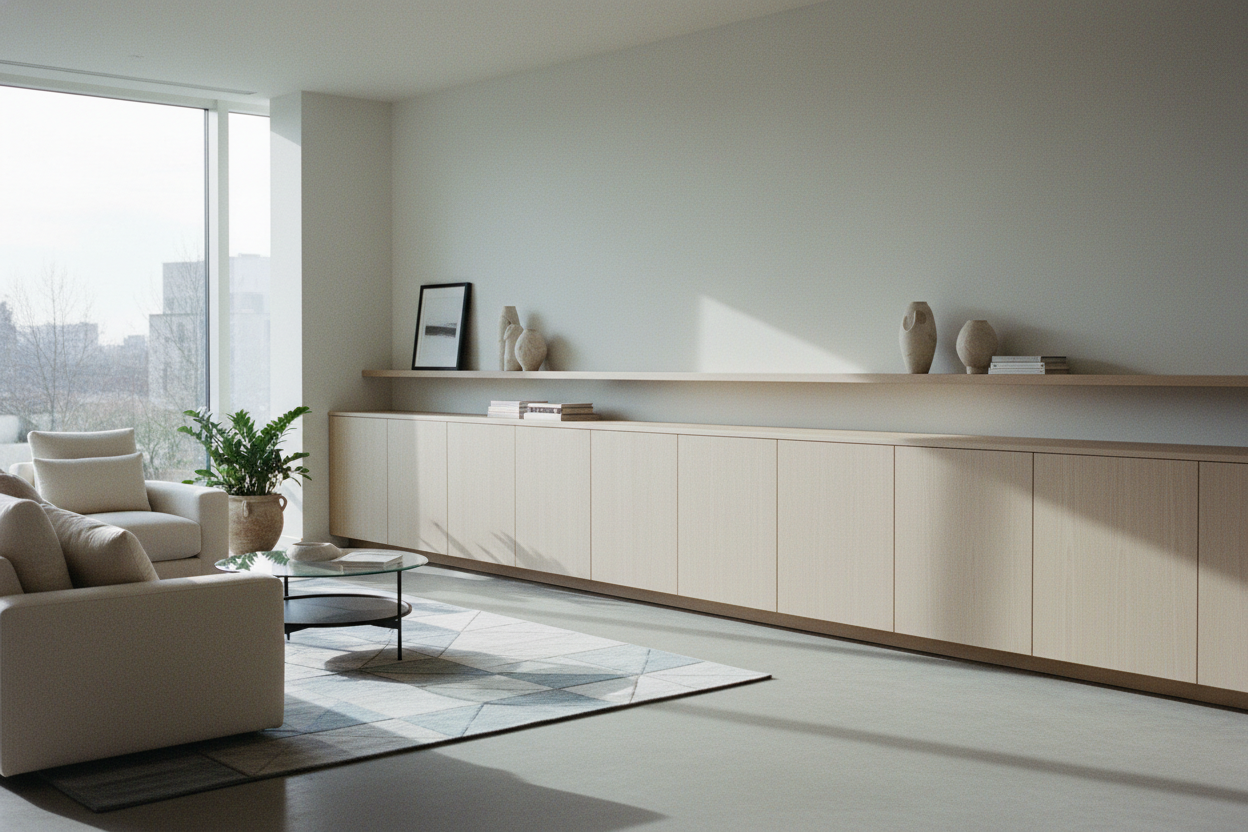
We've all stared at that one massive, blank wall in an open-concept living room or dining area. It feels incomplete, but adding a standard-sized console just looks like a postage stamp on a billboard. This is exactly where long cabinets shine. They anchor the visual weight of a room while quietly absorbing everyday clutter. But getting the scale right takes a bit of strategy.
If you have ever bought a piece of furniture that looked perfectly proportioned online, only to have it overwhelm your hallway in person, you know how tricky dimensions can be. By the end of this guide, you will know exactly how to size, style, and select a piece that actually fits your home's architecture.
Quick Decision Guide
- Measure for negative space: Leave at least 12 to 18 inches of empty wall space on either side of your cabinet so it doesn't look crammed.
- Check the center support: Any cabinet over 60 inches needs a fifth (or center) leg to prevent the middle from sagging over time.
- Match depth to traffic flow: Keep the depth between 15 and 20 inches in high-traffic hallways, but you can go up to 22 inches in dining rooms.
- Consider door clearance: Ensure you have at least 36 inches of walkway space even when the cabinet doors are fully open.
Mastering Scale and Placement
The Rule of Thirds for Long Walls
A common mistake I see is buying a piece that is either too timid or too aggressive for the architecture. If you have a 15-foot wall, an 80-inch cabinet creates a beautiful focal point while leaving enough negative space to let the room breathe. The goal is to fill roughly two-thirds of the usable wall space.
Navigating Open Concept Layouts
In modern North American homes, the lines between the kitchen, dining, and living areas are blurred. A long cabinet acts as a brilliant physical boundary. Placing a low-profile, modern storage cabinet with doors behind a floating sofa provides a visual anchor for the seating arrangement while offering a designated drop zone for keys, mail, or serving dishes.
Concealing Clutter with Intentional Design
Choosing the Right Silhouette
When dealing with significant width, you want to avoid anything that feels visually heavy or blocky. Contemporary storage cabinets with doors often feature floating bases, tapered legs, or wall-mounted designs that keep the floor visible. This trick forces the eye into perceiving more square footage than actually exists.
Texture and Hardware
Because these pieces take up so much visual real estate, a flat, monochromatic finish can quickly look like a giant monolith. Look for modern storage cabinets with doors that incorporate ribbed wood, woven cane, or subtle metal inlay. These textural details break up the mass of the piece. Pair this with minimalist hardware—or push-to-open mechanisms—to maintain a clean, uninterrupted line across the room.
Lessons from My Own Projects
A few years ago, I sourced a breathtaking 96-inch matte black oak credenza for a client's dining room. It looked architectural and sleek. But I learned a hard lesson about long, dark, flat surfaces: they highlight absolutely everything. Every speck of dust, every fingerprint from their toddlers, and every micro-scratch from sliding a ceramic bowl across the top became glaringly obvious.
Worse, the piece only had four corner legs. Within six months of loading it with heavy stoneware plates and serving platters, the center began to bow slightly, causing the middle doors to rub against the frame. We had to retrofit a hidden steel support leg underneath. Now, I never specify a long cabinet without verifying center support, and I always steer clients with young kids toward medium-toned, textured woods rather than flat, dark finishes.
Frequently Asked Questions
What size long cabinet do I need for my TV?
Your cabinet should be at least 6 to 8 inches wider than your television on both sides. This prevents the TV from looking top-heavy and provides a visually balanced base. For a 65-inch TV (which is roughly 57 inches wide), look for a cabinet that is at least 70 to 74 inches long.
How do I decorate the top of a long cabinet?
Avoid cluttering the surface with dozens of small items. Group your decor into three distinct clusters: a tall element (like a lamp or a vase with branches) on one end, a low, horizontal element (like a stack of design books) in the middle, and a medium-height object on the opposite end. This creates an asymmetrical landscape that draws the eye across the piece.
Is a long cabinet good for small apartments?
Yes, provided you choose a shallow depth. A long, narrow piece (around 15 inches deep) can provide massive amounts of closed storage without eating into your precious floor plan. Wall-mounting it to create a floating effect will make the room feel even more spacious.

Leave a comment
This site is protected by hCaptcha and the hCaptcha Privacy Policy and Terms of Service apply.