

















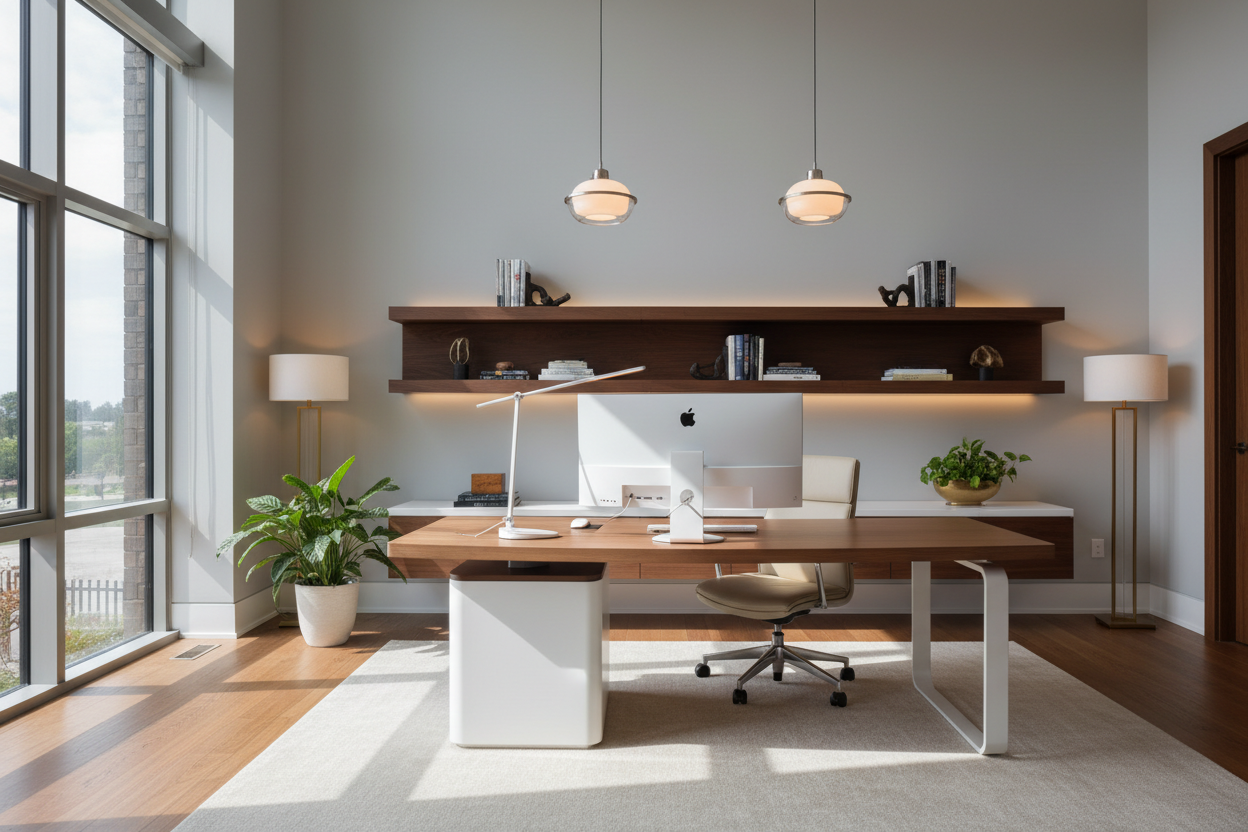
We have all experienced that specific headache that sets in around 3:00 PM. You blame the lack of caffeine or the endless Zoom calls, but as a designer, I look up. Usually, the culprit is poor illumination. Most workspaces suffer from a stark contrast between a bright monitor and a dark room, or harsh overhead fluorescence that washes out the space. Implementing the right lighting ideas for office layouts isn't just about buying a lamp; it is about orchestrating light to reduce eye strain and define the architecture of your room.
Key Features of a Well-Lit Workspace
- Color Temperature (Kelvin): Aim for 3500K to 4000K. This mimics neutral daylight, keeping you alert without the harsh blue tint of industrial LEDs.
- Color Rendering Index (CRI): Look for a CRI of 90+. This ensures that wood grains on your desk and fabric colors on your chair look true to life, not muddy.
- Adjustability: An articulating arm or dimming capability is non-negotiable for adapting to changing daylight conditions.
- Glare Control: Fixtures should have diffusers or shades that prevent the bulb from being directly visible to the eye.
Mastering the Layered Approach
In high-end interior design, we never rely on a single light source. To achieve a functional yet sophisticated look, you must layer your illumination. This adds depth and prevents the sterile "cubicle" feel.
1. Ambient Lighting: The Foundation
This is your general illumination. For many lighting for home office ideas, people default to recessed can lights. While functional, they often cast shadows on your work surface because the light source is behind you. Instead, consider a semi-flush mount or a linear suspension fixture centered over the room—but not directly over the chair—to disperse light evenly. If you have high ceilings, uplighting (bouncing light off the ceiling) creates a softer, shadow-free environment.
2. Task Lighting: Precision and Ergonomics
This is where function meets form. Office light ideas for the desk itself should focus on an articulating task lamp. The placement is critical: if you are right-handed, place the lamp on your left to avoid casting shadows across your notebook while writing. Look for fixtures with a heavy, solid base (brass or marble) to prevent tipping, or clamp-on models to save precious desk real estate.
Balancing Aesthetics with Functionality
Your office shouldn't look like a laboratory. It needs texture and visual warmth. When scouting office room lighting ideas, pay attention to material contrast. If your desk is a sleek, matte laminate, choose a lamp with a metallic finish—brushed nickel or aged bronze—to add a touch of luxury. Conversely, if you have a heavy timber desk, a slender, matte black architectural lamp provides a modern counterpoint.
Integrating Unique Accents
Don't be afraid to introduce unique office lighting that serves purely as "jewelry" for the room. A picture light over a diploma or a piece of art creates a focal point that draws the eye away from the screen, allowing for necessary visual breaks. Even a small, sculptural table lamp on a bookshelf can add a glow that softens the harsh edges of file cabinets and monitors.
My Personal Take on Lighting Ideas for Office
I learned a hard lesson about finish selection during a project for a tech executive in Seattle. I specified a stunning, high-polished chrome architectural lamp for his desk. It was beautiful in the showroom. However, once we installed it, we realized his desk had a high-gloss lacquer finish. The reflection was blinding.
Every time he turned the lamp on, the bulb reflected off the chrome arm and then off the glossy desk, creating a laser-beam of glare right into his eyes. I had to swap it out for a matte powder-coated fixture with a deep conical shade. It taught me that the finish of your light fixture must converse with the finish of your furniture. Now, I always check the "gloss factor" of a client's desk before recommending metallic task lighting. It’s a small, unpolished detail that saves a lot of headaches later.
Frequently Asked Questions
What is the best position for a window in relation to my desk?
Ideally, position your desk perpendicular to the window. Facing the window directly causes contrast glare (your screen looks dark compared to the outdoors), while sitting with your back to the window causes glare on your monitor. Perpendicular placement offers the best balance.
How many lumens do I need for a home office?
For general ambient lighting, aim for about 2,000 to 3,000 lumens total for the room. For your specific task lamp, 450 to 800 lumens is the sweet spot—bright enough to read fine print, but not so bright that it causes eye fatigue.
Can I use warm light in an office?
You can, but be careful. Bulbs under 3000K (very warm/yellow) can induce relaxation and sleepiness, which isn't ideal for productivity. If you prefer a warmer aesthetic, stick to 3000K, but avoid the 2700K bulbs you would typically use in a living room or bedroom.


Leave a comment
This site is protected by hCaptcha and the hCaptcha Privacy Policy and Terms of Service apply.