

















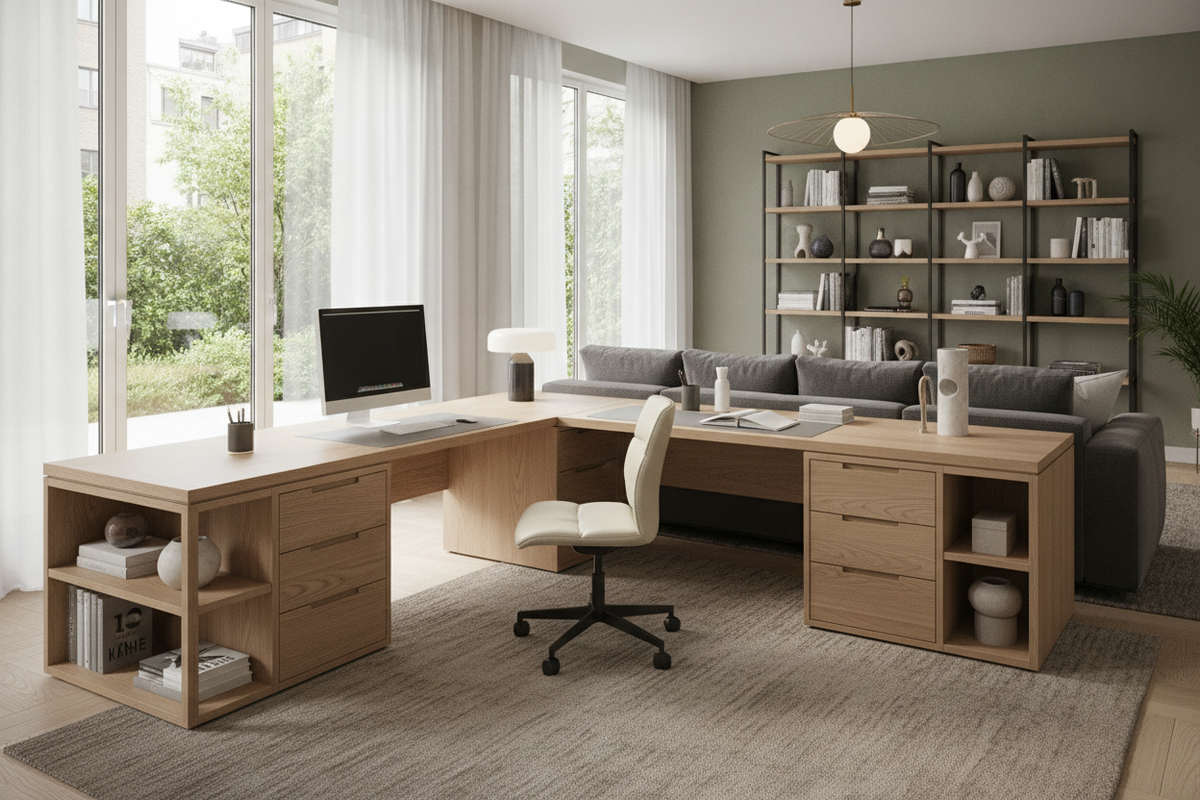
The Strategic Advantages of an L-Shaped Storage Desk
Organizing a productive workspace requires a balance between active desktop area and accessible organization. An l-shaped storage desk solves this challenge by leveraging corner geometry to create distinct work zones while keeping essential equipment, paperwork, and digital tools within an arm's reach.
Dual-Zone Task Management
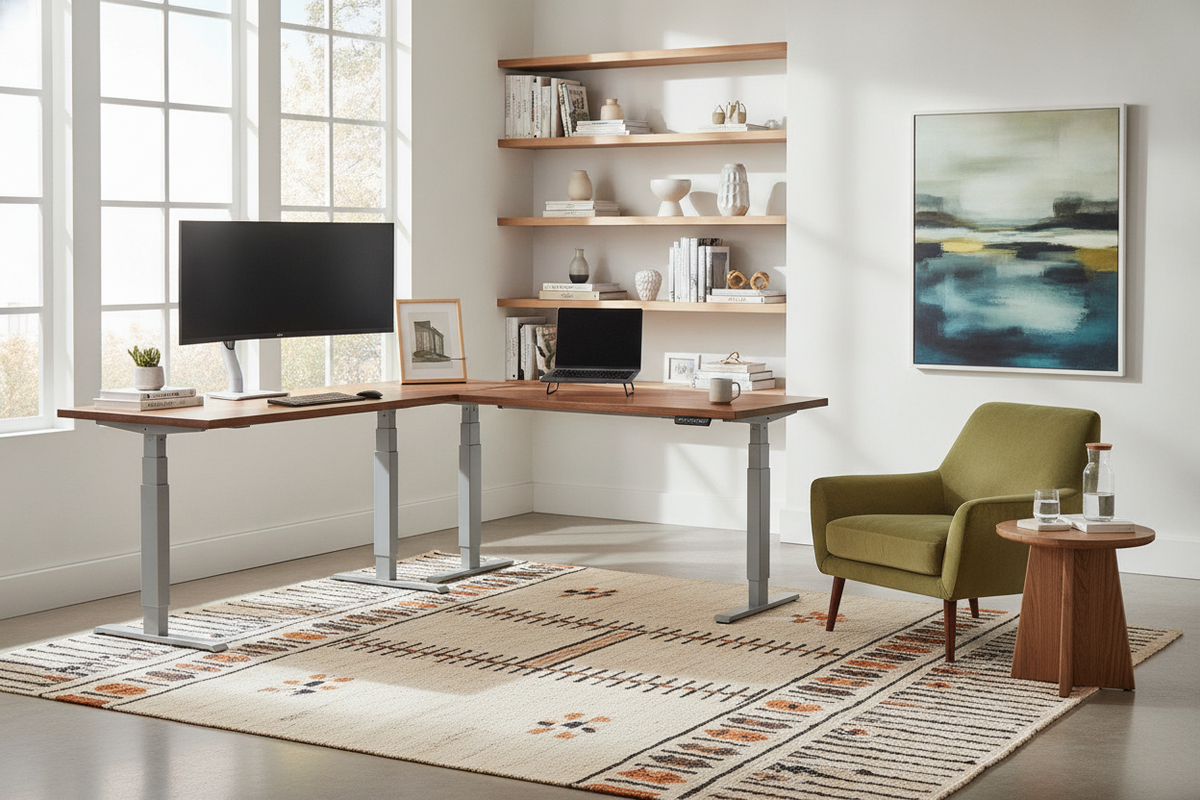
The defining structural benefit of an l shaped table with storage is the natural separation between primary computing and secondary support tasks. The main wing typically accommodates computer displays, keyboards, and primary input hardware. Meanwhile, the perpendicular return wing functions as a dedicated staging area for writing, paperwork review, document sorting, or desktop peripherals like printers and scanners.
By separating high-focus digital workflows from document management, users reduce visual clutter in their direct line of sight. This zoning prevents paperwork from encroaching on keyboard zones and maintains a clear, open surface for daily administrative tasks.
Corner Floor Plan Efficiency
Traditional rectangular desks often extend outward into the center of a room, creating dead space along adjoining walls. An l table configuration fits snugly into perimeter corners, capturing underutilized footprint without impeding room traffic. In open-concept layouts or shared home offices, positioning an L-desk so that one wing projects into the room can also act as an architectural room divider, creating a distinct home office zone without requiring partition walls.
Dimensional Profiles and Corner Footprint Planning
Choosing the right desk profile requires evaluating both the physical dimensions of the furniture and the movement clearance needed around it.
Measuring Perimeter Clearances and Chair Travel
Before selecting a desk, measure along both intersecting walls to ensure the unit does not obstruct doorways, low window sills, heating vents, or electrical baseboards. A functional workstation also demands adequate space behind the desk for chair movement. When planning your layout, leave ample room behind the inner corner vertex to allow an office chair to rotate freely and roll backward without striking walls or adjacent cabinetry.
For rooms with moderate square footage, selecting a dedicated shaped desk storage product offers a balanced footprint that fits standard residential corners while preserving necessary aisle clearance.
Primary Desktop Depth vs. Return Wing Depth
Not all L-shaped surfaces share identical surface depths. Many designs use an asymmetrical depth profile:
- Primary Wing: Typically designed with deeper desktop surfaces to maintain adequate viewing distance between the user and large monitors or laptop risers.
- Return Wing: Often designed with a slightly narrower depth to conserve room space while providing ample surface for notebooks, desk lamps, or storage caddies.
Evaluating this depth differential ensures that your monitor setup remains comfortable while preventing the desk return from feeling overly bulky inside the room.
Integrated Storage Architectures: Cabinets, Drawers, and Shelves
The organization built beneath or alongside the desk determines how effectively the workstation manages daily office supplies. Different configurations of l desks with storage serve varied organizational preferences.
Enclosed Cabinets and Lower Pedestals
An l desk with cabinets provides enclosed storage ideal for concealing bulky computer towers, archives, and office accessories. Cabinet doors maintain a neat, unified aesthetic, which is especially valuable in multifunctional living spaces where an exposed workstation might otherwise look cluttered.
When planning your storage setup, consider exploring an editorial storage cabinets under guide to assess how various enclosed storage options perform when organizing home supplies and accessories.
Open Return Shelving and Tiered Cubbies
For items that require frequent retrieval, open shelving returns and lower cubbies provide immediate accessibility. Open configurations are well suited for reference books, binder storage, decorative baskets, and electronics that benefit from unrestricted ambient airflow. Adjustable interior shelf pegs allow you to customize vertical clearance for tall books or specific hardware dimensions.
Material Selection and Structural Stability
The structural integrity of an L-shaped workstation depends on durable base materials, reinforced frame construction, and solid joinery across the inner corner seam.
Corner Joinery and Load-Bearing Frames
Because an L-desk spans two perpendicular planes, the junction where the primary wing meets the return wing requires sturdy bracing. High-quality desks utilize reinforced metal brackets, mitered cross-plates, or dedicated corner support legs to distribute weight evenly across both sections. Steel perimeter frames and diagonal cross-braces beneath the desktop surfaces help prevent sagging over long spans.
Surface Durability and Edge Banding
Desktop surfaces experience constant friction from mice, keyboards, wrists, and writing utensils. Choosing engineered wood finished with durable laminate or melamine surfaces provides reliable resistance against everyday scratches and moisture rings. Sturdy edge banding along desk borders prevents peeling or chipping, ensuring long-lasting visual appeal and smooth forearm support during extended work sessions.
Assembly, Cable Routing, and Ergonomic Setup
Proper assembly and wire routing ensure that an L-shaped corner desk remains safe, organized, and comfortable to use.
Staging Reversible Return Orientations
Many modern L-shaped desks feature reversible designs, allowing the storage return to be mounted on either the left or right side of the main workstation. Review your room's natural light sources, door openings, and power outlets before beginning assembly. Staging the components on a soft floor surface allows you to confirm your preferred orientation before tightening structural fasteners.
Integrated Wire Management and Power Access
Because L-shaped workstations frequently host multiple electronic devices, managing cords along the perpendicular frame is essential. Consider these practical routing practices:
- Position power strips along the inside panel of the return storage module to keep cables off the floor.
- Utilize integrated desktop grommets to route monitor, keyboard, and charger cables directly beneath the surface.
- Fasten adhesive cable clips along the underside of metal support beams to route wires cleanly from one wing to the other.
With deliberate dimensional planning, sturdy materials, and a functional storage architecture, an L-shaped storage desk creates an organized, ergonomic foundation for any productive home or professional office.

Leave a comment
This site is protected by hCaptcha and the hCaptcha Privacy Policy and Terms of Service apply.