

















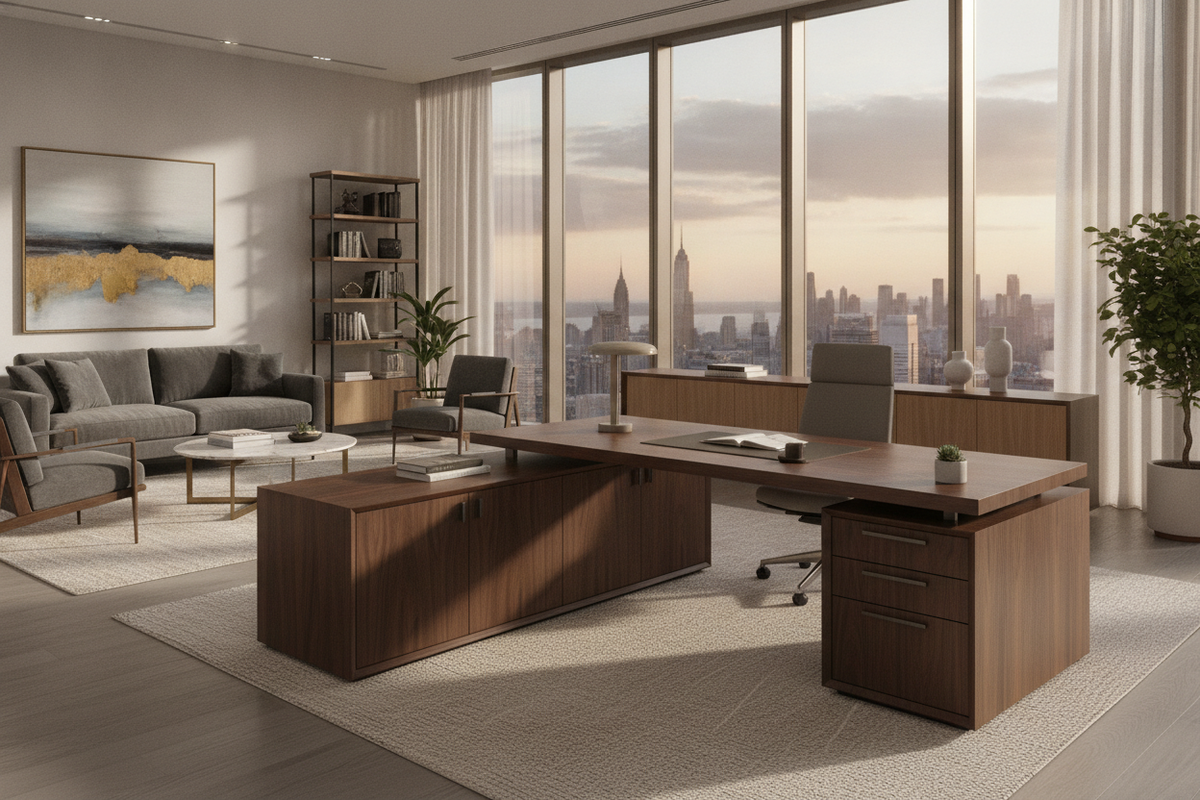
Designing an authoritative and highly functional commercial workspace requires furniture that balances expansive work surfaces with structured organization. An l shaped executive desk with drawer units serves as the central command hub of a private office, providing dedicated zones for digital equipment, document review, and secure paper management. Unlike open-frame tables or compact writing desks, executive configurations integrate substantial modesty panels, return wings, and built-in storage pedestals designed to support daily administrative and managerial operations.
Understanding the L-Shaped Executive Desk with Drawer Architecture
An executive desk differs significantly from general task stations. Structurally, it consists of a primary desk run paired perpendicularly with a secondary return. In an executive profile, these components are anchored by full or partial modesty panels and integrated storage pedestals rather than slender metal legs alone. When planning a reception or client-facing executive area, evaluating a specialized desk shaped executive product can provide visual inspiration for multi-tier counter lines and durable corner joinery.
Choosing a professional l-shaped desk allows you to establish distinct functional zones. The main desk surface typically accommodates daily computer interaction, client meetings, or signing tasks, while the return wing holds peripherals, reference binders, and active project files. The inclusion of built-in drawers ensures essential tools remain within arm's reach without cluttering primary visual planes.
Drawer and Pedestal Configurations for Commercial Workflows
Storage architecture determines the everyday efficiency of any l-shaped desk with pedestal elements. Depending on administrative requirements, pedestals can be configured as fixed base supports or modular sub-assemblies. Reviewing a comprehensive business office desk guide helps clarify how storage volume aligns with specific administrative roles.
Common drawer combinations found in l-shaped office desks for business include:
- Box-Box-File (BBF) Pedestals: These feature two upper utility drawers for office supplies, stationery, and small electronics, resting above a deep lower file drawer equipped with hanging rails for letter- or legal-sized documents.
- File-File (FF) Pedestals: Engineered for high-volume paper archiving, this configuration provides two deep hanging file drawers beneath the desk surface.
- Multi-Compartment Utility Wings: Integrating wider credenza-style storage or paired cabinets, such as a specialized drawer office desk product, creates dedicated space for heavier hardware, catalog binders, and personal items.
- Locking Central Drawers: Positioned directly below the primary work surface or on top of pedestals, central locking mechanisms safeguard sensitive contracts, keys, and company records.
Evaluating Spatial Clearance and Executive Room Layouts
Positioning an l-shaped business desk requires careful consideration of architectural clearance, door swings, and window sightlines. Executive desks command significant floor space, making perimeter planning crucial for a comfortable, open environment. For detailed spatial planning principles, consult our shaped desk office guide to optimize traffic pathways.
Consider these primary placement strategies for an l shaped commercial desk:
- The Command Position: Facing the desk toward the office entry with the return wing extending along an adjacent wall or outward into the room establishes an authoritative sightline while keeping computer screens shielded from incidental outside view.
- The Corner Executive Layout: Nesting the intersection of the primary desk and return into a room corner maximizes floor space in compact private offices, opening up central areas for guest seating or conference tables.
- Floating Island Arrangement: In large executive suites, floating the entire L-shaped unit in the center of the room allows for dual guest chairs on the visitor side and unhindered access to credenzas or bookshelves behind the main chair.
Commercial-Grade Materials, Finish Profiles, and Build Stability
The longevity of an l-shaped commercial office desk depends directly on its core materials and exterior finishes. Commercial environments demand scratch-resistant surfaces capable of withstanding heavy hardware, repeated document handling, and frequent cleaning. While unique conceptual designs like a compact desk drawer shaped product highlight creative geometry, executive commercial setups generally prioritize structural density, thick edge banding, and robust structural joinery.
Engineered wood cores wrapped in high-pressure laminates or thermal-fused melamines provide dependable moisture resistance and uniform finish stability over time. For executive suites, rich woodgrain textures, deep walnut finishes, muted slate tones, and warm oak patterns convey professional authority. Furthermore, sturdy cam-lock fasteners, metal support brackets, and steel drawer ball-bearing slides ensure drawer boxes open smoothly under full document weight without sagging.
Wire Management and Dual-Zone Executive Workflow Integration
A clutter-free work surface is critical for maintaining an orderly executive office. Modern executive desks integrate subtle cable management channels, desktop grommets, and concealed modesty chaseways. By running power cords, monitor cables, and charging leads internally through the desk return, desktop surfaces remain clear for physical meetings and signature portfolios.
Separating the digital workstation from the analog discussion area improves daily productivity. Positioning monitors, docking stations, and communication hubs along the return leaves the primary desk wing completely open for laptop placement, notepad reviews, and face-to-face client discussions.
Selection Checklist for High-Capacity Executive Desks
Before purchasing your next executive workstation, verify the following practical considerations:
- Return Orientation: Confirm whether the unit features a left-hand return, right-hand return, or a reversible design to ensure proper room fit.
- Filing Requirements: Ensure bottom drawer dimensions accommodate your standard filing formats, such as letter, legal, or A4 hanging folders.
- Legroom and Knee Clearance: Check that the placement of pedestals leaves comfortable knee clearance across both the main run and the return wing.
- Hardware Construction: Look for full-extension drawer glides to access files stored at the very back of deep pedestals effortlessly.
- Delivery and Access Path: Verify that large executive side panels and pre-assembled pedestals can easily navigate office doorways, elevators, and stairwells during delivery.

Leave a comment
This site is protected by hCaptcha and the hCaptcha Privacy Policy and Terms of Service apply.