

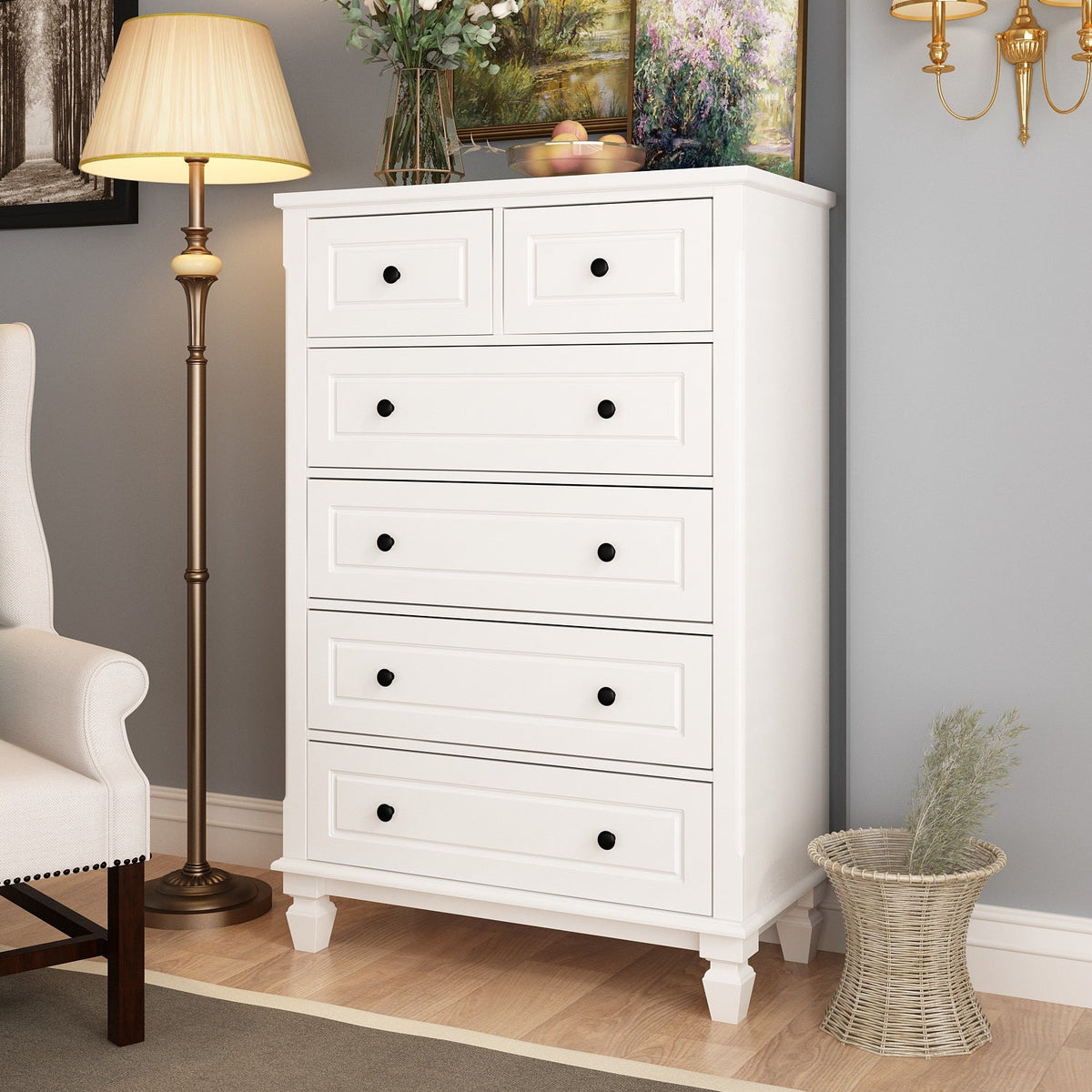
A dresser for a kids room has to stay put before it does anything else. Anchor it to the wall the day you build it. Choose one whose listing includes a tip restraint: dressers made after September 1, 2023 must pass the federal tip-over rule, 16 CFR part 1261, and come with an anti-tip device. Pick a height your child can use from the floor without climbing, look for drawers with safety stops, and keep the TV, toys and anything tempting off the top.
The dressers picked below stand 29.7 to 47.4 inches tall and 31.5 to 63 inches wide, and every one lists a tip restraint and drawer safety stops. For beds, desks and storage made for children, browse our kids' bedroom collection.
Key takeaways
- Anchor it, always: the CPSC recommends anchoring all clothing storage furniture, whenever it was made or bought.
- Tip restraint: covered dressers made after September 1, 2023 must come with an anti-tip device and warning labels.
- Height: everyday drawers should open from the floor; low dressers suit young children, tall chests older kids.
- Drawers and top: look for safety stops, keep heavy things low, and keep TVs, toys and remotes off the top.
What the tip-over rule means for a kids' dresser
Dressers and other clothing storage units sold in the US fall under the CPSC rule at 16 CFR part 1261, adopted under the STURDY Act. The CPSC's business guidance for clothing storage units says the rule covers free-standing units manufactured after September 1, 2023 that have all three of these:
- a height of at least 27 inches;
- a mass of at least 30 pounds;
- at least 3.2 cubic feet of enclosed storage.
A covered dresser must pass three stability tests, which the CPSC names "Clothing load", "Horizontal force" and "Carpet with child weight". An anti-tip device that meets ASTM F3096 must be packed with it, and its warning labels must carry set statements and pictograms. When the rule was adopted, the CPSC's 2023 announcement described tests on carpeting, with loaded drawers and multiple drawers open, and "tests that simulate the weight of children up to 60 pounds interacting with the unit." The same release says CPSC staff knew of 234 deaths from clothing storage unit tip-overs from January 2000 through April 2022, "including 199 child fatalities."
Why a tested dresser still needs anchoring
The rule makes new dressers harder to tip, not impossible. In its February 2024 safety release, the CPSC recommends that all clothing storage furniture, "regardless of when manufactured or purchased, should be anchored and secured to prevent tragedy." The same release estimates that 17,800 people a year are injured in TV, furniture and appliance tip-overs, based on emergency department data from 2020 to 2022.
Small dressers deserve the same care. A dresser under 27 inches tall falls outside the rule's scope, so it may not come with a restraint at all. The Anchor It campaign puts it plainly: "Heavy and wide furniture can still tip over." Anchor low dressers, tall chests and changing-table dressers alike.
How to anchor a dresser in a child's room
The CPSC's Anchor It pages walk through what you'll need and how to install a kit. In short:
- Check the kit. Brackets or plates plus a strap; Anchor It says brackets are usually metal or thick plastic, straps heavy nylon or braided steel, and usually two straps are used.
- Find a stud. On drywall or plaster, use a stud finder; Anchor It notes studs in modern homes are spaced 16 or 24 inches apart. On brick, drill the face of the brick, not the mortar, or call a contractor.
- Fix both brackets. Screw the wall bracket into the stud. On the dresser, choose a thick, sturdy spot, not a thin stapled-on back, and drill a pilot hole first.
- Tighten and check. Push the dresser into place, tighten the straps, then pull on each end. No slack and no movement means it is secure.
Do it the day the dresser is built, before any clothes go in. Our guide on how to anchor furniture to the wall covers wall types and hardware in more detail.

What height should a kids' dresser be?
The right height lets your child open their everyday drawers while standing on the floor. If a child needs a step, a chair or an open drawer to reach something, the dresser is working against you. Heights below come from our listings.
| Type | Height in our range | What a child can use | Best stage |
|---|---|---|---|
| Small 3-drawer dresser | 29.7 in | All three drawers from the floor | Toddler to early school age |
| Wide low dresser | 32 in | Most drawers from the floor; a wide top for a lamp | Toddler to teen, if the wall is long |
| Changing-table dresser | 37 in (our 45-inch model) | Lower drawers only; the top is for adults changing a baby | Baby, then storage as the child grows |
| Tall chest | 46.5 to 47.4 in | Lower drawers; top drawers suit an adult or an older child | School age to teen |
A quick test: stand your child next to a tape measure and note the highest point they reach comfortably with feet flat. Daily clothes go in drawers below that line; spare bedding and out-of-season clothes go above it. For overall sizes and the floor space to leave in front, see our standard dresser dimensions guide.
Drawers kids can use: stops, size and weight
Safety stops
A drawer safety stop keeps a drawer from pulling all the way out when a child yanks it. Look for "Drawer Safety Stop: Yes" in the specs; all four picks below list one.
Drawer size
Children's clothes are small, so shallow drawers work well. Where our picks list an inside height, it runs from 3.9 to 4.7 inches, which suits folded tees, pajamas, underwear and socks.
Weight in the drawers
Some listings give a drawer weight rating: 33 lb for the largest drawer of our 3-drawer dresser and 11 lb on our 5-drawer chest. Books or toy bins can pass a light rating quickly. The CPSC advises families to store heavier items on lower shelves, and the same logic applies to drawers: dense things go at the bottom.
One drawer at a time
The federal tests include multiple drawers open, because open drawers shift weight forward. Teach children to open one drawer at a time and close it before opening the next.
Keep TVs, toys and heavy items off the top
Never put a TV on a child's dresser. Anchor It's advice is to "make sure you use furniture designed to hold a television, like a TV stand or media center," or to mount the TV on the wall. None of the picks in this guide is a TV stand.
The CPSC also warns against storing appealing items "such as toys and remotes where kids may be tempted to climb to reach for them." Keep toys in low bins or on low shelves, route a lamp cord down the back, and hang mirrors on the wall rather than propping them on the top.
Changing-table dresser or regular dresser?
A changing-table dresser has a changing area on top and becomes ordinary storage once the diaper years end; a regular dresser is often lower and wider and lasts longer as a bedroom piece. Both need anchoring, a listed tip restraint and drawer stops. Pads, barriers, straps and supervision are covered in our changing table safety guide.
A dresser that grows with your child
A child's room changes every few years, from nursery to teen room. A dresser bought for a baby can last through all of it:
- Choose a plain finish. White, black or wood tones outlast a nursery theme; bring color in with bedding and labels.
- Think about the next layout. A wide, low dresser fits under a window; a tall, narrow chest leaves floor space for a desk later.
- Move drawers, not furniture. As your child grows, shift everyday clothes up a row.
- Re-anchor after every move. A new room means new studs and a new bracket position.

Organizing a kids' dresser: labels and zones
- One category per drawer: tops, bottoms, pajamas, underwear and socks.
- Label the fronts: pictures for children who cannot read yet, words once they can.
- Daily clothes low, extras high: spare sheets and out-of-season clothes go in the top drawers.
- File-fold and divide: clothes standing on edge, with dividers sized to the listed inside width and depth. Siblings can share a wide dresser by column.
Buying a second-hand dresser for a child's room
Check four things before a hand-me-down dresser goes in a child's room:
- A tip restraint. If the original kit is missing, buy one. Anchor It says a kit that feels flimsy is worth swapping for a sturdier one.
- The warning label. Covered dressers made after September 1, 2023 carry warning labels under the rule. A missing label may mean an older dresser, but anchor it either way.
- Recalls. Search the brand and model on the CPSC's recalls page. Check the anti-tip kit too: in January 2024 the CPSC announced a recall of one maker's anti-tip kits for clothing storage units because the plastic zip ties could become brittle or weak over time.
- Condition. Drawers should run straight and stop before they fall out, and the dresser needs a solid spot for the furniture bracket.
Kids' dresser buying checklist
- Tip restraint: listed as included, plus screws or anchors for your wall.
- Drawer safety stops: "Yes" in the specs.
- Height: everyday drawers below your child's comfortable reach.
- Width: at least the dresser's width of clear wall, after doors, vents and outlets.
- Drawer insides: height and depth listed and matched to what you fold.
- Weight rating: read it if listed, and keep heavy items low.
- Assembly: check how many people the listing suggests; our guide to assembling flat-pack furniture covers slides and hardware.
Our picks: dressers for a kids room
Each pick lists a tip restraint and drawer safety stops in its specs. All figures come from the listings.
31.5" Modern Black/White 3-Drawer Small Dresser with Metal Legs
A small three-drawer dresser that a young child can use from top to bottom. The drawers are 11.8 inches deep inside, run on metal slides with safety stops and lift out for cleaning, and the largest holds up to 33 lb. Gold-tone metal pulls, metal legs, a finished back, in black or white. Size: 29.7" H x 31.5" W x 15.7" D, 61.6 lb. The spec says a tipover restraint is included, and the listing suggests two people for assembly. The title calls it a nightstand; the listing also describes it as a small dresser.
Best for: a toddler's or young child's first dresser in a small room, where every drawer should be in reach.
Skip it if: one child's whole wardrobe has to fit, since three drawers fill fast, or you need inside drawer heights to plan dividers: the listing gives only the depth.
63" Modern Minimalist White/Black Dresser With 12 Drawers
A wide, low dresser with twelve handle-free drawers with grooved fronts, good for sorting small clothes into many categories. The drawers are 3.9 inches high and 13.8 inches deep inside, run on metal slides with safety stops and are removable. Solid and manufactured wood (MDF), in white or black. Size: 32" H x 63" W x 15.7" D, 130 lb. The spec says a tipover restraint is included, and the listing suggests one person can assemble it.
Best for: a long wall and a child, or two siblings, with lots of small, flat clothes that each get a drawer.
Skip it if: your wall is shorter than 63 inches, you store bulky sweaters (3.9 inches of drawer height), or you need a drawer weight rating: the listing gives none, and the spec says the back is not finished.

31.5" Modern White/Brown Dresser with 5 Drawers
A tall chest with five drawers all the same size, which makes labeling simple. Each drawer is about 27.6 inches wide, 11.8 deep and 4.5 high inside, on metal slides with safety stops, and the largest holds 11 lb. Black metal pulls, a finished back, in white or brown. Size: 46.5" H x 31.5" W x 15.7" D, 88 lb, manufactured wood (MDF). The spec says a tipover restraint is included, and the description says the anti-tipping device on the back holds the dresser close to the wall.
Best for: a school-age child in a small room, where floor space matters and five equal drawers make sorting easy.
Skip it if: a young child needs to reach every drawer (the chest is 46.5 inches tall), or you plan to store heavy items: the listing rates the largest drawer at 11 lb, and all five are the same size.
31.5" Modern Minimalist White Wooden 6-Drawer Tall Dresser Chest
A tall white chest with two small drawers on top and four larger ones below. The main drawers are 4.7 inches high, 26 wide and 11.8 deep inside, on metal slides with safety stops. It stands on solid wood legs 5.9 inches high, has a finished back, and the whole chest is rated for 120 lb. Size: 47.4" H x 31.5" W x 15.7" D, 96.14 lb. The spec and description say a tipover restraint is included, and the listing suggests two people for assembly.
Best for: an older child or teen who wants small top drawers for accessories and a compact footprint that leaves room for a desk.
Skip it if: a young child would have to reach the top drawers, or you need a weight rating per drawer: the listing gives 120 lb for the whole chest only.
Compare the picks
| Pick | H x W x D (in) | Drawers | Drawer inside | Safety stops | Tip restraint | Best for |
|---|---|---|---|---|---|---|
| 3-drawer small dresser | 29.7 x 31.5 x 15.7 | 3 | 11.8 in deep | Yes | Included per spec | Toddlers, small rooms |
| 12-drawer dresser | 32 x 63 x 15.7 | 12 | 3.9 in high, 13.8 in deep | Yes | Included per spec | Sorting, siblings |
| 5-drawer tall chest | 46.5 x 31.5 x 15.7 | 5, all equal | 27.6 x 11.8 x 4.5 in | Yes | Included per spec | School age, small floor |
| 6-drawer tall chest | 47.4 x 31.5 x 15.7 | 6, 2 small over 4 large | 26 x 11.8 x 4.7 in | Yes | Included per spec | Older kids and teens |
If you are still choosing between a wide dresser and a tall chest, our guide to dresser vs chest of drawers compares the two. For kids' beds, desks, toy storage and more, see the full FUFU&GAGA kids' bedroom collection.
FAQ
What size dresser is best for a kids room?
For a young child, a low dresser about 30 to 32 inches tall lets them open their everyday drawers from the floor; our low picks are 29.7 and 32 inches tall. For older kids and small rooms, a tall chest about 47 inches tall saves floor space. Width depends on your wall: our picks run from 31.5 to 63 inches.
Do kids' dressers have to be anchored to the wall?
Yes. Covered dressers made after September 1, 2023 must come with an anti-tip device, and the CPSC recommends anchoring all clothing storage furniture regardless of when it was made or bought. A dresser under 27 inches tall is outside the rule but can still tip, so anchor it too.
What is the safest dresser for a child's room?
No dresser is safe unanchored. Look for one made after September 1, 2023 that lists a tip restraint, drawers with safety stops, and a height that lets your child reach daily clothes without climbing. Then anchor it, keep heavy items in the bottom drawers and keep the top clear of toys, remotes and TVs.
Can I put a TV on my child's dresser?
No. The CPSC's Anchor It campaign says to use furniture designed to hold a television, such as a TV stand or media center, or to mount the TV on the wall. None of our picks is designed or rated to hold a TV.

Leave a comment
This site is protected by hCaptcha and the hCaptcha Privacy Policy and Terms of Service apply.