

















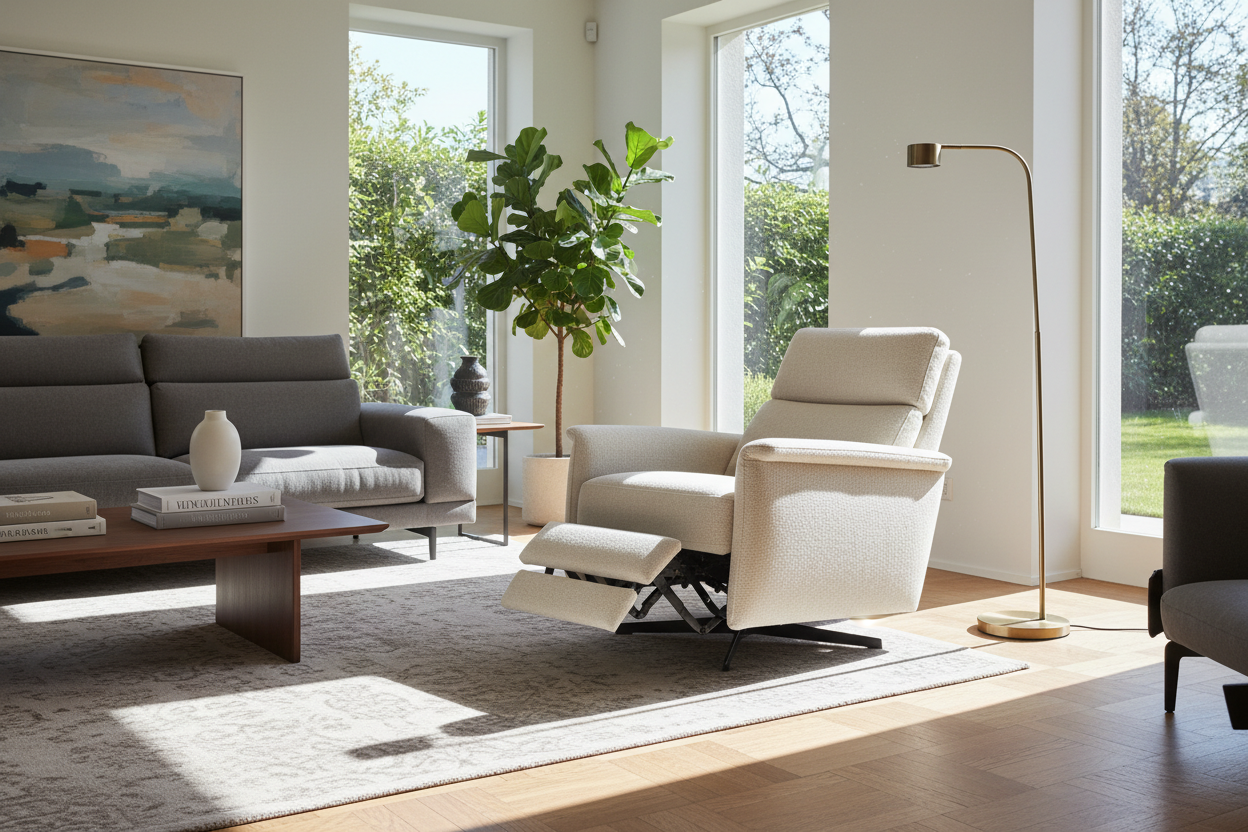
For years, many of my clients hesitated to incorporate a recliner sofa chair into their living spaces, fearing the bulky, overstuffed aesthetic that dominated the market in the 90s. Fortunately, furniture design has evolved. Today, we bridge the gap between high-end ergonomics and sophisticated silhouettes. The challenge is no longer finding a recliner that looks good; it is finding one that maintains its structural integrity and comfort mechanics over a decade of use. This guide cuts through the showroom noise to help you select a piece that serves both your posture and your interior design.
Key Features to Look For
Before falling in love with a fabric swatch, assess these structural non-negotiables to ensure your investment lasts.
- Mechanism Smoothness: The reclining action should be silent and fluid, with no grinding sounds or jerky movements.
- Frame Construction: Look for kiln-dried hardwood frames rather than plywood to prevent warping over time.
- Wall Clearance: Determine if you need a "wall-hugger" design (requires only 2-4 inches of clearance) or a standard recliner.
- Seat Support: High-density foam wrapped in down or fiber offers the best balance of structure and softness.
Analyzing Material Quality
The upholstery you choose dictates the longevity of the chair. In a showroom, everything looks pristine, but daily wear tells a different story.
Leather vs. Performance Fabric
If you opt for leather, insist on top-grain or full-grain. Bonded leather is often marketed as a budget-friendly option, but in my experience, it begins to peel within three to five years. For households with pets or children, I often recommend high-performance velvets or crypton fabrics. These offer the tactile luxury of a soft weave but possess hydrophobic properties that repel spills, making maintenance significantly easier without compromising the visual texture of the room.
Ergonomics and Silhouette
A common design error is ignoring the scale of the chair relative to the user. A recliner is a machine for sitting; if the pivot point of the headrest doesn't align with your cervical spine, the chair fails its primary purpose.
Visual Weight and Balance
To avoid the "heavy" look associated with recliners, seek out designs with exposed legs. A recliner that sits flush to the floor can look like a solid block, visually shrinking a small room. A model with tapered wooden or metal legs allows light to pass underneath, creating a sense of airiness. Ensure the back height doesn't obstruct sightlines, especially if the chair is floated in the center of an open-plan room.
Space Planning & Layout
Placement is critical. Unlike a stationary armchair, a recliner changes its footprint. You must account for the fully extended depth. I always advise clients to tape out the dimensions on the floor—both upright and reclined—to ensure traffic flow isn't impeded. If you are placing the chair near a walkway, ensure there is at least 30 inches of clearance when the footrest is extended to avoid tripping hazards.
Lessons from My Own Projects
I want to share a specific hurdle I encountered during a penthouse renovation last year that changed how I specify these chairs. We selected a stunning, high-end electric recliner for the center of the living room. The aesthetic was flawless, but we made a critical oversight: power cord management.
Because the chair was floating in the room (not against a wall), we were left with an ugly black cord snaking across a beige wool rug to reach the nearest outlet. It ruined the clean lines we worked so hard to achieve. I had to retrofit a rechargeable battery pack specifically designed for furniture mechanisms. It mounts underneath the frame, invisible to the eye.
Another detail to note is "leather puddling." On a project where we used a very soft, Italian aniline leather recliner, the seat leather stretched and created loose waves (puddling) after just six months of daily use. This is natural for high-end leather, but the client thought it was a defect. Now, I always warn clients: if you want a perpetually tight look, choose a corrected-grain leather or a heavy weave fabric. If you want character and patina, go for the aniline, but expect it to look "lived in."
Conclusion
Selecting the right recliner requires looking past the initial comfort of the showroom sit. By focusing on the mechanism quality, appropriate scale, and material durability, you can secure a piece that elevates your home’s style while providing the relaxation you deserve. Don't settle for comfort or style—demand both.
Frequently Asked Questions
How much space do I really need behind a recliner?
Standard recliners typically require 10 to 14 inches of wall clearance to fully recline. However, "wall-hugger" or "zero-clearance" models are engineered to slide forward on a track as they recline, requiring as little as 2 to 4 inches of space behind the chair.
Are power recliners more prone to breaking than manual ones?
Modern power motors are generally very reliable, often rated for 10,000+ cycles. The vulnerability usually lies in the switch or the power source rather than the motor itself. Manual levers have more mechanical tension points that can wear out physically over time, whereas power mechanisms offer smoother, consistent motion that puts less stress on the frame.
What is the best way to maintain the mechanism?
Dust and pet hair are the enemies of recliner mechanics. I recommend flipping the chair over (with help) once a year to vacuum the underside mechanism. If you hear squeaking, a small amount of clear silicone lubricant on the metal pivot points usually solves the issue—avoid oil-based lubricants as they can stain upholstery and attract more dust.


Leave a comment
This site is protected by hCaptcha and the hCaptcha Privacy Policy and Terms of Service apply.