

















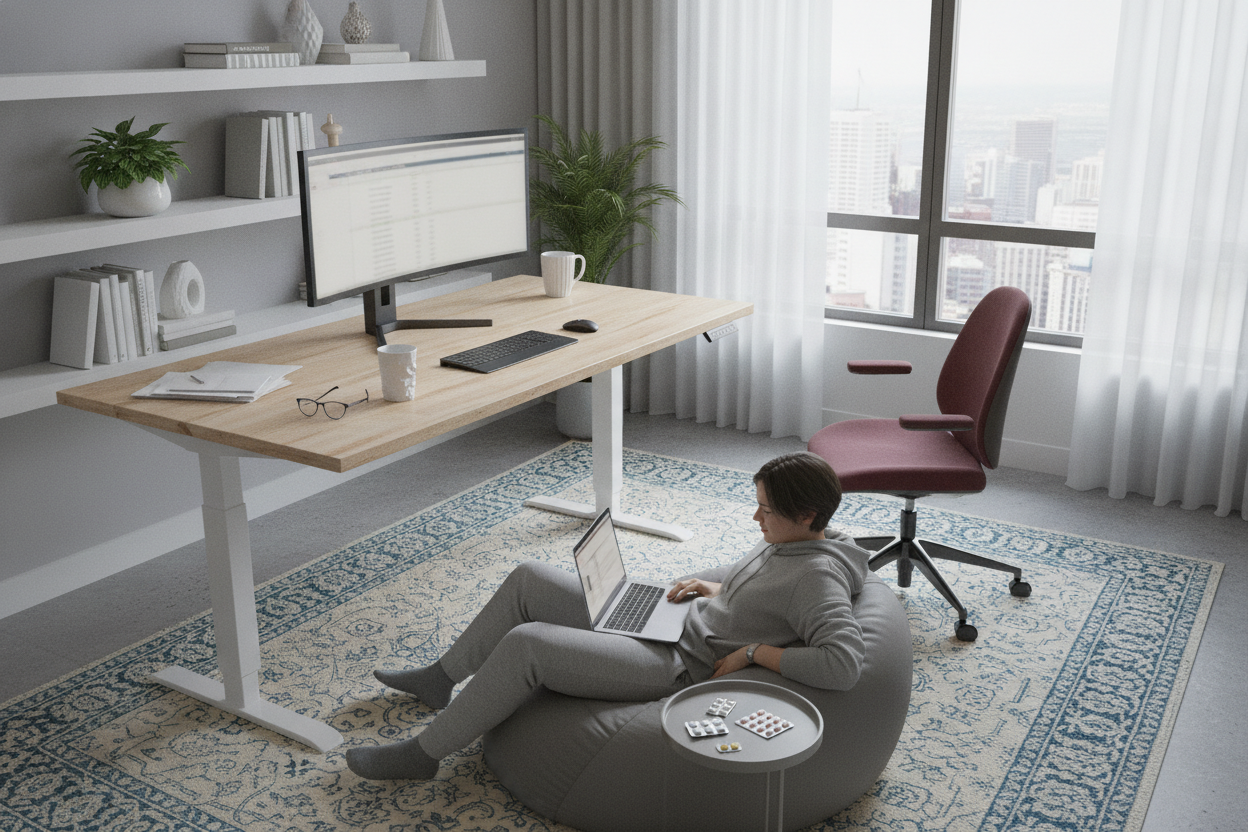
I remember the day I decided to finally stand at desk for a full eight-hour shift. I’d just unboxed a beautiful new adjustable desk for office use, and I was convinced that my days of being a sedentary sloth were over. I even put my ergonomic chair in the guest room as a sign of commitment. I pictured myself burning calories, improving my posture, and feeling like a high-performance athlete of productivity. By noon, I was questioning every life choice I’d ever made, leaning on my elbows like a tired pub patron at closing time.
- Standing all day is just as hard on your body as sitting all day—it just hurts in different places.
- The 20-8-2 rule is the sweet spot for avoiding fatigue and joint pain.
- Memory presets are a non-negotiable feature for any functional standing desk for home office.
- Aesthetics matter; don't let your workspace look like a sterile corporate cubicle just for the sake of ergonomics.
The 'All-Day Standing' Delusion
We’ve all seen the headlines. Sitting is the new smoking, your chair is a death trap, and if you aren’t using a stand up desk for home office work, you’re basically inviting a lifetime of posture problems. I fell for it hard. When I got my first home office standing desk, I felt a weird sense of moral superiority. I thought sitting down was a sign of weakness, a failure of the will. I forced myself to stay upright even when my body was screaming for a break, thinking I was 'winning' at health.
This all-or-nothing mindset is exactly how people end up hating their home stand desk. You wouldn't try to run a marathon without training your legs first, yet we expect our bodies to support our full weight for eight hours straight the moment we get a stand up desk at home. It’s a recipe for burnout and a very expensive piece of furniture that eventually just becomes a high-altitude clutter magnet because you're too sore to use it. The guilt of sitting is a mental trap that ignores how human physiology actually works.
What Actually Happens to Your Body by Hour Four
The first hour of using a stand up desk home is great. You feel energetic, your blood is flowing, and you’re typing with a strange sense of urgency. By hour two, the novelty wears off and you start shifting your weight from foot to foot. By hour three, you’re likely leaning on one hip or locking your knees, which is actually worse for your spine and pelvis than sitting in a halfway decent chair. By hour four? The brain fog sets in because your body is diverting all its energy to your throbbing heels and calves.
I learned the hard way that locked knees are the enemy of any stand up workstations setup. When you use adjustable desks for home office tasks for too long without a break, your joints take the brunt of the load instead of your muscles. My ankles swelled, my lower back felt like it was being compressed by a hydraulic press, and I ended up more exhausted than if I’d spent the day moving furniture. Prolonged standing isn't 'active'—it's just static in a different direction. Without movement, you're just a statue with a sore back.
The Golden Ratio for Stand Up Workstations
The secret to actually enjoying your standing desks for work isn't endurance; it's oscillation. Ergonomists often suggest the 20-8-2 rule. You sit for 20 minutes, stand for 8 minutes, and spend 2 minutes moving or stretching. It sounds tedious to track, but it’s the only way I’ve found to use a stand sit computer desk without ending the day in a puddle of ibuprofen. It keeps your metabolism ticking without overtaxing your joints.
If you're just starting with a sit stand desk home, don't aim for hours. Aim for twenty-minute increments. Your body needs to build the core and calf strength to support your weight properly. Eventually, you can work up to a 50/50 split, but even then, the best position is the next position. A sit stand desk for home office use is a tool for movement, not a podium for a marathon. I found that I was most productive when I stood during 'low-brain' tasks like clearing emails and sat during 'deep-work' tasks like writing or analysis.
Let the Motors Do the Remembering
I used to have a manual stand table for work that required a hand crank. Guess how often I adjusted it? Almost never. The friction of having to work for your height change is a total habit-killer. This is why I always recommend a sit stand up desk with memory preset controller. Being able to tap one button and have the desk glide to your perfect standing height while you grab a coffee is the difference between using the feature and ignoring it.
Without those presets, you’ll never quite find that 'just right' spot again. You'll be slightly too high, causing shoulder strain, or slightly too low, causing you to hunch. A lift desk for home office should remove all barriers to movement. Spend the extra money on the motor memory; your wrists and neck will thank you when the monitor is exactly at eye level every single time you transition.
Making Your Setup Look Good While You Move
One reason people avoid sit to stand desks for home use is that they can look a bit... industrial. Like a piece of hospital equipment drifted into your living room. But you don't have to sacrifice your style. Use a high-quality anti-fatigue mat—the kind with beveled edges so you don't trip—and choose an adjustable desk home with a solid wood or high-pressure laminate top that fits your decor. Cable management is also vital; a mess of dangling wires is the fastest way to make a standing desk work from home setup look like a disaster zone.
I’ve found that adding a dedicated desk lamp with warm light helps ground the space and makes it feel like a home, not a cubicle. When you're trying to maintain a specific design for a luxury home office, look for desks with slim profiles and hidden drawers. You want an adjustable desk home office that feels like a piece of furniture, not a transformer caught midway through a change. Hide the tech, highlight the textures.
When to Just Give Up and Sit Down
Here is the truth: some days, you just need to sit. If you’re doing deep-focus work or your legs are genuinely tired, forcing yourself to stand is just performative productivity. The beauty of an adjustable desks for home is that it gives you the choice. It isn't a failure to spend six hours in your chair if that's what your body needs that day. The goal is to avoid being stuck in one position for too long.
In fact, when you compare it to a standard writing computer desk, the adjustable version is superior precisely because it adapts to your energy levels. Stand when you’re on a boring Zoom call to stay awake; sit when you’re drafting a complex report. Use the movement to break up the monotony, not to punish yourself. Your desk should serve you, not the other way around. Listen to your feet—they usually know better than the productivity gurus.
FAQ
How long should I stand at my desk each day?
Start small. Aim for 15 minutes every hour. Standing for more than 4 hours total across a full workday is usually the tipping point where benefits turn into backaches for most people.
Do I need special shoes for a standing desk?
Unless you have a thick anti-fatigue mat, don't stand barefoot or in flat socks. Supportive house shoes or sneakers with an actual arch will save your feet from flattening out over time.
Will a standing desk help me lose weight?
Not significantly. You burn about 8 to 10 more calories per hour standing than sitting. It’s about blood flow, mental alertness, and spinal health, not a replacement for the gym.

Leave a comment
This site is protected by hCaptcha and the hCaptcha Privacy Policy and Terms of Service apply.