

















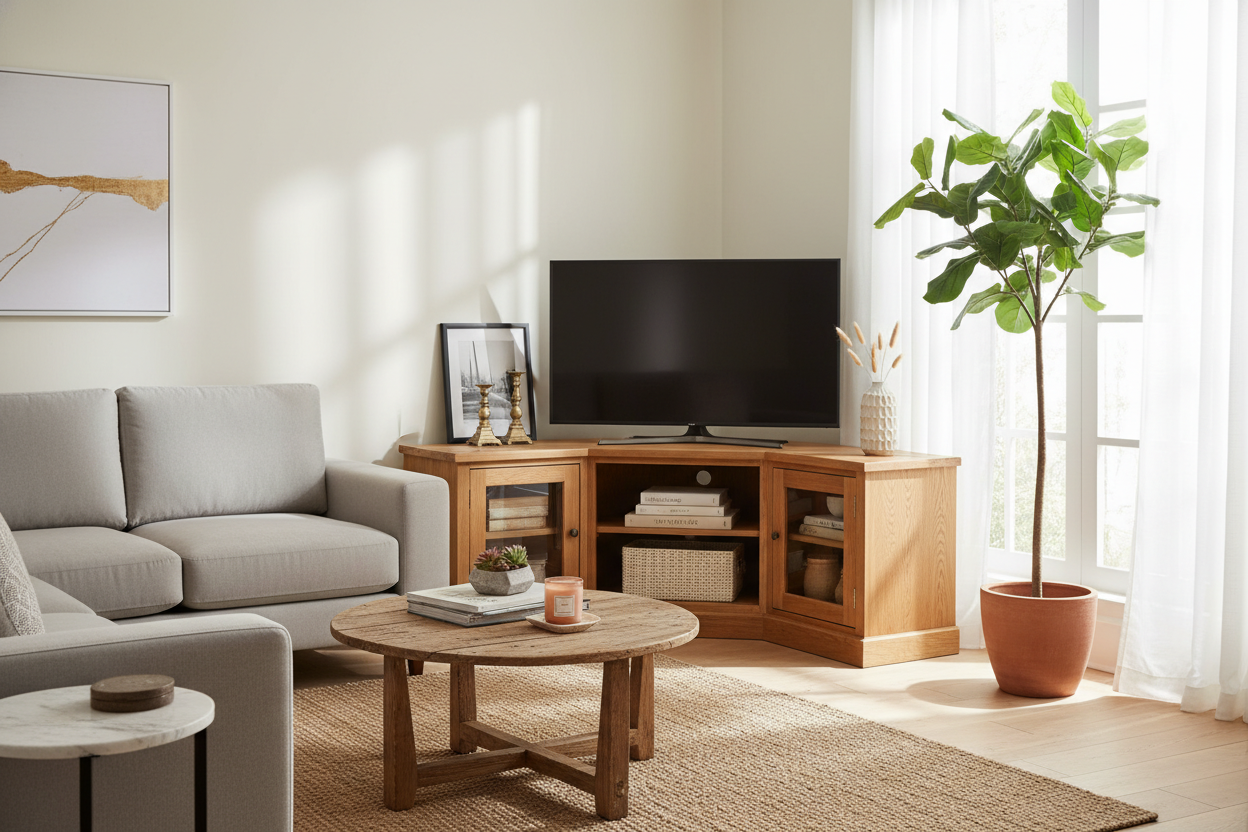
I spent three weeks staring at my living room floor plan like it was a 1,000-piece puzzle with missing parts. My new place has floor-to-ceiling windows on two walls and a massive fireplace on the third. There was literally nowhere to put a television without blocking a view or melting the screen. I finally realized that the only way to save my floor plan was to reclaim a dead corner with a corner oak tv stand.
- Corners are often the most underutilized square footage in open-concept homes.
- Oak provides a structural warmth that hides dust and scratches better than dark finishes.
- Measure the front width of the unit to ensure your TV doesn't overhang the edges.
- Solid timber prevents the 'sag' common in cheap particle board units.
The 'Too Many Windows, Not Enough Walls' Dilemma
Modern architecture loves glass, but it hates media consoles. My living room felt like a hallway because I tried to 'float' the sofa in the middle of the room to face a flat wall that wasn't actually there. It looked like a waiting room, not a home. Every time I tried to place a standard rectangular unit, it either blocked a heater or cut off the flow to the balcony.
I realized I needed to Stop Wasting Wall Space: Why I Switched to an Oak Corner TV Stand. Moving the screen to the corner let me push the sofa back against the only solid wall I had. This opened up a six-foot walkway that previously didn't exist. It turns out, you don't need more square footage; you just need to stop fighting the corners of your room.
Why I Wanted a Corner TV Stand in Oak (and Not Black MDF)
I briefly considered a stylish black tv stand entertainment center. They look sleek in professional photos, but in a room flooded with natural light, black furniture is a magnet for visible dust and fingerprints. I've owned the cheap stuff before—the kind where the 'wood' is just a sticker—and it peels the second you spill a glass of water.
I wanted a corner tv stand in oak because the honey-colored grain feels architectural rather than industrial. Real oak has a weight to it. It doesn't wobble when my dog bumps into it, and the natural grain helps the unit blend into the floor rather than standing out like a dark thumb. Plus, if you're working with a smaller room, light-colored wood keeps the space feeling airy.
How to Measure for a Corner Entertainment Unit Oak (Without Crying)
Geometry was never my strength, and corner units are tricky. You can't just measure the wall; you have to measure the 'clipped' corner and the depth from the back point to the front edge. Most people buy a corner entertainment unit oak based on the TV size, but they forget about the depth. If the unit is too shallow, your 55-inch screen will stick out past the sides, looking like a top-heavy mushroom.
I specifically looked for corner adapted storage that was cut at 45-degree angles to sit flush against the baseboards. Pro tip: measure the width of the front face of the stand. If your TV's legs are at the very edges of the screen, you might find they don't actually fit on the stand even if the 'screen size' says it's compatible. I learned that the hard way with a return shipping fee I'd rather forget.
Styling the 'Dead Zone' Behind an Oak Corner Entertainment Stand
There is always a triangular gap behind an oak corner entertainment stand. If you leave it empty, it becomes a graveyard for dust bunnies and lost remote batteries. I didn't want to see a mess of black cables hanging in that void, so I used a few cable management clips to run everything down the back leg of the unit.
I tucked a small LED uplight into that back triangle. It bounces soft light off the walls and makes the screen easier on the eyes at night. If you have the space, a tall snake plant in a slim pot can mask the cables while thriving in that low-light pocket. It turns an awkward architectural gap into a deliberate design choice.
The Final Verdict on My Corner Oak Entertainment Center
Switching to a corner oak entertainment center was a pride-swallowing moment. I used to think corner units were for finished basements or dorm rooms. I was wrong. It fixed the flow of my entire main floor. My sofa finally has a 'home' against a wall, and I can actually walk to the kitchen without dodging a coffee table.
If you're struggling with a room that has too many doorways or windows, stop trying to make a flat-wall console work. Embracing the corner was the best layout compromise I've ever made. The room feels twice as big, and I finally stopped tripping over my own furniture.
Is a corner stand better for small rooms?
Absolutely. By utilizing the corner, you free up the center of the room for better traffic flow and larger seating options. It makes a 12x12 room feel much less cramped.
Will my soundbar fit on a corner oak tv stand?
You need to check the width. Since corner stands taper toward the back, long soundbars often have to sit at the very front edge. Measure your soundbar before you buy the stand.
Does oak furniture require a lot of maintenance?
Not really. A quick dust once a week and a bit of wood polish every six months is plenty. Oak is incredibly durable and handles the heat from electronics better than synthetic materials.


Leave a comment
This site is protected by hCaptcha and the hCaptcha Privacy Policy and Terms of Service apply.