

















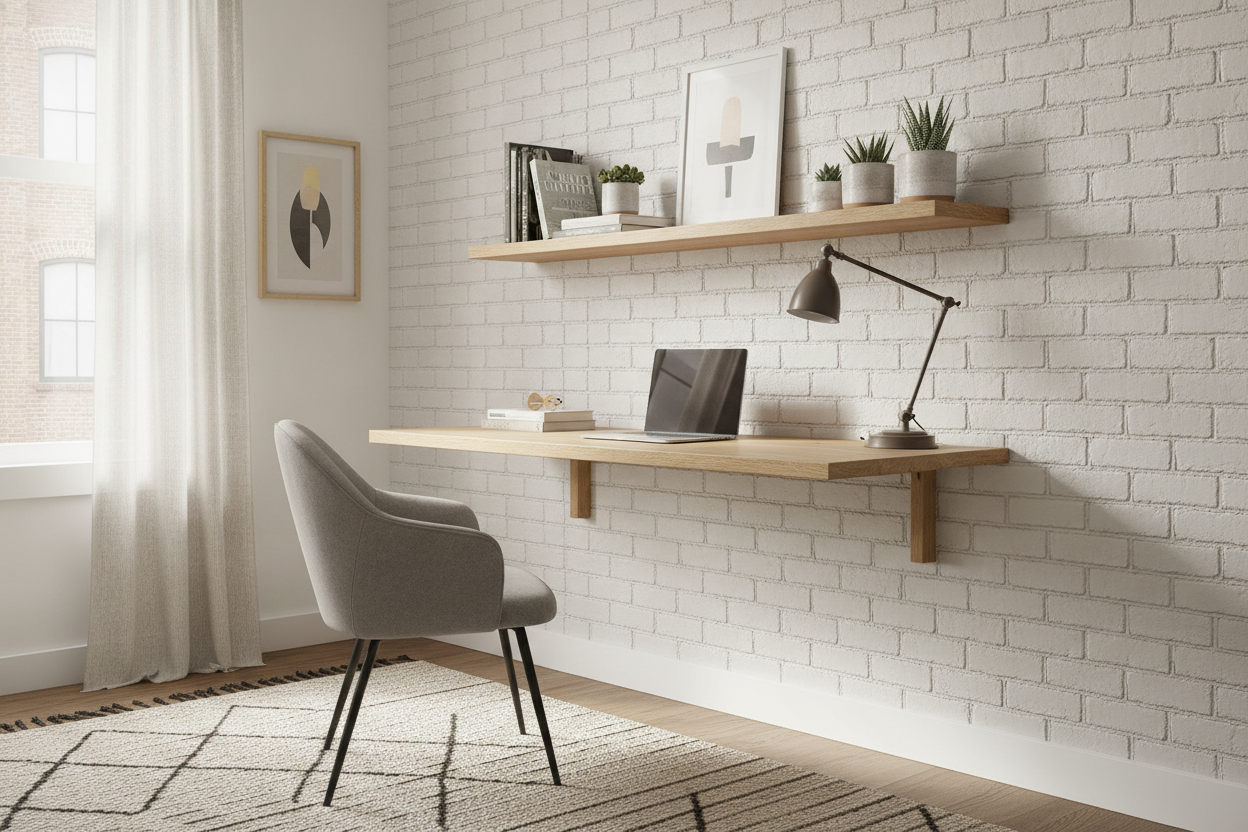
I spent three months shimmying sideways past my bed just to reach my closet because I insisted on a 'proper' office setup. My shins were a roadmap of bruises from kicking those wooden posts every time I stood up to grab a coffee. The epiphany came at 2 AM while staring at my floor plan: floor space is the rarest currency in a 150-square-foot bedroom, and my desk no legs attached was the only way to get my deposit's worth of square footage back.
The Claustrophobia of Four Posts
When I first moved in, I tried to force a standard writing computer desk into the corner. It was a beautiful piece of mid-century furniture, but in a room this small, it felt like an intruder. Those four legs didn't just hold up a tabletop; they created a 'dead zone' underneath where dust bunnies went to retire and where I couldn't even tuck my laundry basket. It made the room feel like a storage unit rather than a bedroom.
The problem with traditional desks isn't the surface area—it's the footprint. Even a slim desk with 1-inch metal legs creates a visual barrier. Your eyes stop at the floor where the legs land, making the walls feel like they're closing in. I realized that if I could see the floor extending all the way to the baseboard, the room would instantly feel three feet wider. That’s when I started looking into the magic of the floating setup.
I’ve tested dozens of layouts, and nothing kills the vibe of a cozy bedroom faster than bulky furniture legs. You don't realize how much mental energy you spend navigating around them until they're gone. Once I cleared the floor, I could actually move my chair without it catching on a rug or a desk leg. It was the first time my bedroom felt like it had 'air' in it since I signed the lease.
What Actually Is a Desk With No Legs?
A desk with no legs isn't just a fancy shelf, though that's how some people treat it. You’ve got a few distinct categories here. First, there are the heavy-duty wall-mounted slabs—usually a solid piece of butcher block or kiln-dried walnut held up by industrial-grade steel brackets. Then you have the 'secretary' styles that fold up into the wall when you're done, which are great for people who want to hide their work stress at 5 PM.
It is a total 180 from something like an L shaped desk with 3 drawers and wood legs. While those big units are great if you have a dedicated 12x12 office, they are absolute space-killers in a multi-purpose room. A legless desk keeps the weight off the floor, which is the golden rule of small-space design. You want your furniture to look like it's hovering, not like it's anchored to the ground.
I personally went with a 48-inch solid wood top. I skipped the cheap MDF options because they tend to sag under the weight of a dual-monitor setup. If you're going to bolt something to your wall permanently, you want it to be a material that won't warp the second the humidity hits 60 percent. Go for solid wood or high-grade plywood with a finished edge.
The Physics of Wall Mounting (Please Find a Stud)
Let’s talk about the scary part: the installation. If you try to hang a desk without legs using those flimsy plastic drywall anchors that come in the box, you are going to have a very bad, very expensive day. I learned this the hard way with a floating nightstand that ended up ripped out of the wall at 3 AM. For a desk, you need to hit at least two studs with 3-inch lag bolts. No exceptions.
I used a magnetic stud finder—the $10 ones are actually better than the fancy digital ones—and marked out my points. You want brackets that are rated for at least 100 lbs each. Why so much? Because you aren't just holding up a laptop; you're holding up your own arm weight when you lean in to type. A solid wall mount is actually more stable than a cheap four-post setup; it’s basically part of the house now.
If you have ever wondered why your DIY desk with legs is wobbling, it is usually because the mechanical joints where the legs meet the top are loose or made of cheap zinc. A wall-mounted slab doesn't have joints to wiggle. It's rock solid. Just make sure you use a level. There is nothing more soul-crushing than finishing a two-hour install only to realize your pencil rolls off the left side of the desk every time you set it down.
The Unexpected Ergonomic Perks
Most desks are manufactured at a standard height of 29 or 30 inches. That’s fine if you are exactly 5'10", but for the rest of us, it's a recipe for carpal tunnel. When you go legless, you can dial in the height to the exact millimeter. This is a massive win for finding a desk that fits short people or the exceptionally tall. I set mine at 27.5 inches, and my shoulder tension vanished within a week.
I also found that I could finally use my ergonomic stool properly. Without legs or a crossbar in the way, I have 360 degrees of movement for my feet. I can stretch my legs out fully, tuck them under, or even keep a small footrest under there without feeling cramped. It’s a level of freedom you just don't get when you're boxed in by a traditional frame.
The lack of a 'modesty panel' or drawers also means your knees never knock against the underside of the desk. I used to have to sit in a very specific, rigid way to avoid hitting the drawer pull on my old desk. Now, I can swivel and shift as much as I want. It’s the closest thing to working at a standing desk without actually having to stand for eight hours a day.
Is a Legless Setup Actually Right for You?
It’s not all perfect. You have to be ruthless with cable management because there are no legs to zip-tie your power strip to. If you don't buy a cable tray to mount underneath, you'll end up with a 'spaghetti monster' of wires hanging down in plain sight, which ruins the whole 'minimalist' look. I spent $15 on a metal mesh tray, and it saved the entire aesthetic.
Also, if you’re a renter, you need to be honest with yourself about your DIY skills. You’re going to be drilling some serious holes. Most landlords are fine with it as long as you spackle and paint when you leave, but check your lease first. And remember: weight limits are real. Don't sit on the desk. Don't let your 20-lb cat use it as a launching pad to the top of the bookshelf unless you've reinforced it with extra brackets.
But for me? I’m never going back to four posts. Being able to vacuum the entire room in five minutes without moving a single piece of furniture is a luxury I didn't know I needed. My room feels like a sanctuary again, not a cubicle.
FAQ
How much weight can a floating desk hold?
If you are bolted into at least two wooden studs with heavy-duty brackets, a standard floating desk can easily hold 75 to 100 pounds. Just don't try to sit on it or use it as a step stool.
Can I install a desk with no legs on a plaster wall?
Yes, but you shouldn't use standard screws. You’ll need toggle bolts or, ideally, you should mount a wood 'cleat' to the studs first and then attach the desk to that cleat for maximum security.
How do I hide the wires?
Buy a cable management tray that screws into the underside of the desk. This hides the power strip and all the excess cord length so you only see one clean wire running down to the outlet.


Leave a comment
This site is protected by hCaptcha and the hCaptcha Privacy Policy and Terms of Service apply.