

















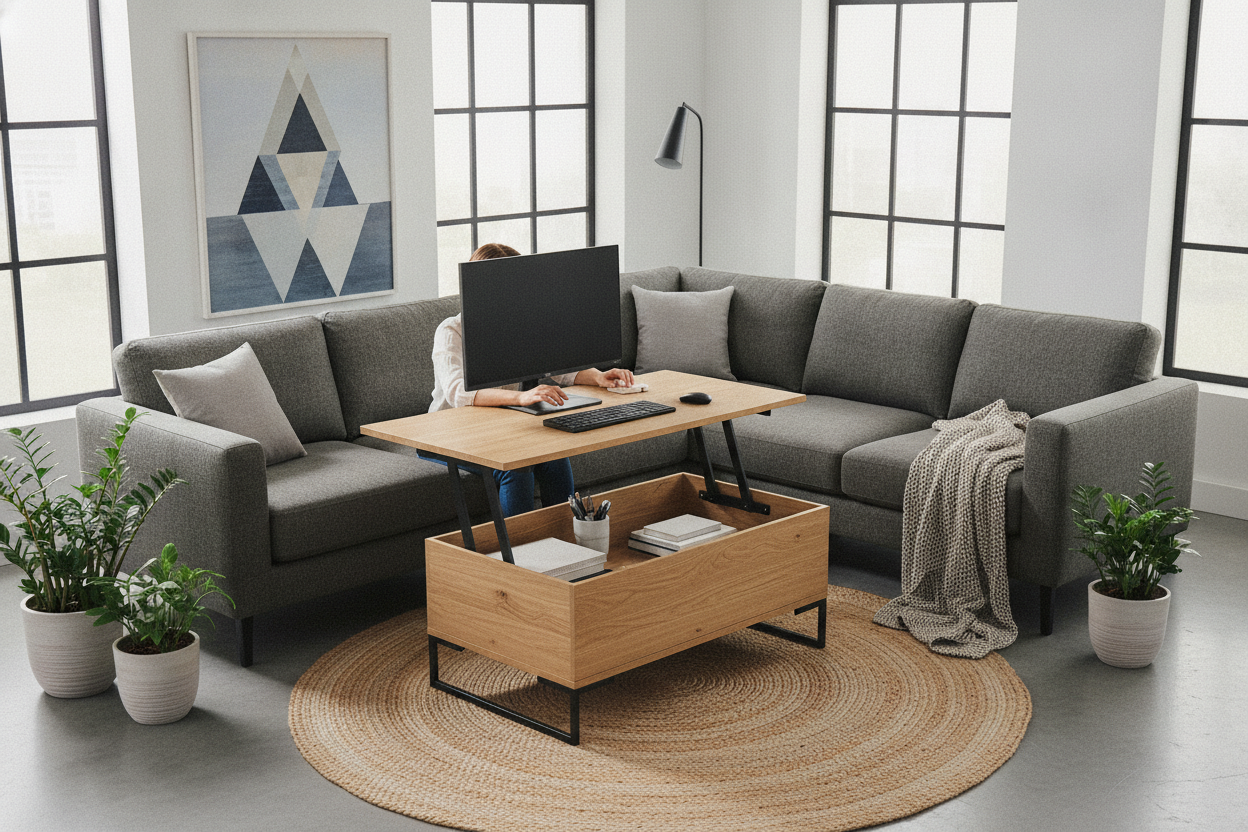
I spent three months convinced I could work from my sofa using a stack of hardcover books as a makeshift riser. My 600-square-foot studio apartment didn't have a spare inch for a desk and coffee table setup, so I chose the 'living room office' lifestyle. By week four, my lower back felt like it was being compressed by a hydraulic press, and my laptop was overheating on my thighs.
The reality is that most apartments aren't built for the 40-hour-a-week grind. You either sacrifice your walking space for a bulky workstation or you sacrifice your spine. I was tired of moving my mouse across a cushion, so I started looking for a way to make my furniture work twice as hard as I do.
- Look for Cantilever Action: The top should move toward you, not just up.
- Check the Weight Capacity: Aim for a lift mechanism rated for at least 40-50 lbs.
- Measure Your Sofa: Your seat height determines if the desk height will actually be ergonomic.
- Storage is Key: Hidden compartments are the only way to keep your 'office' from bleeding into your 'relaxation' zone.
The Couch-Working Delusion (And My Ruined Posture)
We've all been there. You start the morning with the laptop on your knees, feeling productive and cozy. By noon, you're hunched over like a medieval gargoyle. By 3 PM, you've moved to the coffee table, which is usually about 16 to 18 inches high—perfect for resting a drink, but a nightmare for typing. You end up in this weird half-crunch position that makes your neck scream.
I tried everything. I bought a lap desk, but it just trapped the heat against my legs. I tried sitting on the floor, but my legs fell asleep in ten minutes. I realized that a dedicated workspace was mandatory, but my floor plan was already maxed out. I had exactly 42 inches of space between my sofa and the TV stand. It was either a coffee table or a desk; I couldn't have both without turning my home into an obstacle course.
The 'hunch' isn't just a temporary discomfort; it’s a productivity killer. When you’re constantly shifting to find a comfortable angle, you aren't focusing on your spreadsheets. I needed a surface that met me where I was sitting, rather than forcing me to bend to its level. That is when I started looking into the world of 'transformer' furniture.
Hunting for a Coffee Table That Turns Into a Desk
I’ll be honest: I was skeptical. Most multifunctional furniture I’ve seen looks like it belongs in a dorm room or a cheap hotel. I didn't want a coffee table computer desk that looked like a plastic filing cabinet. I wanted something that looked like actual furniture—solid wood, clean lines, and a mechanism that didn't squeak every time I touched it.
I spent hours scrolling through reviews, debating if the viral table to desk transformer was actually worth the hype or just a clever marketing gimmick. I saw plenty of options that looked great in photos but had reviews mentioning 'wobbly legs' or 'flimsy springs.' If I was going to trust my $2,000 MacBook to a moving platform, that platform needed to be rock solid.
I eventually found a heavy-duty coffee table that turns into desk with a steel frame and a thick oak veneer. It wasn't the cheapest option, but the weight alone told me it wasn't going to tip over the second I leaned my elbows on it. The trick was finding a coffee table that turns into a desk without sacrificing the aesthetic of my living room. I wanted guests to see a stylish centerpiece, not a workstation.
Why Most Lift-Tops Are Actually Terrible for Typing
Here is the secret no one tells you about these hybrids: height isn't the only factor. Most cheap lift-tops only move vertically. If the table stays 20 inches away from your torso, you still have to lean forward to reach the keys. That completely defeats the purpose of having a coffee table desk convertible. You need a mechanism with a 'forward-reach' cantilever.
The model I chose extends the top about 10 inches toward the sofa. This means I can sit back against the cushions with proper lumbar support while the keyboard sits right at my fingertips. It turns the sofa into a high-end office chair. If the table you’re looking at doesn't specify a 'forward motion,' skip it. You'll just end up with the same back pain, just at a slightly higher altitude.
Stability is the other big issue. If you're typing and the screen is shaking like there's an earthquake, you're going to get a headache. I looked for a unit with gas-spring struts rather than just tension springs. Gas springs provide a smooth, controlled motion that doesn't slam shut or bounce when you set your coffee down. A coffee table with computer desk functionality is only as good as its hinges.
The 5 PM Magic Trick: Hiding the WFH Clutter
The best part of this setup isn't the ergonomics—it's the psychological shift. When you work from home, your 'office' is always staring at you. It’s hard to relax when your laptop and a mess of charging cables are sitting on the table while you’re trying to watch a movie. Using a coffee table desk combo solved this instantly.
Underneath the lifting top is a massive storage compartment. At 5:01 PM, I fold my laptop, toss my mouse and notebook into the 'void,' and pull the table top back down. The transition is instant. My living room goes from a frantic workspace back to a sanctuary. It’s significantly cleaner than the exposed mess of a traditional writing computer desk that usually ends up as a magnet for mail and random junk.
I even managed to tuck a power strip inside the storage area. Now, I only have one cord running from the table to the wall outlet, rather than a spiderweb of cables across the floor. If you're a minimalist, this is the ultimate hack. You get the utility of a full office without the visual noise of one. It’s the only way I’ve found to truly 'leave the office' while staying in the same room.
Is a Coffee Table Desk Combo Right for Your Space?
After six months, I’m a total convert. This coffee table converts to desk setup has saved my back and my floor plan. However, it’s not for everyone. If you use dual 27-inch monitors or a massive mechanical keyboard, you’re probably going to find the surface area a bit cramped. This is a solution for the laptop warriors and the casual researchers.
If you're looking for a coffee table that converts to desk, don't cheap out on the base. A light table will tip over when the top is extended. Look for something with a bit of heft—mine weighs about 60 pounds, and it doesn't budge. It’s the perfect compromise for anyone living in a studio or a one-bedroom where every square foot is precious. You don't need a bigger apartment; you just need furniture that knows how to multitask.
FAQ
Can I use a monitor arm with a lift-top coffee table?
Generally, no. Most lift-tops are made of engineered wood or veneers that can't handle the concentrated clamping pressure of a monitor arm. Plus, the weight of a heavy monitor might make the lift mechanism unstable or difficult to open. Stick to a laptop or a lightweight stand.
Is assembly difficult for these types of tables?
The table itself is usually standard flat-pack stuff, but the lift mechanism can be tricky. It often comes pre-assembled, but you'll need a second pair of hands to hold the top in place while you screw it into the hinges. Don't try to do it alone or you'll end up with a crooked desk.
Will it clear my knees?
This is why you measure! Standard sofa seats are 18 inches high. A good lift-top should reach about 24 to 28 inches when fully extended. Measure from the floor to the top of your thighs while sitting on your sofa to ensure you have at least 2-3 inches of clearance.


Leave a comment
This site is protected by hCaptcha and the hCaptcha Privacy Policy and Terms of Service apply.