

















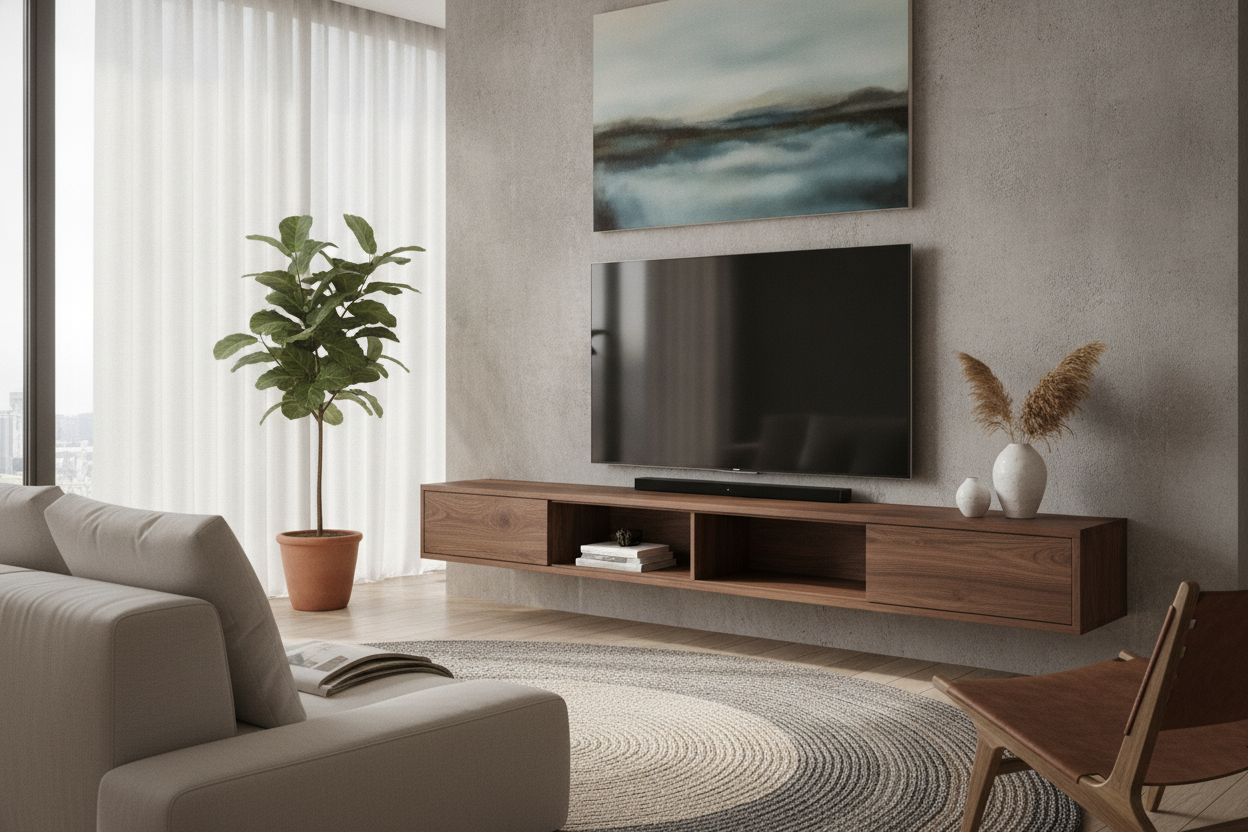
I woke up at 3:14 AM to a sound that resembled a tectonic plate shifting inside my living room wall. It wasn't an earthquake; it was the slow, agonizing death of a $120 flat-pack console. By the time I reached the hallway, the bottom half of my drywall was shredded, and my 65-inch OLED was precariously tilted toward the floor.
That was the night I learned an expensive lesson about physics. If you are going to hang sixty pounds of electronics on a wall, a solid wood floating tv stand isn't a luxury—it is a structural requirement. Particle board is just compressed dust, and dust doesn't like being pulled away from a wall for three years straight.
- MDF and particle board eventually bow or crumble under the constant tension of wall mounting.
- Real wood offers superior screw retention, meaning your mounting hardware actually stays put.
- Natural timber handles humidity and weight without the 'sag' common in cheap alternatives.
- Installation is 90% of the battle; if you miss the studs, the material doesn't matter.
The Day Gravity Defeated My Cheap MDF Console
My old unit looked great in the professional photos. It was sleek, white, and cost less than a nice dinner for two. But here is the thing about floating furniture: it is constantly fighting a war against gravity. Because the unit isn't supported by legs, the entire load is concentrated on the mounting rail and the back panel.
Cheap units use a thin piece of MDF for that back panel. Over time, the screws holding the bracket into the console started to 'chew' through the soft wood fibers. It didn't happen all at once. It was a slow, millimeter-by-millimeter surrender until the whole thing literally peeled off the wall like a wet sticker. I spent the next weekend patching drywall and swearing off honeycomb-core furniture forever.
Why a Real Wood Floating TV Stand is Non-Negotiable
When you upgrade to a solid wood floating media console, you are paying for density. Natural timber like oak, walnut, or mango wood has a complex grain structure that grips hardware. You can torque a lag bolt into a solid wood frame and it stays. Try that with a budget unit and the wood just turns back into sawdust.
Beyond the safety aspect, there is the 'sag' factor. A wood floating media console maintains its linear profile. I have seen countless 'floating' units that develop a sad, U-shaped dip in the middle after six months because the weight of the soundbar is too much for the compressed glue-wood. If you want that high-end, architectural look, you need a natural wood and black finish to ensure the horizontal lines stay perfectly straight for a decade, not a season.
Finding Your Vibe: From Light Oak to Moody Walnut
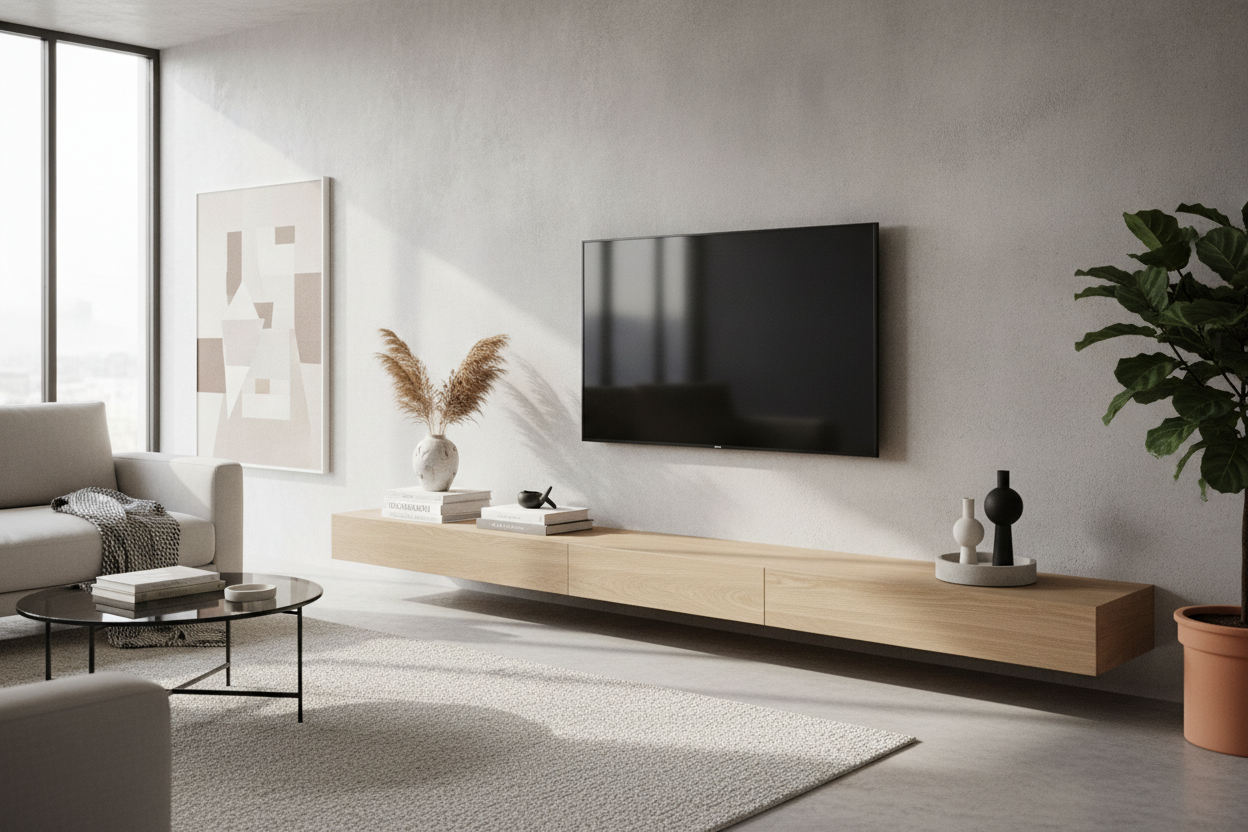
Choosing the right species changes the whole temperature of the room. A light wood floating tv stand—think white oak or ash—is the backbone of that 'Scandi-boho' look everyone is chasing. It makes the room feel larger because it doesn't create a heavy visual block on the wall. It’s airy and clean.
On the flip side, a darker natural wood floating tv stand in walnut or stained acacia brings a certain gravity to the space. It anchors a room that has high ceilings or lots of white space. I personally love a solid wood floating tv shelf with a live edge if you want to break up the sterile lines of a big black screen. It adds texture that a painted surface just can't replicate.
The Stud-Finder Reality Check (Please Don't Skip This)
I don't care how many 'heavy duty' drywall anchors the box comes with—throw them in the trash. A solid wood floating entertainment center is heavy before you even put a remote inside it. You must anchor the mounting bracket directly into at least two, preferably three, wall studs.
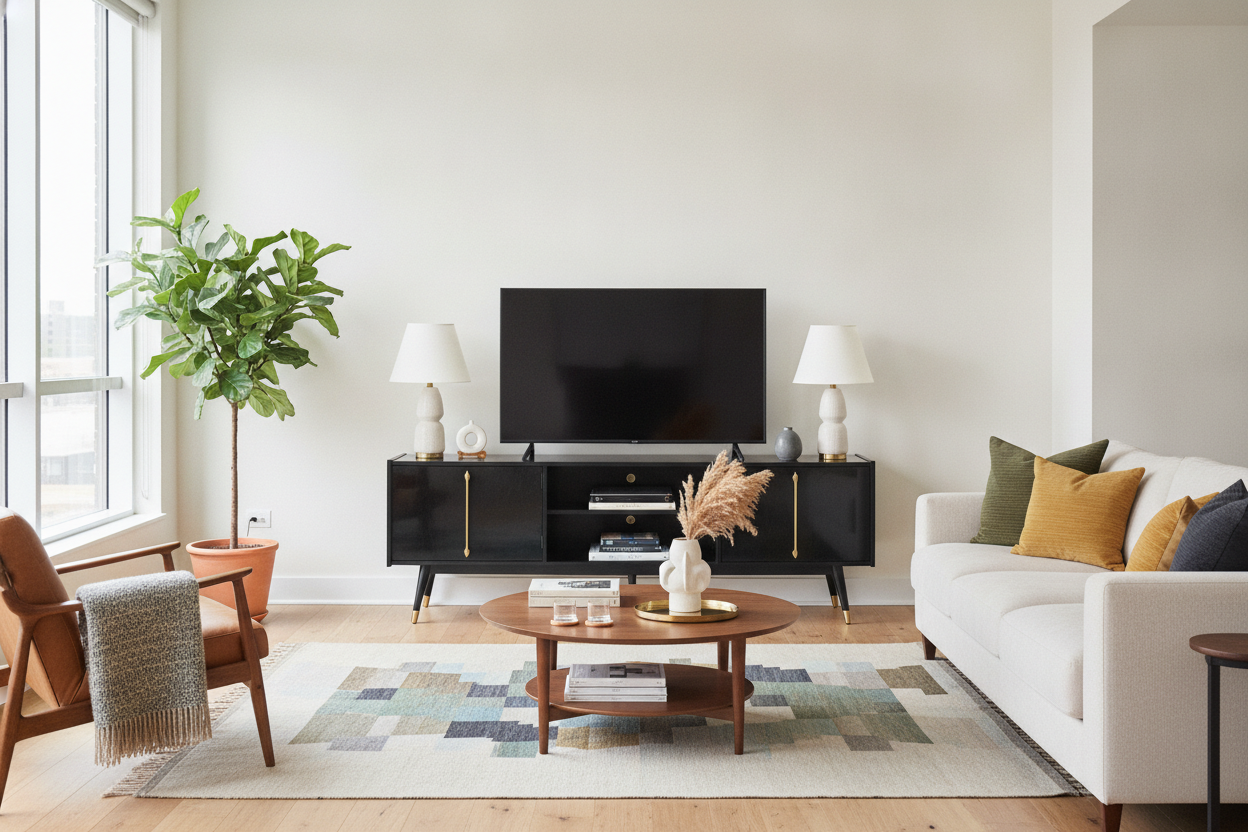
If you live in an old house with plaster and lath, or a modern condo with metal studs, you need specialized hardware. If you tap your wall and it sounds hollow or you can't find a solid anchor point, do not risk it. In those cases, I always tell people to browse traditional Tv Stands instead. A beautiful piece of furniture on legs is infinitely better than a 'floating' one that ends up in a heap on your rug.
Renters: The Ultimate Wall-Mount Fake-Out Method
I get it. Your landlord wants their security deposit back, and drilling four 3-inch holes into the studs is a non-starter. You can still get the look without the structural liability. There are hybrid units that use a floor-based console with an integrated vertical spine to hold the TV.
I actually wrote a whole guide on how I Faked a Floating Screen Using a Wood TV Stand With Mount. It gives you that sleek, hovering aesthetic while the actual weight of the solid wood floating tv console is supported by the floor. It is the best way to get the vibe without the 'will-it-fall-tonight' anxiety.
Can I mount a floating stand on a stone fireplace?
Yes, but you will need a masonry drill bit and Lead Anchors or Tapcons. It is a permanent move, so measure three times before you start drilling into your expensive stonework.
How high should a floating TV stand be?
The sweet spot is usually 8 to 12 inches off the floor. You want it low enough to keep your TV at eye level while seated, but high enough to let a robot vacuum pass underneath easily.
Does solid wood warp near a heater?
It can. If your floating tv stand solid wood is directly above a radiator or right in front of a vent, the wood might expand or contract. Keep a few inches of clearance to prevent the doors from sticking.

Leave a comment
This site is protected by hCaptcha and the hCaptcha Privacy Policy and Terms of Service apply.