

















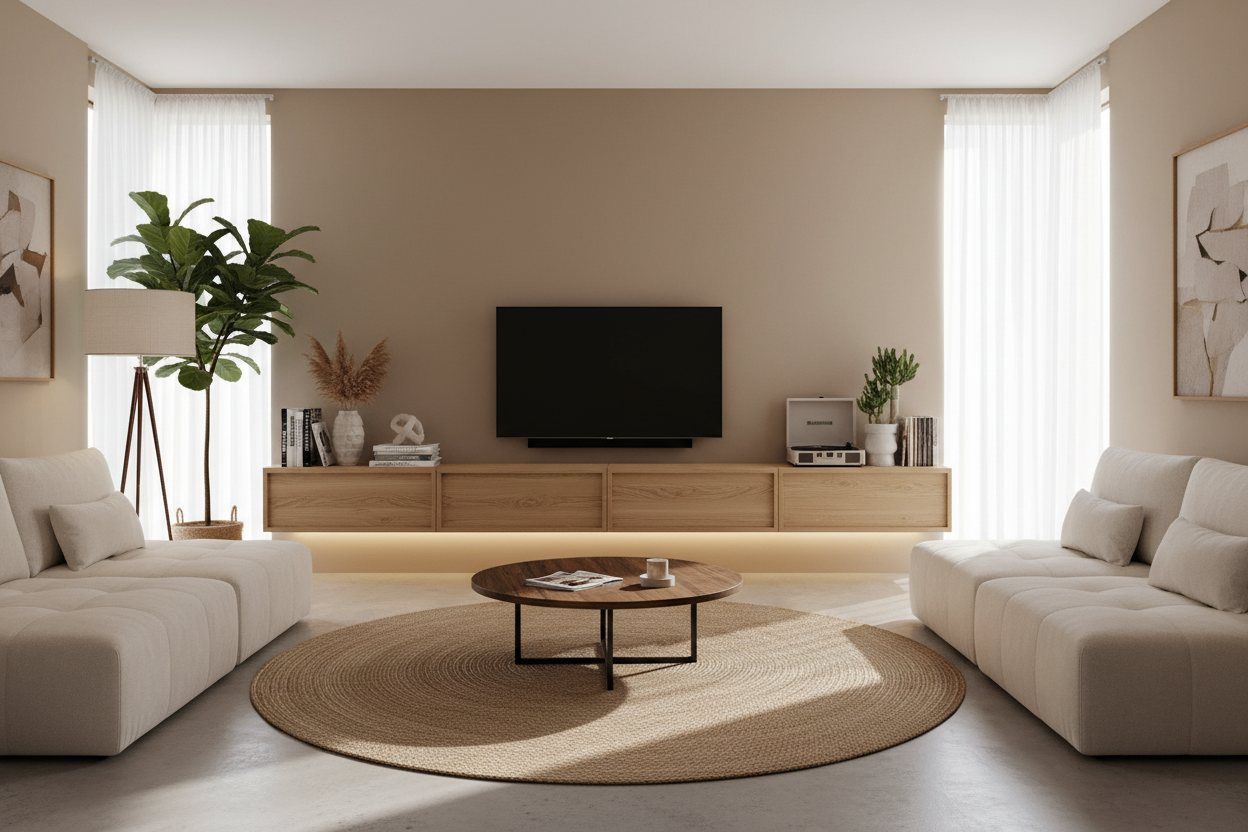
I remember staring at my 65-inch OLED mounted on a pristine white wall in my first 'adult' apartment. I had spent $1,200 on the screen and another $800 on a mid-century console, but the whole setup looked like a waiting room in a tech startup. It was cold, awkward, and deeply unsatisfying. I realized then that simply buying wooden tv stand ideas off a Pinterest board wasn't enough—you have to actually ground the piece in the room.
- Scale is everything: Your stand should be at least 10-12 inches wider than the TV screen.
- Avoid the 'Floating Screen' look by keeping the gap between the stand and a mounted TV to under 6 inches.
- Texture beats color: Look for grain patterns or slatted doors rather than just a flat stain.
- Asymmetry is your friend: It makes the tech feel like part of the decor, not the center of it.
The 'Floating Screen in a White Void' Problem
The most common mistake I see is what I call the 'floating screen' syndrome. You buy a beautiful piece of solid oak or walnut, center it perfectly under your TV, and then step back only to realize the wall still feels like a giant, empty abyss. The TV looks like a black hole sucking the life out of your living room. This happens because we treat the media console as a pedestal rather than an anchor.
When I finally fixed my own space, I realized the stand needs to be part of a larger visual story. It’s not just a box to hold your PlayStation and hide your messy HDMI cables. It’s the foundation for the entire focal wall. If the stand is too short or too small, the TV feels top-heavy. If it’s too cluttered, it feels chaotic. You need to find that sweet spot where the wood grain adds warmth to the cold glass of the screen.
Idea 1: Ground It With Asymmetrical Art (Not a Gallery Wall)
I am officially over the symmetrical gallery wall surrounding a TV. It looks dated and frankly, it's a headache to level 15 different frames. Instead, I’ve started leaning one oversized, moody piece of art on one side of the wooden console. It breaks the rigid horizontal lines of the screen and makes the whole setup feel like a curated vignette rather than a home theater.
The best part? This approach solves the wood-matching panic. You don’t need to obsess over perfectly matching your floor when you have a piece of art that bridges the gap. If you have light oak floors and a dark walnut stand, a frame in a medium wood tone or a black finish ties the whole room together. It’s about creating a 'collected' look rather than a 'showroom' look.
Idea 2: Fake the Custom Built-In Look
If you have a massive wall and a standard 60-inch stand, the scale is going to be off. I’ve found that you can fake the look of $5,000 custom millwork by flanking your timber unit with tall, narrow shelving. This creates verticality and fills the 'dead air' that usually haunts the sides of a television. I once used two cheap ladder shelves painted to match the wall, and people asked if they were built-in.
For those who want a more polished version without the DIY hassle, I often recommend a modern 3 piece entertainment center. It gives you that intentional, wall-to-wall presence. The key is to ensure the wood tones are consistent across all three pieces so it reads as one large architectural element. It’s a massive upgrade from a lonely stand sitting in the middle of a blank wall.
Idea 3: Lean Into the Low and Long Silhouette
There is something inherently luxurious about a TV stand that is significantly longer than it needs to be. I’m talking about an 80-inch or 90-inch console under a 55-inch TV. It creates 'negative space' on the ends of the unit, which is where the magic happens. You can place a lamp, a stack of books, or a ceramic bowl there without it looking like you're trying too hard.
This is what designers actually think makes a room look high-end. It’s the luxury of unused surface area. When I switched to a low-profile, extra-long acacia wood stand, my living room suddenly felt twice as wide. Just make sure the unit is low—around 18 to 22 inches high. If it’s too tall and too long, it starts to look like a dresser that wandered out of the bedroom.
Idea 4: Soften the Tech with High-Contrast Greenery
TVs are aggressive black rectangles. They are all sharp corners and cold surfaces. To fix 'blank wall syndrome,' you need organic shapes to fight back. I always place a tall, structural plant on one side of my wooden console. A 6-foot Fiddle Leaf Fig or a structural Olive tree in a heavy terracotta pot does wonders for softening those harsh edges.
Before you browse our TV stands, take a look at the lighting in your corners. A plant provides a vertical 'stop' for the eye, preventing the wooden stand from looking like it's just floating in space. The contrast between the natural wood grain and the deep green leaves makes the tech feel less like an intruder and more like a part of the home's ecosystem.
Is a wooden TV stand better than metal?
Usually, yes. Wood brings acoustic benefits—it doesn't vibrate or rattle like cheap metal or glass when you're watching a movie with heavy bass. Plus, it adds much-needed warmth to a room filled with glass and plastic electronics.
How wide should my TV stand be?
The golden rule is at least 6-10 inches wider than the TV on each side. If the TV is wider than the stand, it creates a 'top-heavy' look that makes the room feel unstable and cramped.
How do I hide cables on a wooden stand?
Look for units with pre-drilled cable management holes or a 'floating' back panel. If yours doesn't have them, a 2-inch spade bit and a power drill can fix most solid wood stands in about five minutes. Just don't try that on particle board!


Leave a comment
This site is protected by hCaptcha and the hCaptcha Privacy Policy and Terms of Service apply.