

















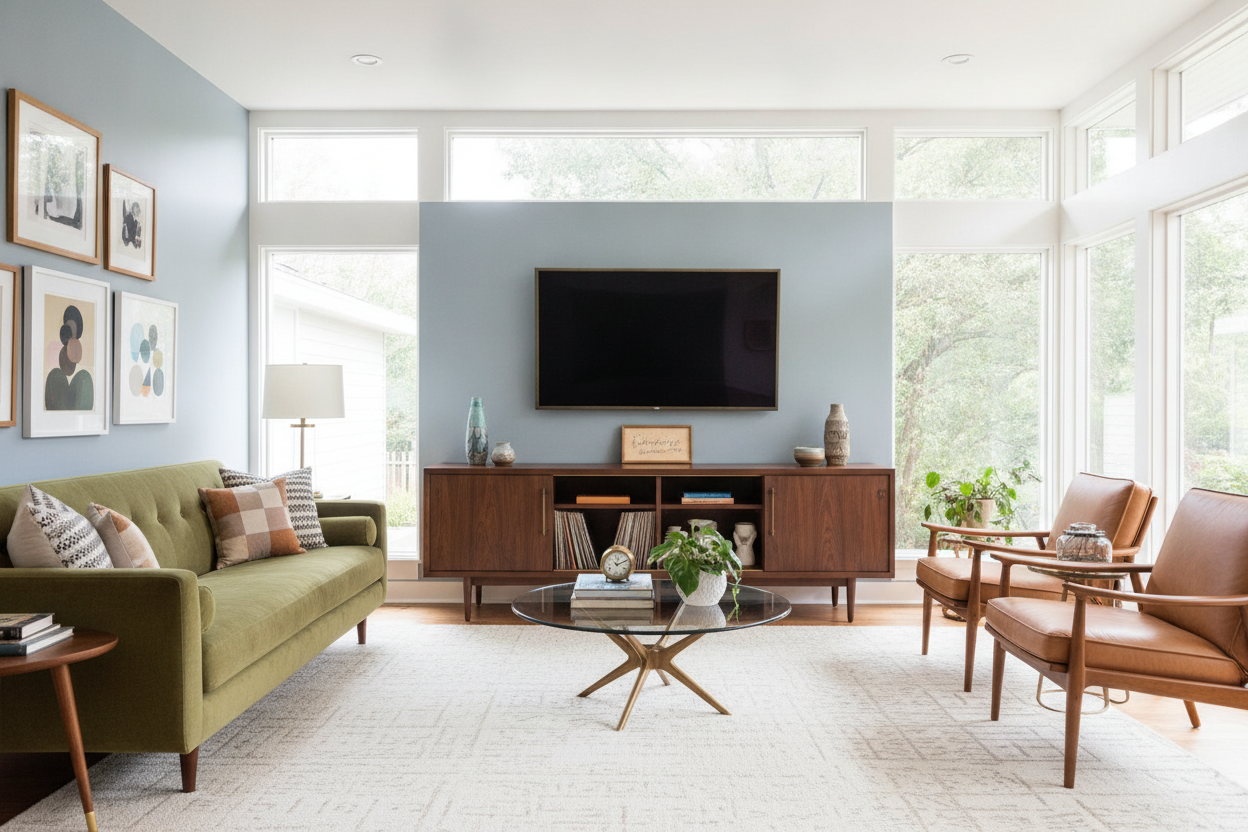
I spent three months scouring Facebook Marketplace for a teak sideboard that didn't smell like a damp basement. I finally found one, hauled it up three flights of stairs, and realized my 65-inch TV looked like a giant black monolith perched on a toothpick. It was a disaster. That’s when I realized a mid century modern tv stand 80 inch isn't a compromise—it's a necessity for anyone living in the era of the home cinema.
- Vintage credenzas are almost always too high (30 inches+), leading to serious neck strain.
- Modern 80-inch consoles provide the 'visual overhang' needed to balance large screens.
- Authentic MCM pieces lack the cable management and ventilation modern tech requires.
- A high-quality reproduction offers the same walnut aesthetic without the antique store markup.
The Brutal Truth About 1960s Living Rooms
Here is the thing about the 1960s: people weren't watching 75-inch 4K displays. They were huddled around tiny boxes in wood cabinets. Because of that, authentic vintage sideboards and credenzas were built to be high. They were designed for storing china or record players, not for ergonomic screen viewing. When you try to repurpose a 32-inch high vintage piece as a media center, your TV ends up sitting way above eye level.
It’s one of the biggest sizing mistakes people make when trying to force an antique into a modern layout. Beyond the height, there is the scale issue. A vintage 60-inch sideboard might look great on its own, but put a modern screen on it and the TV will hang off the edges or look top-heavy. It creates this awkward, cramped energy that ruins the clean lines MCM is supposed to celebrate.
Why You Need to Go Extra Wide (Even for a 65-Inch Screen)
Interior design is mostly just math you can see. There is a rule of thumb called the 2/3 rule: your furniture should be about two-thirds the width of the wall it is against, and your TV should be about two-thirds the width of the stand. If your TV is 65 inches wide and your stand is 65 inches wide, the whole setup looks like it’s about to tip over. It feels 'tight' and stressful.
Opting for a mid century modern tv console 80 inch gives you that crucial 6 to 10 inches of breathing room on either side of the screen. This is where you put the 'soul' of the room—a sculptural vase, a stack of coffee table books, or a small plant. It anchors the wall. If you are mastering the layout of a large living room, that extra width is the difference between a room that looks professionally staged and one that looks like a dorm room.
How I Faked the Vintage Look Without the Antique Store Hassle
I used to be a purist, but I've learned that 'new' doesn't have to mean 'cheap.' When looking for an 80 inch tv stand mid century modern style, I look for three non-negotiables: tapered solid wood legs, mitered joints, and real walnut veneer. You want a finish that shows the grain, not a printed paper sticker that’s going to peel at the corners in six months. I’ve seen enough particle board 'deals' to know that spending a bit more on kiln-dried wood pays off in the long run.
The relief of buying new is real. You aren't bidding against twenty other people on Instagram or driving three hours to a barn in the middle of nowhere. You can actually find a mid century modern tv stand with slatted doors that looks like it was pulled straight from a 1964 Palm Springs estate, but it arrives in a box with all the parts included. No mystery stains, no 'charming' cigarette smells from 1972, and no wobbles you have to fix with a folded-up matchbook.
The Features Vintage Pieces Never Had (But You Desperately Need)
Let’s talk about the back of the unit. Vintage credenzas are solid wood boxes. If you want to put a PlayStation or a cable box inside, you have to take a hole saw to the back panel, which feels like a crime against history. Modern consoles come with pre-drilled cable management ports. It sounds small, but being able to route five different power cords through a single grommet is what keeps your living room looking like a magazine spread instead of a cable nest.
Then there’s the heat. Modern electronics run hot. If you shut a PS5 inside a vintage cabinet with no airflow, you are essentially slow-cooking your console. Modern designs often include slatted doors or ventilated back panels. This allows remote control signals (IR) to pass through the wood and keeps the air moving. If you are ready to stop fighting with your furniture, it is time to browse modern tv stands that actually respect your technology.
Is an 80-inch stand too big for a small apartment?
Not necessarily. Often, one long, low piece of furniture makes a small room feel wider and less cluttered than three small, mismatched pieces. Just measure your wall twice to ensure you have walking clearance.
What is the best wood for a mid-century look?
Walnut is the gold standard for MCM. It has that deep, chocolatey tone and tight grain that defines the era. Teak is a close second, but it tends to be more expensive and harder to match with other furniture.
How high should my TV stand be?
For an 80-inch unit, look for something between 18 and 24 inches tall. This keeps the center of your TV at eye level when you're sitting on a standard 18-inch sofa cushion.

Leave a comment
This site is protected by hCaptcha and the hCaptcha Privacy Policy and Terms of Service apply.