

















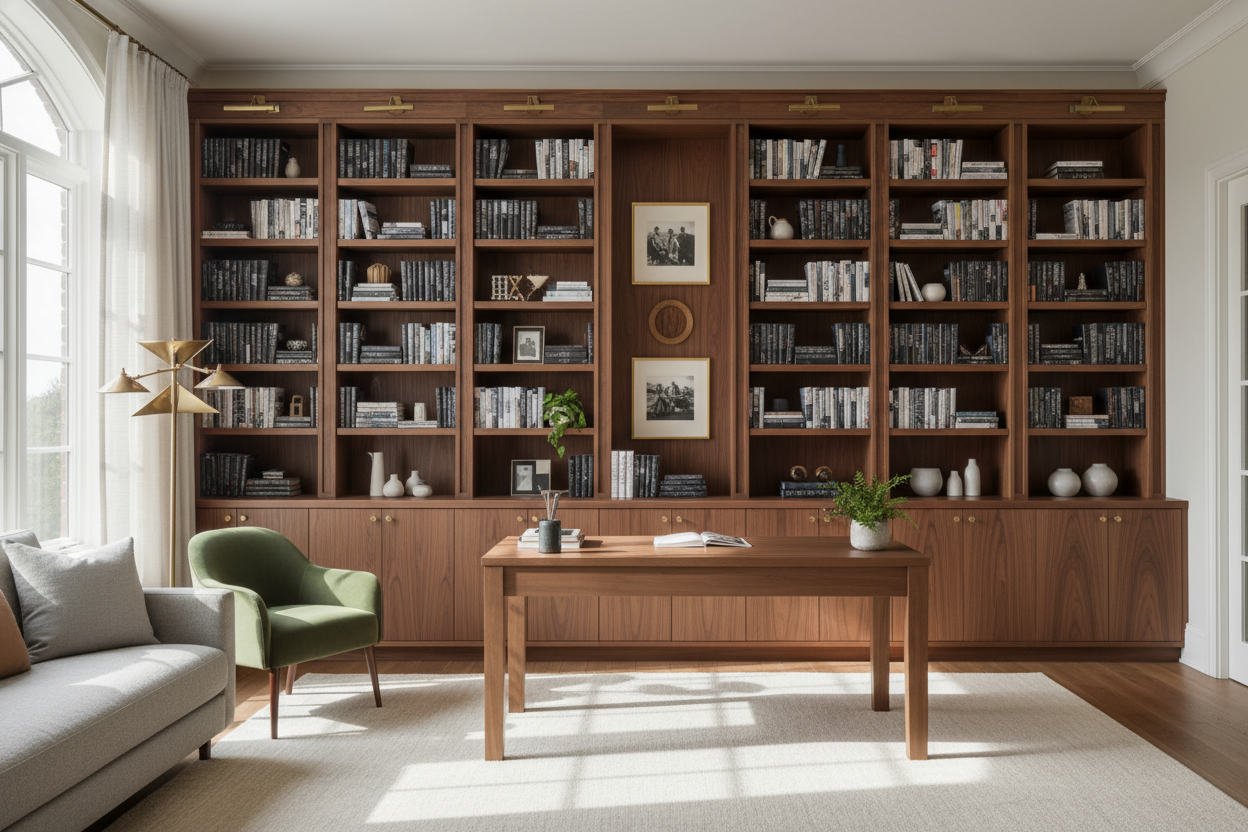
I spent three years staring at a 'temporary' wall of flat-pack shelves that had developed a permanent, sad-looking sag in the middle. Every time I hopped on a Zoom call, I prayed the background blur would hide the fact that my professional library was held together by hope and cam-locks. I finally snapped when a stack of hardcover design books caused the middle shelf to bow so low it looked like a wooden smile. I realized my 'office' looked like a college dorm, and I'm thirty-six. It was time to invest in real carpenter bookshelves.
- Custom units cost significantly more upfront but eliminate the 'buy it twice' cycle of cheap furniture.
- Solid wood spans can handle 50+ lbs per foot without bowing, unlike MDF or particleboard.
- Scribing the units to your specific walls and baseboards is the only way to get a true built-in look.
- Closed storage at the base is non-negotiable for hiding the inevitable cable nests and printer paper.
My Breaking Point with Wobbly Office Furniture
The breaking point came on a Tuesday morning during a high-stakes presentation. I heard a faint 'crack' from the corner of the room. It wasn't the house settling; it was the veneer on my Swedish-made shelves finally giving up. When you work from home full-time, your environment isn't just a backdrop—it is your infrastructure. I was tired of furniture that felt disposable. I wanted something that felt like it was part of the architecture, which is why I started researching custom office bookshelves.
Cheap furniture is designed for the 'average' wall, but no wall is actually straight. My home office has a slight slope in the floor and a crown molding that makes standard tall units look awkward and gappy. I wanted solid wood—kiln-dried poplar for the frames and maple plywood for the boxes—to ensure these things wouldn't warp the second the humidity hit 60 percent. Making the jump to permanent furniture felt like a commitment to my career, moving away from the 'temporary' mindset of my twenties.
The Real Cost of Custom Built Bookcases Cabinets
Let’s talk about the numbers, because this is where most people get cold feet. I reached out to three local woodworkers for quotes on a 10-foot wide, floor-to-ceiling installation. The range was eye-opening. The low-end quote was $3,200 for paint-grade MDF, while the high-end came in at $7,500 for white oak. I eventually settled on a mid-range specialist who quoted $5,400 for custom built bookcases cabinets made from solid poplar and high-grade birch ply.
Why so much? You aren't just paying for wood. You’re paying for the shop time to plane the lumber, the specialized tools to create dovetail joints or clean dados, and the expertise to handle a 100-inch tall installation. Lumber prices have stabilized, but high-quality 3/4-inch plywood still runs $80 to $110 a sheet. My project used twelve sheets plus the face frame material. When you factor in the professional-grade lacquer finish—which is way more durable than the latex paint you buy at the hardware store—the price starts to make sense. It’s an investment in your home’s equity as much as your storage.
Why I Insisted on Closed Storage at the Bottom
One mistake I see people make with custom bookcases and cabinets is going for all-open shelving. It looks great in a curated Instagram photo, but in a real working office, you have junk. You have tax folders, extra printer ink, and a tangle of chargers that look like a bowl of black spaghetti. I insisted on a 30-inch high cabinet section at the base with solid shaker-style doors.
This creates a visual 'anchor' for the room. The bottom doors hide the mess, while the top shelves showcase the books and art. Before I went the custom route, I spent weeks looking at various bookcases display cabinets online. Many of them were beautiful, but they rarely fit the wall perfectly from edge to edge. By going custom, I was able to have the carpenter build a hidden 'chase' behind the lower cabinets to run all my power strips and internet cables. No more visible wires trailing down the wall.
The Messy Reality of Installation Day
If you think hiring a pro means a clean, quiet afternoon, you’re in for a shock. Even though most of the custom bookshelf cabinets were built in the carpenter's shop, the final 'fitting' happens in your room. There is sawdust. There is the high-pitched whine of a table saw on your driveway. There is the smell of wood glue and caulking. It took two full days to get the units leveled, shimmed, and trimmed out.
My carpenter spent four hours just on the 'scribing' process—this is where they shave the side of the cabinet to perfectly match the curve of your wall. It’s a tedious, dusty process, but it’s the difference between a piece of furniture that looks like it was dropped in the room and one that looks like it grew out of the walls. My advice? Move your computer and any delicate electronics to a different room entirely during the install. The fine dust gets everywhere, no matter how many drop cloths they use.
Faking It: When You Can't Afford the Real Deal
I realize that five grand for shelving isn't in everyone's budget, especially if you’re renting. If you can't commit to a permanent installation, you can still achieve a custom built in look by using a few tricks. The key is height and trim. Most retail shelves stop at 72 inches, which leaves a weird 'dead zone' at the top that gathers dust and looks cheap.
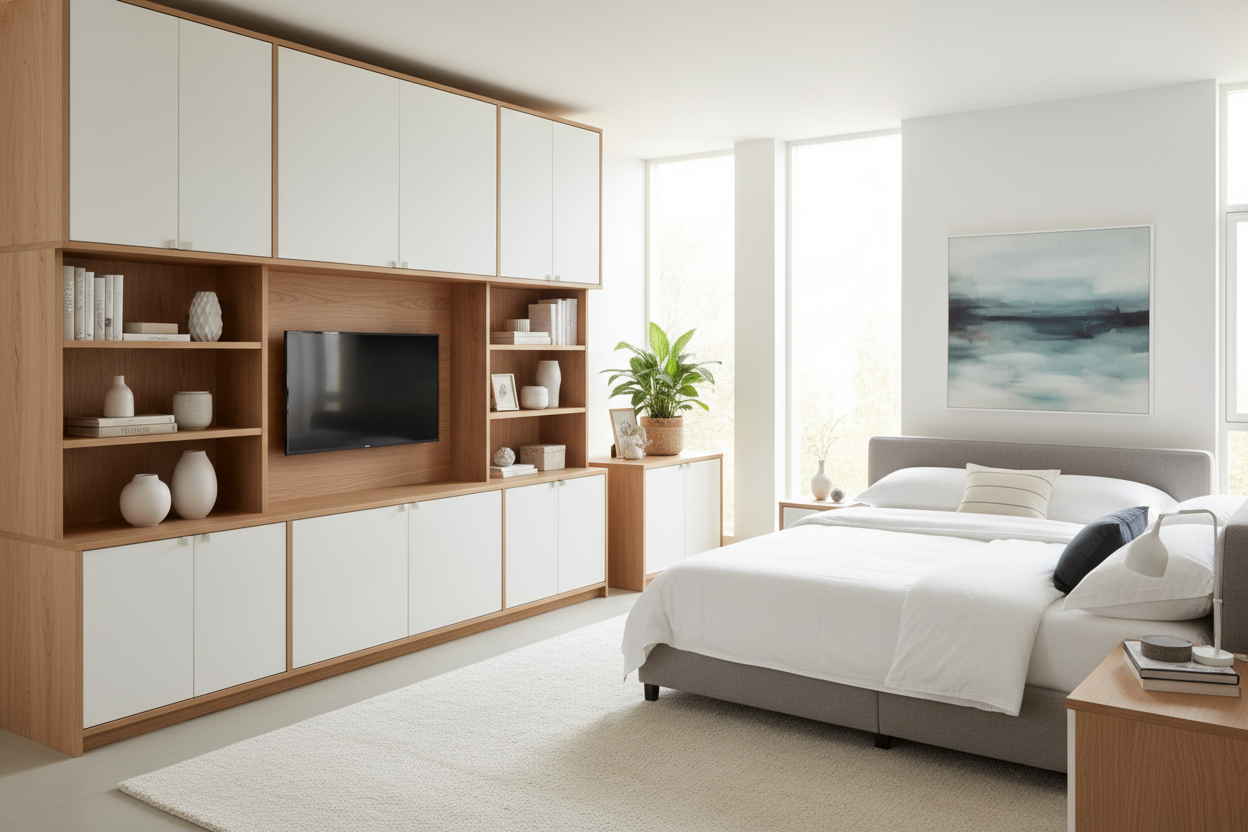
Look for something with more presence. A modern tall bookcase with dual cabinets can give you that essential 'mullet' storage (business on top, hidden mess on the bottom) without the permanent price tag. If you buy three of them and line them up, then add a simple piece of crown molding across the top of all three, you can trick the eye into seeing a single architectural unit. It won't be as rock-solid as a carpenter-built piece, but it beats the 'wobbly smile' of cheap particleboard any day.
How much weight can custom wood shelves hold?
A 3/4-inch solid wood shelf can typically hold 40-60 pounds per linear foot without noticeable sagging, depending on the wood species and how it is supported. This is roughly double what most flat-pack furniture can handle.
Do built-in bookshelves add value to a home?
Yes. Appraisers often view high-quality built-ins as a permanent upgrade to the home's 'finish level.' In a home office, custom shelving is a major selling point for remote workers who want a professional background.
What is the best wood for painted bookshelves?
Poplar is the industry standard for paint-grade projects. It’s a hardwood that is relatively affordable, takes paint beautifully, and is much more stable than pine, which tends to bleed sap through the finish over time.

Leave a comment
This site is protected by hCaptcha and the hCaptcha Privacy Policy and Terms of Service apply.