

















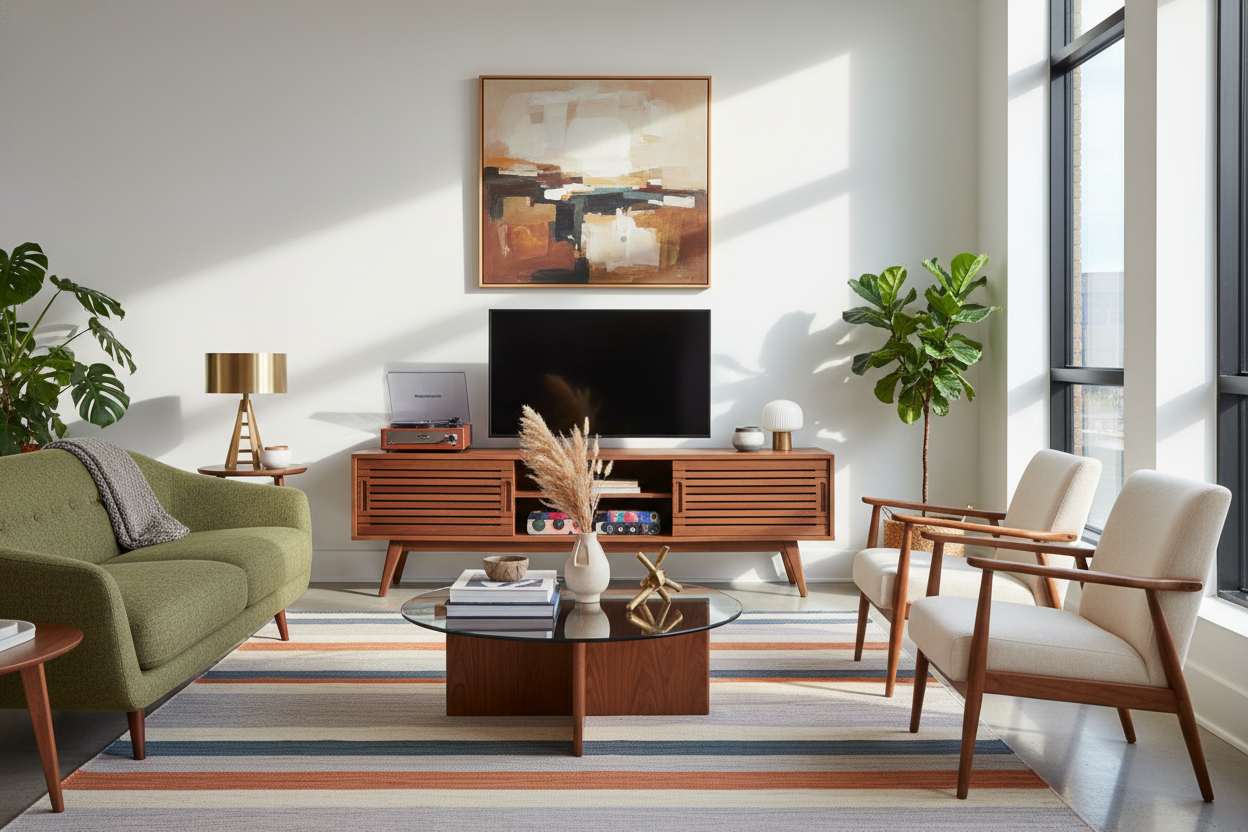
I spent my entire twenties living in apartments filled with 'disposable' furniture. You know the kind: the flat-packed boxes that weigh eighty pounds, smell like formaldehyde, and start to peel at the corners if you so much as look at them with a glass of water. My last media console was a grey-wash particle board unit that cost $120. By year two, the middle was sagging under the weight of my 55-inch TV, and the 'wood' grain was literally a sticker that was bubbling off the edges. It looked like a college dorm remnant, even though I was thirty.
Last year, I finally hit my breaking point and decided to invest in a real walnut mid century modern tv stand. I wanted something that didn't just hold my tech, but actually anchored the room. There is a massive difference between a piece of furniture that just 'functions' and one that makes you feel like an actual adult when you walk through the front door. This was the single purchase that stopped my living room from looking like a temporary staging area and started making it feel like a home.
Quick Takeaways
- Real walnut offers a depth of color—think honey, chocolate, and charcoal—that printed paper finishes can never replicate.
- Tapered legs are your best friend in small spaces because they let you see the floor underneath, making the room feel less crowded.
- Always check the back panel; cheap units use flimsy cardboard, while high-quality stands use finished plywood with proper cord cutouts.
- Slatted doors are the ultimate hack for hiding ugly cable boxes while still allowing your remote control signals to pass through.
The Dark Days of Peeling Fast-Furniture Consoles
For years, I convinced myself that it didn't matter what the TV sat on. It’s just a rectangle to hold another rectangle, right? Wrong. Every time I sat down to watch a movie, my eyes would wander to the chipped corner of my old console. It was depressing. It felt like I was living in a waiting room. The problem with fast furniture isn't just that it breaks; it's that it has no soul. It’s mass-produced to be as cheap as possible, which usually means using 1.2 lb density MDF that can't handle the humidity of a standard summer without warping.
When I finally decided to upgrade your current tv stand, I realized I was looking for an 'anchor piece.' In interior design, an anchor is the heavy hitter that sets the tone for the rest of the furniture. If your TV stand is high-quality, your $300 IKEA sofa suddenly looks a lot more expensive by association. I spent weeks measuring my wall, realizing that a 70-inch console on an 8-foot wall provides that perfect 'breathing room' on either side. I wanted something that felt permanent, something that would survive a move without the cam-locks ripping out of the pre-drilled holes.
Why Authentic Walnut is the Ultimate Mid-Century Flex
There is something about the specific warmth of a mid century modern tv stand walnut finish that nothing else can touch. Oak can feel too country, and black-stained wood often looks like a bachelor pad from 2004. Walnut, however, has this incredible range of tones. In the morning light, it looks golden; at night, under warm lamps, it turns into a rich, dark espresso. It’s the most timeless wood choice because it plays well with both cool greys and warm beiges.
I’ve read a lot about what designers actually think, and the consensus is usually that walnut is the gold standard for the MCM era. It’s a hardwood, meaning it’s dense and durable. Unlike pine, which dings if you drop a TV remote on it, walnut can take a bit of a beating. My cat has done high-speed sprints across the top of my new console, and there isn't a single claw mark in sight. That’s the difference between a 0.5mm paper veneer and a 2mm thick walnut veneer over a solid core.
Spotting the Fakes: Good Veneer vs. Bad Plastic
Shopping for a walnut mid century tv stand online is a minefield. You’ll see prices ranging from $150 to $3,000, and in the photos, they all look suspiciously similar. Here is the trick: look at the grain patterns. If the grain repeats perfectly every six inches, you’re looking at a printed 'photo' of wood glued onto sawdust. Real wood grain is chaotic and unique. If you see 'wood-grain finish' or 'walnut color' in the description, run away. You want to see the words 'solid walnut' or 'walnut veneer on kiln-dried hardwood.'
I learned the hard way about what most stores won't tell you regarding weight limits. A lot of those cheap units are only rated for 50 pounds. A modern 65-inch OLED might only weigh 45 pounds, but as soon as you add a soundbar, a PlayStation, and a few heavy coffee table books, you’re in the danger zone for bowing. My walnut piece is rated for 150 pounds, and it feels like a tank. When I push on the center, there is zero flex. That’s the peace of mind you’re paying for.
My Favorite Secret Feature: Slatted Wood Doors
The biggest struggle with a walnut tv stand mid century design is usually the tech. MCM design was perfected in the 1950s, long before we had bulky routers, messy cable boxes, and tangled HDMI cords. My favorite solution is the slatted door. It looks like a solid piece of wood from an angle, but it’s actually individual strips of walnut with tiny gaps between them. This allows the heat from my Xbox to escape so it doesn't melt, and more importantly, it lets the IR signal from my remote reach the components inside.
I specifically looked for a tv stand with slatted doors because I hate seeing wires. There is nothing that ruins a 'grown-up' living room faster than a black spaghetti mess of cables hanging down the wall. My unit has internal cable management channels that let me snake everything through the legs and out the back. It’s clean, it’s organized, and it makes the whole room feel calmer. I did make one mistake, though: I didn't measure the height of my center-channel speaker, so I had to remove one internal shelf to make it fit. Measure your gear twice, folks.
How to Avoid the 'Retro Theme Park' Living Room
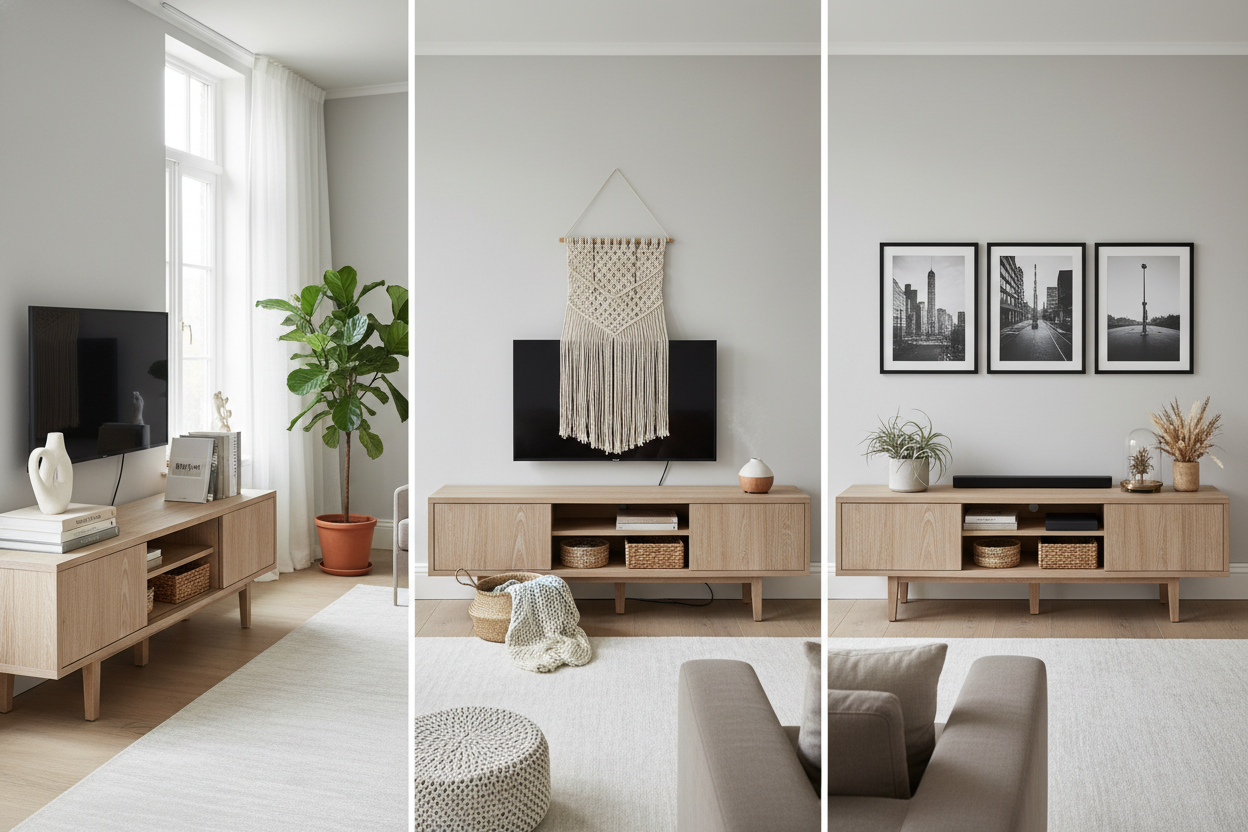
One danger of buying a mid century modern walnut tv console is that you can accidentally make your house look like a Mad Men set. Unless you want to live in a museum, you have to mix the eras. I paired my walnut stand with a very contemporary, chunky knit rug and some matte black metal lamps. The organic warmth of the wood balances out the cold metal and soft fabric. It’s about contrast.
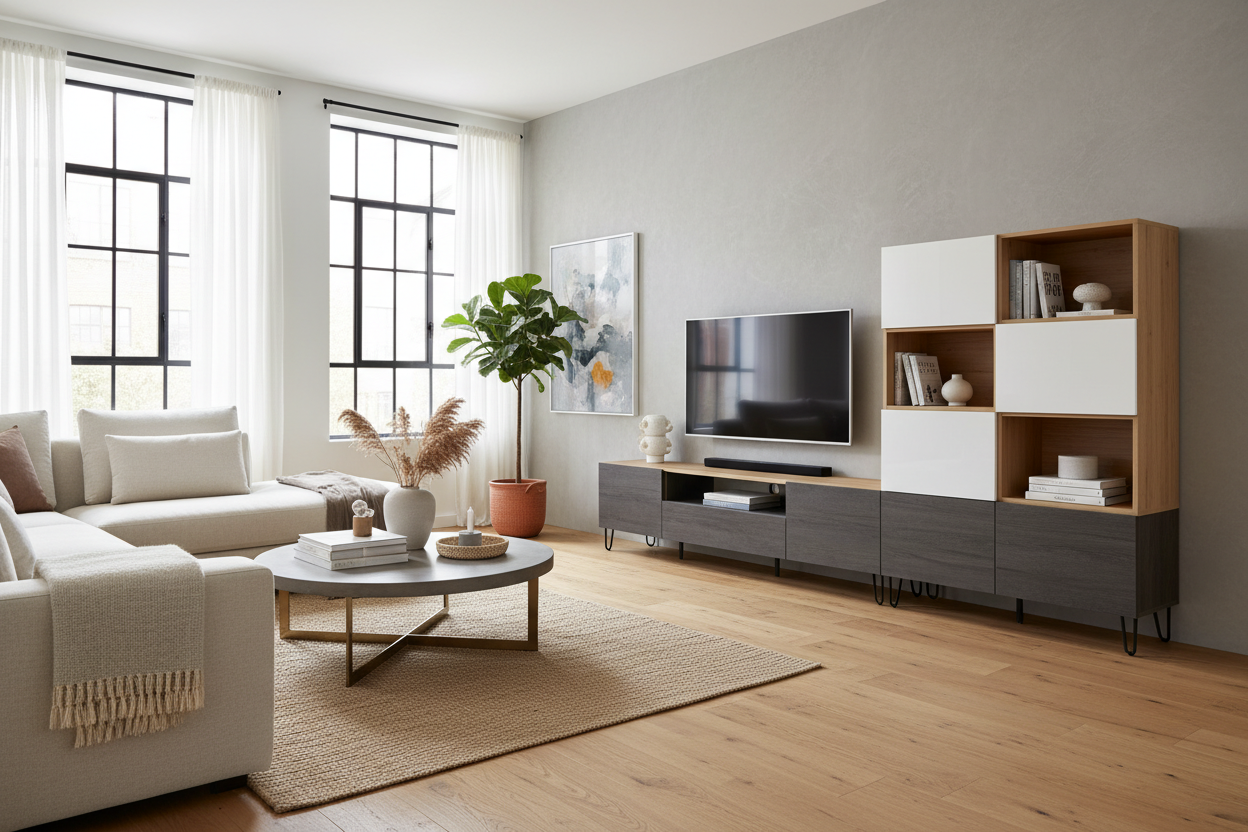
If you’re worried that the classic tapered-leg look is a bit too 'on the nose,' you can always opt for a minimalist dark walnut tv console. These versions often have a lower profile and cleaner lines without the flared legs, which feels a bit more 2024 and a bit less 1962. Personally, I love the legs because they make cleaning easier—my robot vacuum can actually get under there and get the dust bunnies, which never happened with my old floor-skimming unit. It’s a small detail, but it’s one of those things you appreciate every single day.
FAQ
Is walnut hard to maintain?
Not really. Don't use those greasy aerosol sprays you find at the grocery store; they just build up a waxy film. A slightly damp microfiber cloth is all you need for dusting. If the wood starts to look dry after a few years, a quick rub-down with some high-quality furniture oil will bring the luster back instantly.
Will my 75-inch TV fit on a 70-inch stand?
Technically yes, but it will look top-heavy. Ideally, you want your TV stand to be at least 4 to 6 inches wider than your TV on both sides. This creates a visual 'frame' and prevents the setup from looking like it’s about to tip over. For a 75-inch TV (which is about 66 inches wide), look for an 80-inch console.
Does walnut wood change color over time?
Yes, and this surprises people. Most woods like cherry or oak get darker with sun exposure, but walnut actually tends to lighten slightly into a more honey-toned brown over the years. If you keep it in direct, harsh sunlight, the change will happen faster, so try to use curtains during the peak UV hours of the day.

Leave a comment
This site is protected by hCaptcha and the hCaptcha Privacy Policy and Terms of Service apply.