







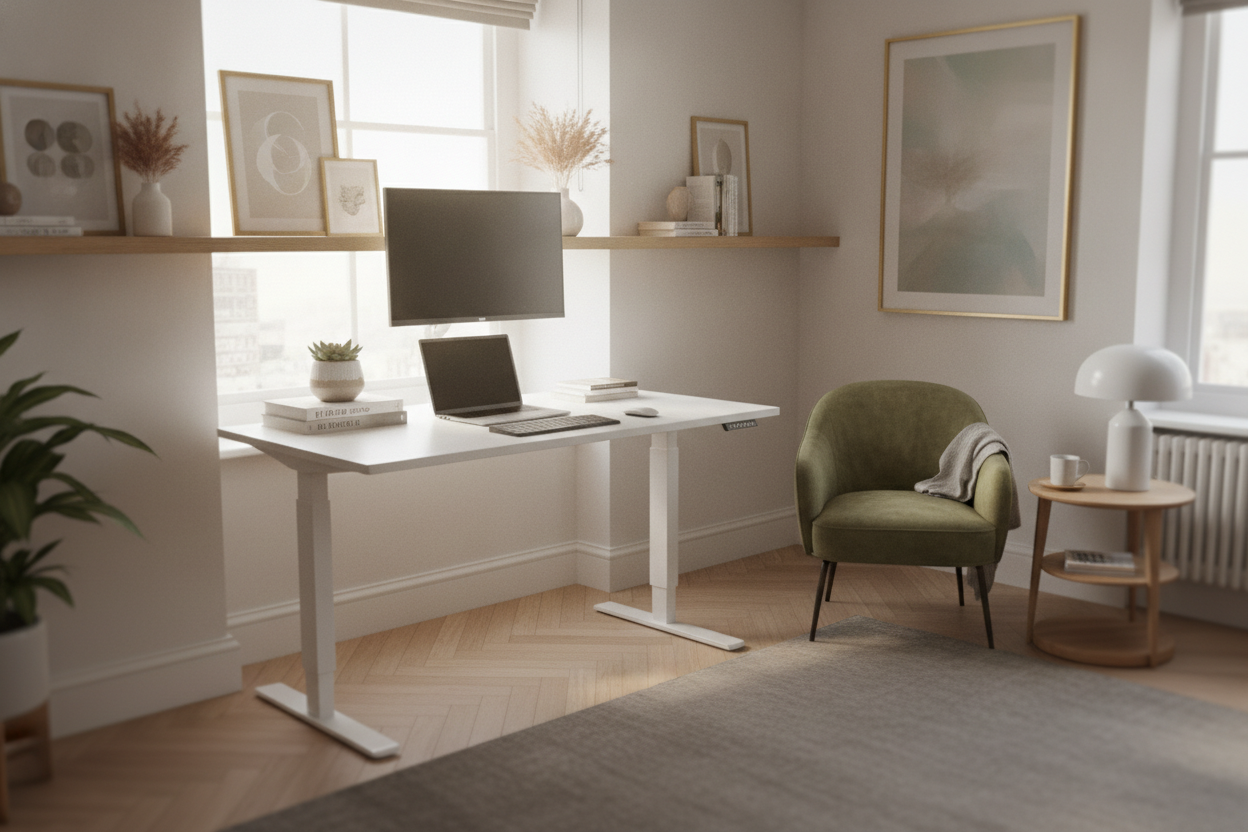
I spent three weeks measuring the same 120cm alcove in my Victorian lounge, convinced that geometry would eventually change if I stared at it long enough. Most office furniture is designed for sprawling suburban basements, not a third-floor walk-up in Hackney where every square inch is a battleground. I needed a standing up desk uk that wouldn't make my living room look like a corporate cubicle farm.
After three failed returns and a lot of bruised shins, I realized the 'standard' size for ergonomic gear is fundamentally at odds with British architecture. You can't just shove a 160cm slab of MDF into a room where the door barely opens 90 degrees. Here is how I finally managed to build a workspace that didn't ruin my back or my interior design.
Quick Takeaways
- Depth is the enemy: Avoid 80cm deep desks unless you want your workspace to eat half your room.
- Go Custom: Buying a frame and a separate top is often the only way to fit a 1.2m alcove.
- Motors are mandatory: Cranking a handle in a tight corner is a recipe for broken knuckles.
- Off-desk storage: Use monitor arms or floor stands to keep your actual desk surface tiny but functional.
The Reality of British Homes vs. Massive Office Furniture
The struggle with uk standing desks is that they are often just rebadged imports designed for the US market. When a manufacturer says 'compact,' they usually mean 140cm. In a Victorian terrace, 140cm is practically a ballroom. I spent months searching for a stand up desk uk that could squeeze into the weird gaps created by chimney breasts and wonky walls.
Most 'ergonomic' solutions assume you have a dedicated room. I have a corner of my bedroom that also functions as a laundry drying zone. Finding a uk standing desk that fits a 1.2-meter alcove without looking like it was salvaged from a call center is surprisingly difficult. You have to stop looking at 'all-in-one' packages and start looking at modular components.
What to Look For When Space is Ridiculously Tight
If you are working with a truly awkward space, stop looking for a finished product. The smartest move I ever made was sourcing a height adjustable desk frame uk separately. This allows you to pick a frame that has a narrow footprint—some go down to 100cm—and then you can get a custom piece of timber cut to the exact millimetre of your gap.
I went to a local timber yard, picked up a piece of kiln-dried oak, and sanded it myself. It cost less than the flimsy chipboard tops sold by most big-box retailers and it actually looks like furniture. When you buy a stand up desks uk as a kit, you're stuck with their dimensions. When you buy the frame alone, you're the boss of your floor plan.
Beware the Depth Trap
This is where most people mess up. They focus on the width but forget the depth. A standard 80cm depth will absolutely ruin the flow of a small room. It juts out into the 'walking zone' and makes the whole space feel cramped. I switched to a 60cm depth, and while I was worried about screen distance, it was a total revelation for the room's layout.
A 60cm profile allows you to tuck the desk into a hallway or a bedroom corner without it feeling like a permanent obstacle course. Just make sure your monitor is on an arm so you can push it back as far as possible to maintain a healthy focal length for your eyes.
Motorized vs. Manual: Don't Compromise on Power
I tried a manual crank desk to save £50 and a bit of electricity. It was a disaster. Because my desk was tucked into a tight corner, I had about 3 inches of clearance to turn the handle. I hit my knuckles on the wall every single time I wanted to stand up. Within a week, I stopped using the standing feature entirely because it was such a chore.
A motorised desk uk is not a luxury; in a small space, it's a functional necessity. You need to be able to transition with zero friction. I eventually upgraded to a desk with a memory preset controller, and it changed everything. Being able to hit a button and walk away to grab a coffee while the desk adjusts itself is the only reason I actually stand for four hours a day now.
My Trick for Reclaiming Tiny Desktop Space
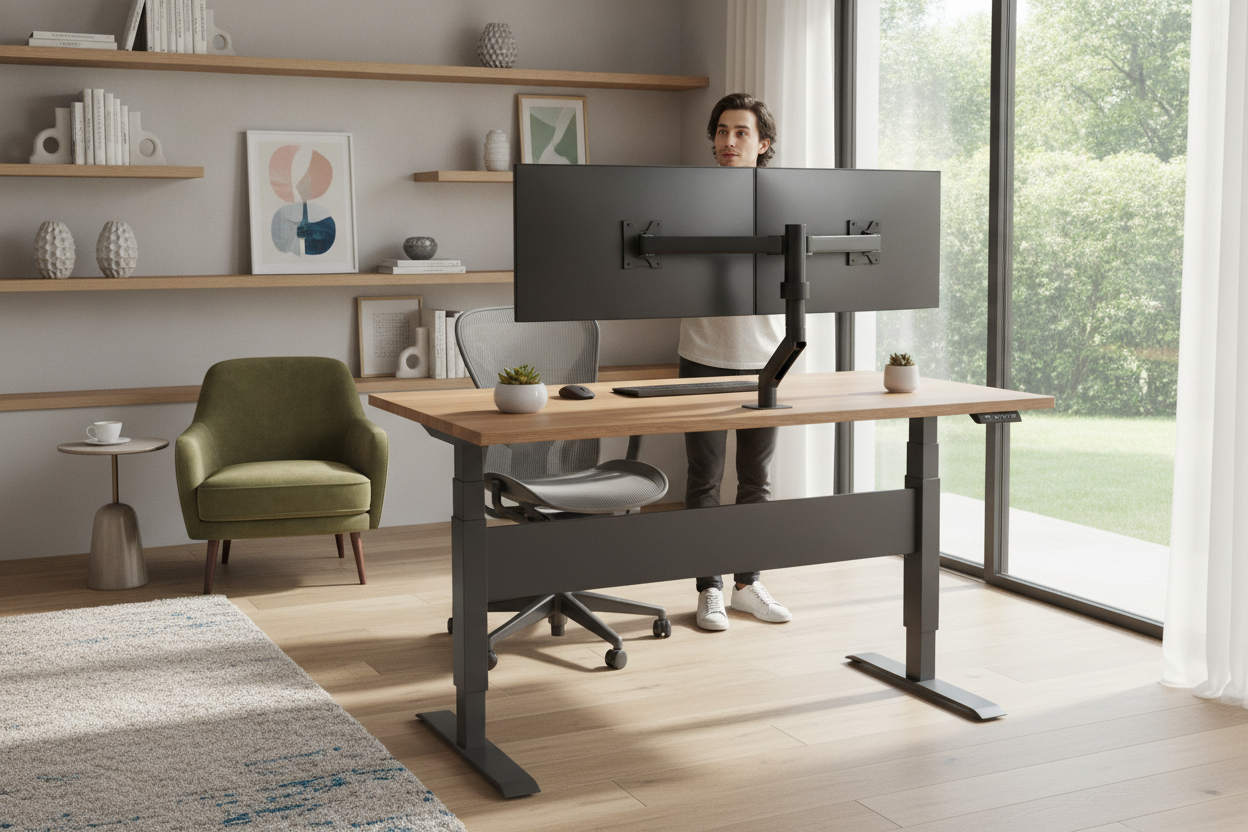
When your desk is only 100cm or 120cm wide, every centimetre of surface area is precious. The biggest space-killer is the monitor stand. Those giant plastic 'duck feet' take up 30% of your usable area. My hack was using a floor stand for monitor screens instead of mounting them to the desk itself.
By getting the heavy screens off the desk, I eliminated the 'wobble' that plagues almost every standing up desk uk at full height. Most desks get a bit shaky when they're extended to 110cm+, especially if you have a heavy 27-inch iMac sitting on top. Moving the screen to a separate floor stand or a wall mount makes the desk feel rock solid and leaves you enough room for a keyboard, a mouse, and—crucially—a cup of tea.
The Final Verdict: Is the Squeeze Worth It?
Setting up a sit stand workstation uk in a tiny flat is a headache, but my lower back doesn't miss the dining room chair one bit. You don't need a massive dedicated home office to make this work. You just need to be ruthless about measurements and avoid the 'one-size-fits-all' approach. Investing in a high-quality height adjustable computer desk uk that actually fits your space is the best career move you'll make this year.
FAQ
Will a standing desk wobble on a carpeted floor?
Yes, more than on hard floors. If you have thick UK pile carpet, look for a frame with heavy steel feet and a wide base. Using a floor-mounted monitor stand also helps isolate the screen from any desk movement while you type.
Can I use a kitchen worktop as a desk top?
Absolutely, but watch the weight. Kitchen slabs are often 38mm thick and very heavy. Ensure your motorized frame has a weight capacity (usually 70kg-100kg) that can handle both the heavy wood and your gear.
Is 60cm depth enough for a laptop?
It's perfect for a laptop. If you use a large external monitor, it might feel a bit close. Using a monitor arm to 'float' the screen slightly behind the back edge of the desk is the best way to make a shallow desk work.


Leave a comment
This site is protected by hCaptcha and the hCaptcha Privacy Policy and Terms of Service apply.