

















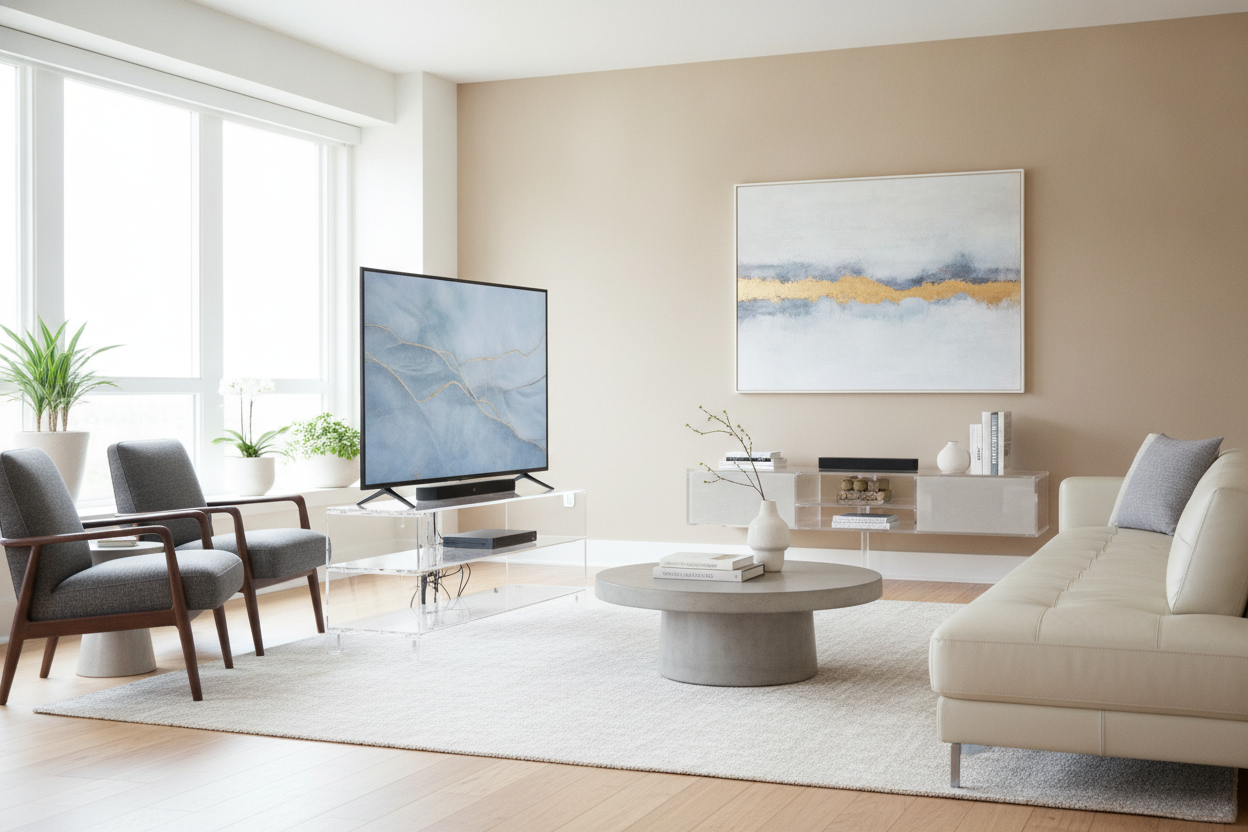
I spent three hours trying to shove a massive, 70-inch walnut credenza into my apartment’s service elevator, only to realize it made my living room look like a storage unit. My 400-square-foot studio was already gasping for air, and that heavy block of wood was the final blow. I spent weeks staring at 47 browser tabs of media furniture at 2 AM before I finally took a leap on an acrylic tv stand. I was terrified it would look like a cheap dorm room or, worse, a tangled nest of exposed wires.
Quick Takeaways
- Acrylic furniture eliminates visual weight, making small rooms feel significantly larger.
- Cable management is the make-or-break factor for any transparent setup.
- Plexiglass is safer and lighter than glass, especially if you have pets or kids.
- Mixing textures like wood or ceramic prevents the 'invisible' furniture from looking too cold.
Why I Finally Evicted My Bulky Wood Console
For years, I believed that a contemporary wooden tv stand was the only way to make a living room look 'adult.' I wanted that mid-century vibe with the tapered legs and the solid presence. But in reality, that 'solid presence' was just a giant dark rectangle that ate up four feet of floor space and cast a shadow over my rug. It was a visual anchor in the worst way possible. Every time I walked into the room, my eyes stopped right at the console instead of flowing through the space.
The search for a clear tv stand started out of desperation. I needed something that could hold a 55-inch OLED without claiming its own zip code. My friends thought I was crazy—they warned me about fingerprints and the '90s mall aesthetic—but I was convinced that transparency was the answer to my claustrophobia. I didn't just want a place for my TV; I wanted my floor space back. I wanted a clear acrylic tv stand that would basically disappear when I wasn't looking directly at it.
The 'Invisible Furniture' Trick Actually Works
The first thing you notice when you swap a solid unit for a modern acrylic tv stand is that your rug suddenly looks twice as big. Because you can see the baseboards and the floor through the acrylic media console, your brain registers that space as 'open' rather than 'occupied.' It’s a classic interior design hack that actually holds up in real-world testing. I’m currently using a U-shaped acrylic tv table that is about 1/2 inch thick, and the lack of vertical supports or heavy doors is a revelation.
Unlike a traditional acrylic entertainment center that might have bulky shelves, a minimalist clear tv stand allows light to pass through from the windows. No more dark corners where dust bunnies hide in the shadows of a mahogany cabinet. If you’re really tight on space, an acrylic tv stand on wheels is even better because you can pivot the screen for kitchen viewing and then tuck it back against the wall when you're done. It’s about removing the visual barriers that make an apartment feel like a series of small boxes.
The Elephant in the Room: Hiding Cords on a Clear TV Stand
Let’s be honest: a tv stand transparent setup is a nightmare if you’re lazy with cables. If you just let your HDMI and power cords dangle, your living room will look like the back of a server rack. The secret to making a clear glass television stands or acrylic equivalent work is aggressive cable management. I spent an entire Saturday morning with a roll of white Velcro ties and a pack of adhesive cable clips, and I don't regret a single second of it.
First, I routed all the cables down the back of the TV's own legs. Most modern TVs have a little groove for this. Then, I used a white cable sleeve that matched my wall color perfectly. Instead of a black wire hanging in space, I had a single, neat white cord that blended into the paint. For the power strip, I tucked it into a decorative ceramic lidded box on the bottom shelf. From the front, it just looks like a curated object. If you’re using a clear glass tv stand, you can also use frosted window film on just the back panel to hide the 'guts' of your tech while keeping the rest of the unit see-through. It takes effort, but the payoff of a clean, floating look is worth the cord-wrangling headache.
Acrylic vs. Glass: Why I Skipped the Shatter Risk
When I was shopping, I briefly considered clear glass television stands, but I quickly pivoted to a plexiglass tv stand. Why? Because I’m clumsy, and I have a 15-pound cat who thinks every flat surface is a launching pad. Acrylic (or Lucite) is significantly more impact-resistant than tempered glass. If I accidentally bump the corner with a vacuum, a lucite tv stand might get a tiny scratch, but it won't shatter into a thousand dangerous shards. It’s also about half the weight of glass, which made assembly a one-person job instead of a back-breaking ordeal.
Acrylic also has a 'warmer' feel to the touch and doesn't have that distinct green tint on the edges that cheap glass often exhibits. If you really can't handle the maintenance of acrylic—it does attract dust like a magnet—you might consider a media console with glass doors. It gives you a bit of that reflective, airy quality while hiding the mess behind the doors. But for the true 'floating' effect, nothing beats a high-quality acrylic tv console.
How to Style Lucite Without Looking Like a '90s Dorm
The danger with an acrylic tv stand is that it can feel a bit cold or 'plastic' if you don't ground it. To avoid the 1998 Britney Spears music video look, you need to layer in some organic textures. I styled mine by placing a stack of heavy, matte-finish coffee table books on the bottom shelf. The weight of the books provides a nice contrast to the lightness of the lucite tv stand. I also added a small wooden tray to hold my remotes, which adds a much-needed touch of warmth to the modern acrylic tv stand.
This aesthetic actually leans into the trend of the post modern tv stand, where we see a mix of high-gloss plastics and natural materials. I’ve found that placing a potted plant nearby—where the leaves can be seen through the stand—really sells the 'invisible' look. It turns a piece of utility furniture into a design statement. Just remember to use felt pads under everything you place on the stand. Acrylic is durable, but it’s not invincible to scratches from a rough ceramic bottom.
FAQ
Does an acrylic TV stand scratch easily?
It’s more prone to fine surface scratches than glass. Never use paper towels or Windex to clean it—only a soft microfiber cloth and a dedicated acrylic cleaner like Novus. Use felt pads under any decor to prevent scuffs.
How much weight can a clear tv stand actually hold?
It depends on the thickness. A high-quality unit made of 1/2-inch or 3/4-inch acrylic can usually support 50 to 80 pounds. Always check the manufacturer's specs before putting a heavy 75-inch TV on one.
Will it turn yellow over time?
High-quality acrylic (Lucite) is UV-stable and won't yellow if it's kept indoors. Cheap, knock-off plastics might, but if you're buying a proper furniture-grade plexiglass tv stand, it should stay crystal clear for years.

Leave a comment
This site is protected by hCaptcha and the hCaptcha Privacy Policy and Terms of Service apply.