
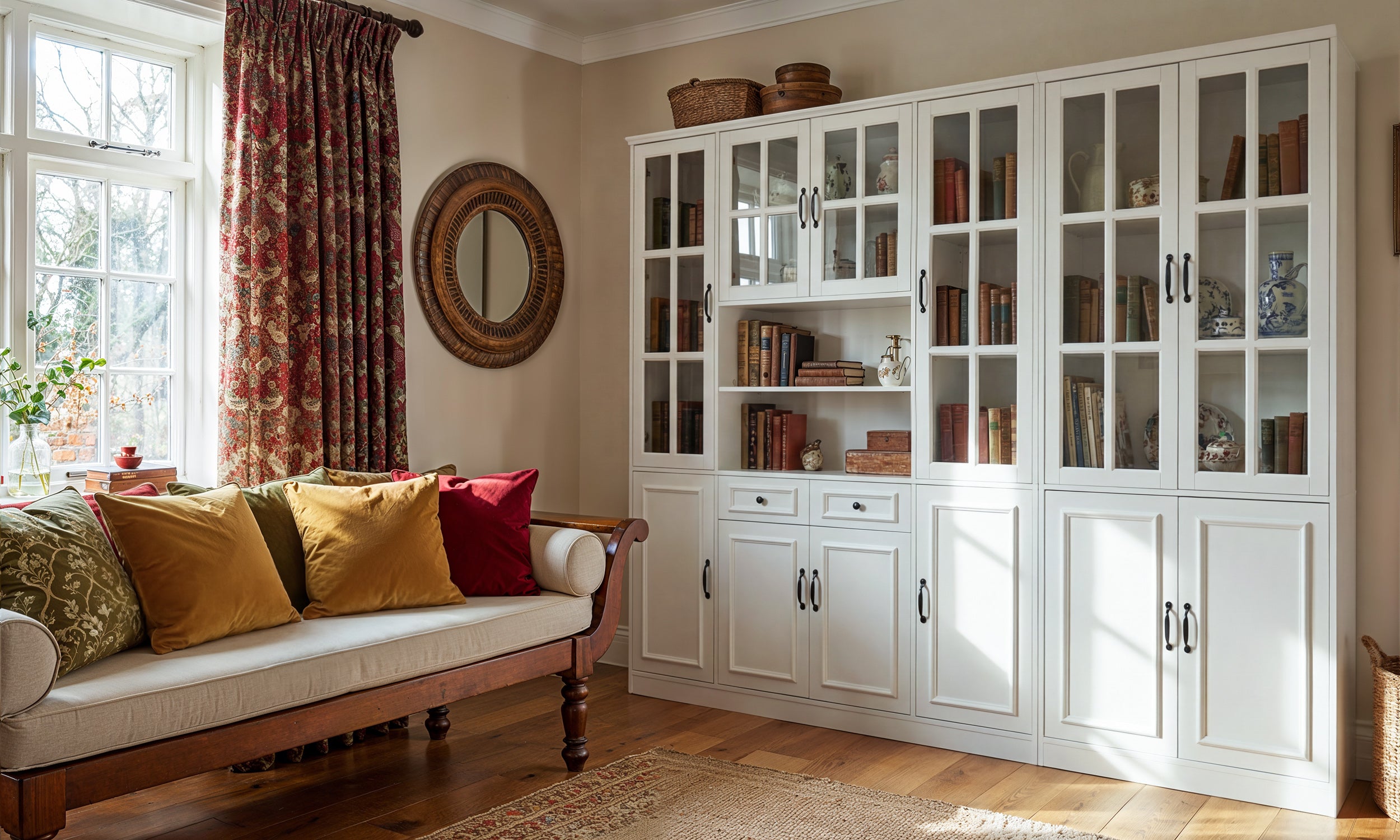
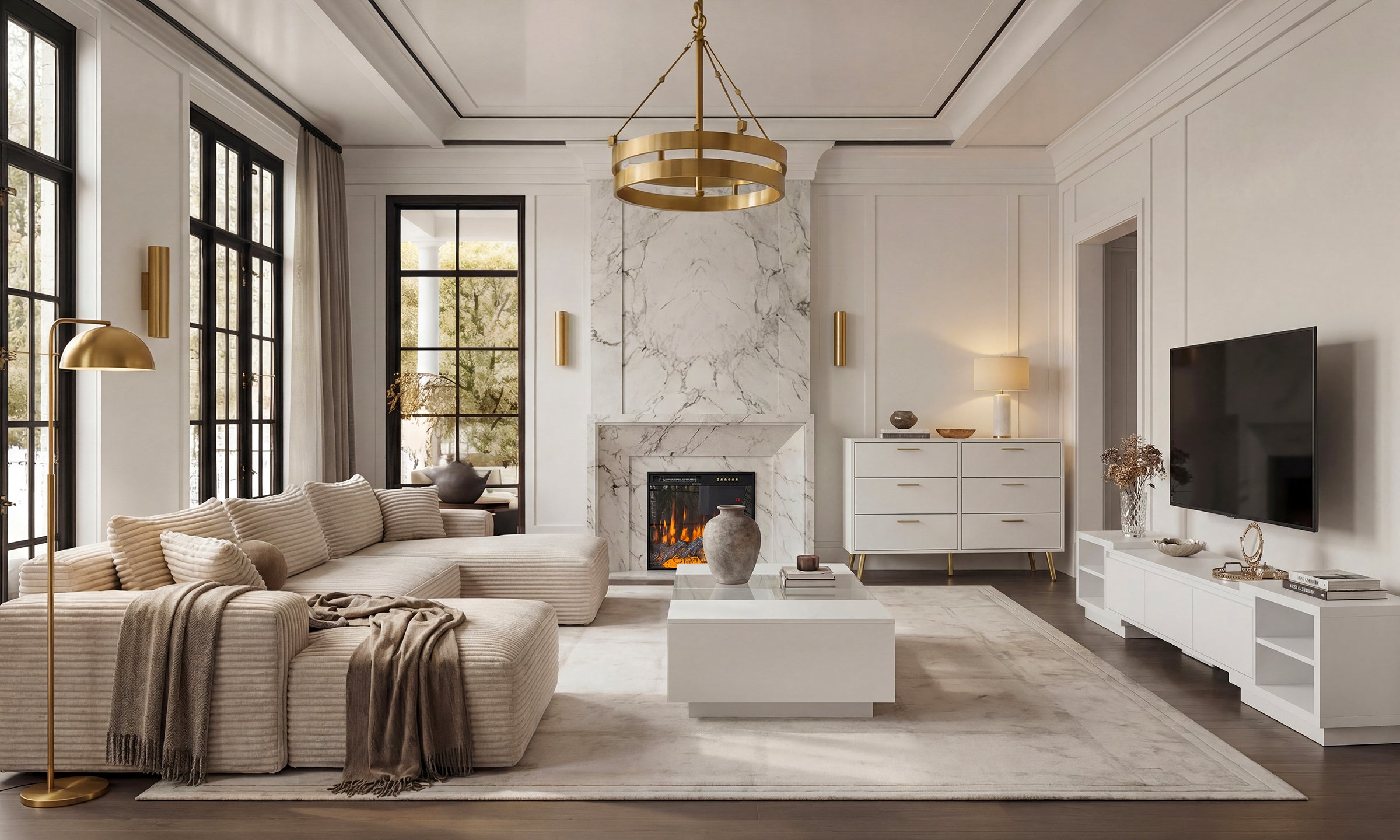
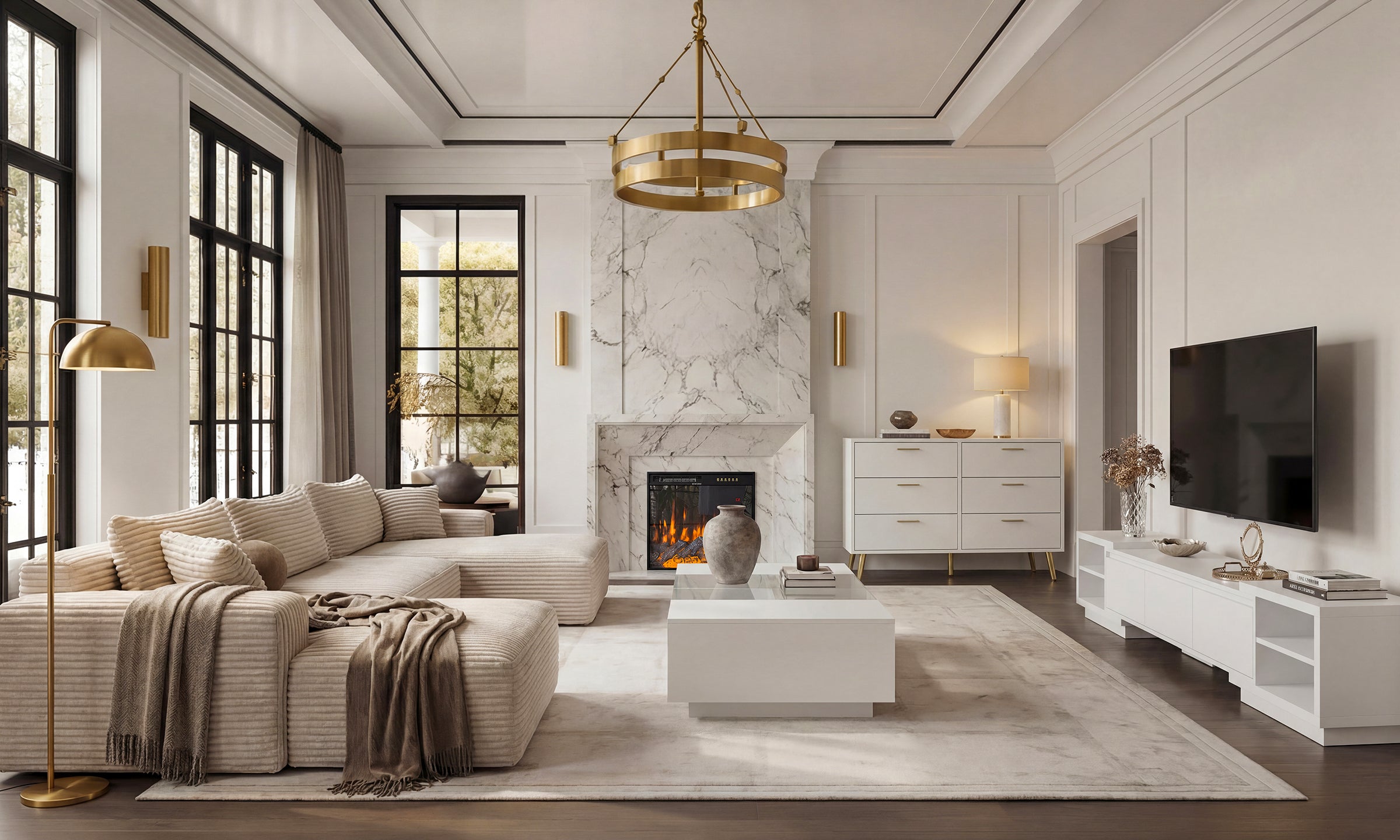


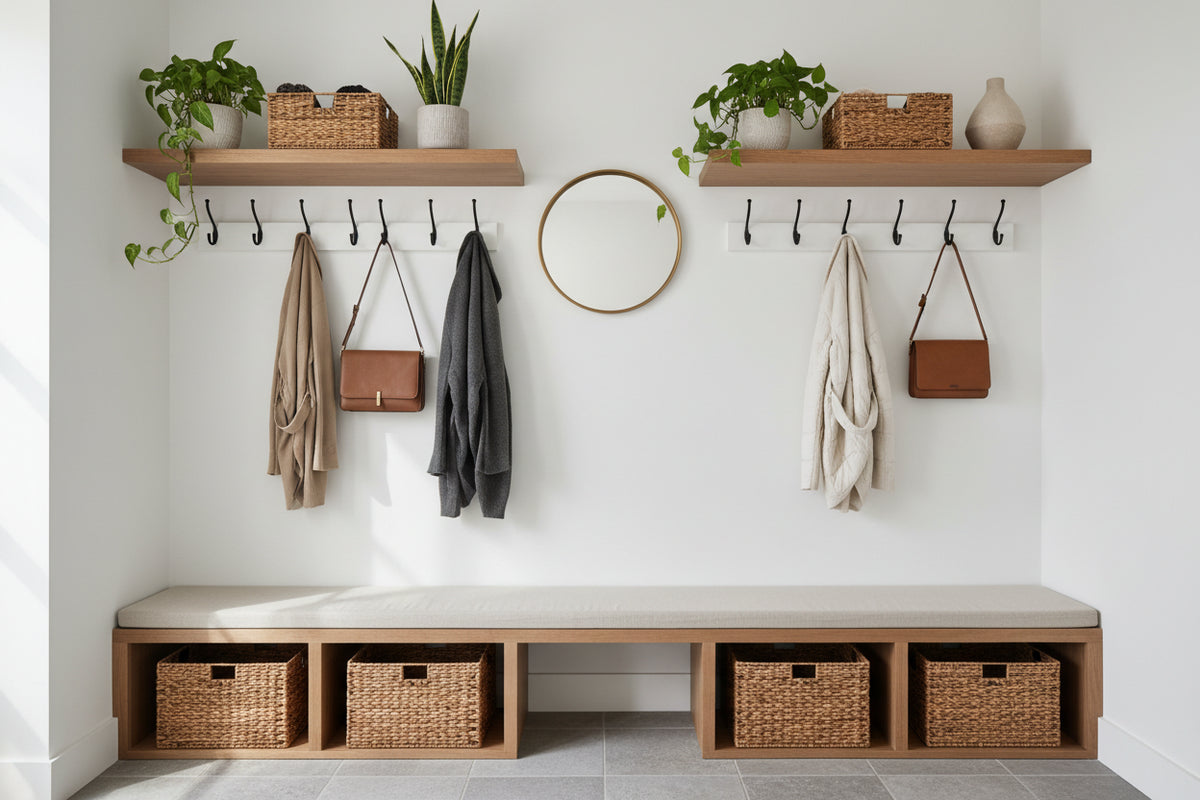
An entryway wall organizer gives everything that comes through the front door a fixed place: hooks for coats and bags, a shelf or cubbies for small things, a spot for keys and mail, and somewhere to sit or drop shoes below. Choose a wall-mounted rail with a shelf when the floor is tight, and a freestanding hall tree when you cannot drill much or want hooks, a bench and shoe storage in one piece.
Below: heights, spacing, walkway depth, mounting, what goes where, and six picks from the FUFU&GAGA hall tree collection and our slim shoe cabinets.
Quick answer
- Adult hooks: about 60 inches from the floor; children's hooks 36, 40 or 44 inches by age.
- Spacing: about 6 to 10 inches between hooks.
- Walkway: keep about 36 inches clear in front of the wall.
- Mounting: studs where you can, otherwise at least two anchors rated well above the load.
- Freestanding pieces: anchor a hall tree or tall shoe cabinet with its tip restraint.
What does an entryway wall organizer include?
It can be a row of hooks under a shelf, a unit with a key rack, mail slot and cubbies, or a hall tree: a tall freestanding frame with hooks, a bench and shoe storage. The best setups cover four zones: hanging (coats, bags, leashes), a landing surface (keys, wallet, mail), a seat, and shoe storage at floor level.
Wall-mounted organizer or hall tree?
| Point | Wall-mounted rail or shelf | Freestanding hall tree |
|---|---|---|
| Floor space | Leaves the floor clear | The hall trees below are 15.8 to 16.5 inches deep |
| Hook height | You choose it, and can add a children's row | Fixed by the frame |
| Seat and shoes | Needs a separate bench or cabinet | Built in |
| Drilling | The fixings carry the full load | A small tip-restraint fixing; the floor carries the weight |
Many entries combine both: a slim shoe cabinet or small bench on the floor, with a hook rail and shelf above it at heights you choose. For hall tree widths and types, see our hall tree buying guide.
How high should an entryway wall organizer be?
No building code sets a hook height for homes, so these figures come from reference sources. Hunker says that "installed at 5 feet on a wall, the average adult and a school-aged child are able to reach the hooks on a wall-mounted rack", adjusted up or down as needed (Hunker). Wikipedia gives 150 to 180 cm, about 59 to 71 inches, for an adult rack, and hook spacing "between 150 and 250 mm", about 6 to 10 inches (Wikipedia).
For children, the 2010 ADA Standards give advisory reach limits "where building elements such as coat hooks, lockers, or operable parts are designed for use primarily by children" (U.S. Access Board, section 308).
| Element | Height from the floor | Source |
|---|---|---|
| Adult hooks | About 60 in; range 59 to 71 in | Hunker; Wikipedia |
| Children's hooks | 36 in max (ages 3 and 4), 40 in (5 to 8), 44 in (9 to 12) | ADA advisory 308.1 |
| Hook for a wheelchair user | 15 to 48 in | ADA 308.2.1 |
| Hat rack above the hooks | About 170 to 180 cm (67 to 71 in) | Wikipedia |
Hooks set close together look neat when empty, but winter parkas then overlap and hide the shelf above, so use the wide end of the spacing range for bulky coats. Hooks over a bench also need to clear a seated head and keep long coats off the seat; our coat hook height guide works through that arithmetic.
How much depth can it take from the walkway?
The 2021 International Residential Code sets the minimum residential hallway width at 3 feet, in section R311.6 (Building Code Trainer). For the space left beside furniture, the ADA guide to accessible routes calls for a "minimum 36″ continuous clear width" (U.S. Access Board guide). That rule is for public buildings, but 36 inches is a sensible target at home. Add it to the depth of the piece against the wall:
| Piece | Depth | Hallway width for 36 in clear |
|---|---|---|
| Slim flip-drawer shoe cabinet | 9.4 in | 45.4 in |
| 24-inch shoe bench | 12 in | 48 in |
| 63-inch hall tree | 15.8 in | 51.8 in |
| 34.3-inch hall tree | 16.5 in | 52.5 in |
Coats hang out past the hooks, so treat these as minimums. Wall shelves raise one more point: the ADA Standards limit objects "with leading edges more than 27 inches and not more than 80 inches above the finish floor" to 4 inches of protrusion into a circulation path, because a cane may not detect them (U.S. Access Board, section 307). In a narrow hall, keep wall shelves shallow and put the deep storage low.

How do you mount it so it holds?
Several winter coats and a school bag add up quickly, so weigh your heaviest bag on a bathroom scale first.
- Use studs. Hunker advises securing a rack "to wall studs, if available, for maximum security no matter how many heavy coats hang from the rack".
- No stud? Use several anchors. The same guide says: "If a stud is not available, install at least two sturdy wall anchors, or more if the rack is more than 2 feet long."
- Read the rating as a maximum. One anchor maker lists the ultimate load from laboratory tests, then adds: "Industry safety standards recommend 1/4 of that ultimate load as a reasonably safe working load for each installed anchor" (TOGGLER FAQ). By that rule, an anchor tested to 100 lb has a working load of about 25 lb.
- Keep weight close to the wall. The same FAQ says moving a load away from the wall "significantly increases the effective weight" on the anchor, so hang heavy bags flat and keep deep shelves light.
A long backing board or cleat across two or more studs spreads the load better than a few small keyhole fixings. A hall tree is different: the floor carries the weight, and the wall fixing stops it tipping.
What goes where
| Item | Where it goes |
|---|---|
| Daily coats | Adult hooks, one or two per person; seasonal coats go to a closet |
| Bags and backpacks | End hooks or a lower row, on the strongest fixing |
| Keys and mail | A tray on the shelf or cabinet top, or a key hook by the door |
| Dog leash | A hook near the door handle |
| Umbrellas | A stand or a hook over a drip tray, not a cabinet top |
| Hats and gloves | One basket per person on the top shelf or in cubbies |
| Shoes | Bench cubbies or a slim shoe cabinet, sized to the pairs worn each week |
A landing surface works better with a tray or raised edge, so small round items do not roll off, and with a finish you do not mind scuffing.
A small entry with no closet
Look for wall that does nothing else: the strip between the door frame and a corner, the wall behind the open door, or the side of a staircase. Check the door swing so bags do not stop it opening. A shoe cabinet about 9 to 10 inches deep with a hook rail and small shelf above gives you shoes, a landing top and hanging space in very little floor. With about 35 inches of wall and 16.5 inches of depth to spare, a compact hall tree does the same in one piece and adds a seat. Long coats belong on a closet rod; our entryway coat closet dimensions guide covers rod height.
A family drop zone
Plan more hooks than people, since everyone has a coat and a bag. Put adult hooks at about 60 inches and a children's row at the ADA advisory height for their age, beside the bench rather than over it, and raise it as they grow. Give each person a basket, and put shoe storage under the seat. A wide hall tree suits this when the wall allows: six hooks across 63 inches give about 10.5 inches each (63 divided by 6).
Renters: freestanding pieces and fewer holes
If you cannot drill much, let the floor carry the load: a hall tree, a bench or a coat stand needs no rail. Over-the-door hooks suit light jackets, and adhesive hooks suit keys, within the weight on the package. A tall piece still needs its tip restraint, usually one or two small screws, so ask your landlord. The U.S. Consumer Product Safety Commission offers tips for repairing a wall after removing a furniture anchor, "a crucial resource for the one-third of Americans who rent their homes" (CPSC).

Safety: anchor hall trees and tall shoe cabinets
A hall tree is tall and shallow, and coats load it near the top. Tall, slim shoe cabinets are top-heavy too, especially with a flip drawer open. The CPSC's Anchor It campaign states that "anchoring all furniture with drawers, doors, and shelves to the wall prevents tip-over injuries and deaths" (Anchor It), and its 2025 release adds: "store heavier items on lower shelves" (CPSC). Fit the restraint before loading the hooks, keep heavy bags low, and do not let children climb the shelves. Our guide on how to anchor a bookcase to the wall shows the same steps.
Checklist
- Hallway width minus 36 inches is the most depth you can use.
- Measure the wall between the door frame, corners and switches.
- Allow one hook per daily coat or bag, plus a spare.
- Adult hooks at about 60 inches; children's row at 36, 40 or 44 inches.
- Studs, or at least two anchors rated at four times the expected load.
- For a hall tree or tall cabinet, confirm a tip restraint is included.
Our picks for an entryway wall organizer
Three hall trees, two slim shoe cabinets to put under a wall rail, and one small bench. Sizes are W x D x H in inches, from the listings; where a listing gives two different figures, we leave both out.
34.3" 4-in-1 hall tree with padded bench and drawers
At 34.3" W x 16.5" D x 68.5" H, this is the compact one-piece option. Four double-prong hooks are rated at 11 lb each, the highest per-hook rating here, roughly 8.6 inches apart if spread across the frame (34.3 divided by 4). The padded seat is 30" wide on a bench rated for 220 lb, with two drawers for keys and an open shoe shelf below, plus two compartments up top. It comes in white, black or gray, and a tipover restraint is included.
Best for: a small entry with no closet that needs hooks, a seat, drawers and shoes in one piece.
Skip it if: your hallway is under about 52.5 inches wide (16.5 plus 36 inches of walkway), or you need a stated seat height; the listed figure does not look like a floor-to-seat measurement, so we do not quote it.
63" 3-in-1 hall tree with double hooks and 18 shoe cubes
The family drop-zone option: 63" W x 15.8" D x 66.9" H, with six double-prong metal hooks, a top shelf with three open cubbies for keys and sunglasses, and a full-width bench over 18 shoe slots. It is white, made of solid wood and MDF, and a tipover restraint is included.
Best for: a busy family entry on a wall at least 63 inches wide.
Skip it if: you keep boots by the door, since the slots are 5.3 inches high. The specification gives no per-hook rating, and the listing shows two different bench ratings, so we quote neither.

Black farmhouse 4-in-1 hall tree with wicker-look cabinets
This tall unit measures 63" W x 15.8" D x 76.8" H. Four hooks hang in the open center bay over the bench, and side cabinets with plastic wicker-look doors hide bags, shoes and outerwear. It is MDF with iron hardware, weighs 207.5 lb, arrives in 3 packages, and an anti-tipping device is included.
Best for: an open foyer where you want most of the clutter behind doors.
Skip it if: you need many hooks or exact numbers: four hooks is few for this width, the listing gives no hook rating or seat height, and its bench rating differs between the specification and the drawing.
22.4" farmhouse 3-flip-door slim shoe cabinet
At 22.4" W x 9.4" D x 42.3" H, this is a base for a wall organizer in a narrow hall: hang a hook rail and small shelf above it and use the top for keys and mail. Three flip drawers with 6 adjustable shelves hold about 12 pairs, per the listing. It comes in white, brown, gray or dark brown, and the listing says wall mounting is required.
Best for: a hallway at least 45.4 inches wide (9.4 plus 36 inches of walkway), where a bench will not fit.
Skip it if: you cannot fix anything to the wall, need a seat, or store tall boots. Our slim shoe cabinet guide explains how flip-drawer depth limits which shoes fit.
22.4" farmhouse 2-flip-drawer compact shoe cabinet
This low cabinet is 22.4" W x 9.4" D x 29.5" H, leaving plenty of wall above for a hook rail, with a top for a key tray. Two flip drawers open onto 4 adjustable shelves. It comes in brown, gray or dark brown wood grain, one person can assemble it, and the listing marks mounting as required.
Best for: a small apartment entry that needs a landing surface and a few everyday pairs under a rail.
Skip it if: you have large shoes; the listing warns very large sizes may not fit. The pair counts we have disagree, so we give none.
24" shoe storage bench with hidden compartment
A small bench for under a rail you mount yourself: 24" W x 12" D x 21.2" H, with two shelves for about 6 pairs. The PU leather seat lifts on a metal hinge to a compartment for keys, umbrellas and small items. It comes in white or brown.
Best for: a narrow wall beside the door, with hooks at the height you choose.
Skip it if: you need a listed weight capacity or seat height; the listing gives neither. Our 24 inch bench guide compares it with wider benches.
Compare the picks
| Pick | W x D x H (in) | Hooks | Shoe storage | Wall fixing (listing) |
|---|---|---|---|---|
| 34.3" hall tree | 34.3 x 16.5 x 68.5 | 4, 11 lb each | Open shelf | Tipover restraint included |
| 63" hall tree, 18 cubes | 63 x 15.8 x 66.9 | 6 double-prong | 18 slots | Tipover restraint included |
| Black farmhouse hall tree | 63 x 15.8 x 76.8 | 4 | Cabinets | Anti-tipping device included |
| 3-flip slim cabinet | 22.4 x 9.4 x 42.3 | Add a rail | About 12 pairs | Wall mounting required |
| 2-flip compact cabinet | 22.4 x 9.4 x 29.5 | Add a rail | 2 flip drawers | Mounting marked required |
| 24" shoe bench | 24 x 12 x 21.2 | Add a rail | About 6 pairs | Not stated |
FAQ
How high should an entryway wall organizer be hung?
Put adult hooks about 60 inches from the floor, within roughly 59 to 71 inches, with any hat shelf above them. Add a lower row at 36, 40 or 44 inches for children, by age.
Can drywall anchors hold a coat rack with heavy bags?
Yes, with enough of them: at least two, more for a rack over 2 feet long, each loaded to about a quarter of its tested ultimate load. Studs are stronger still.
What can I use instead of a coat closet in a small entryway?
A compact hall tree, or a slim shoe cabinet with a hook rail and shelf above it. Both keep daily coats, bags and shoes by the door in 9.4 to 16.5 inches of depth.
Take your hallway width, wall width and hook count to the FUFU&GAGA hall tree collection and compare each piece against your own measurements.

Leave a comment
This site is protected by hCaptcha and the hCaptcha Privacy Policy and Terms of Service apply.