

















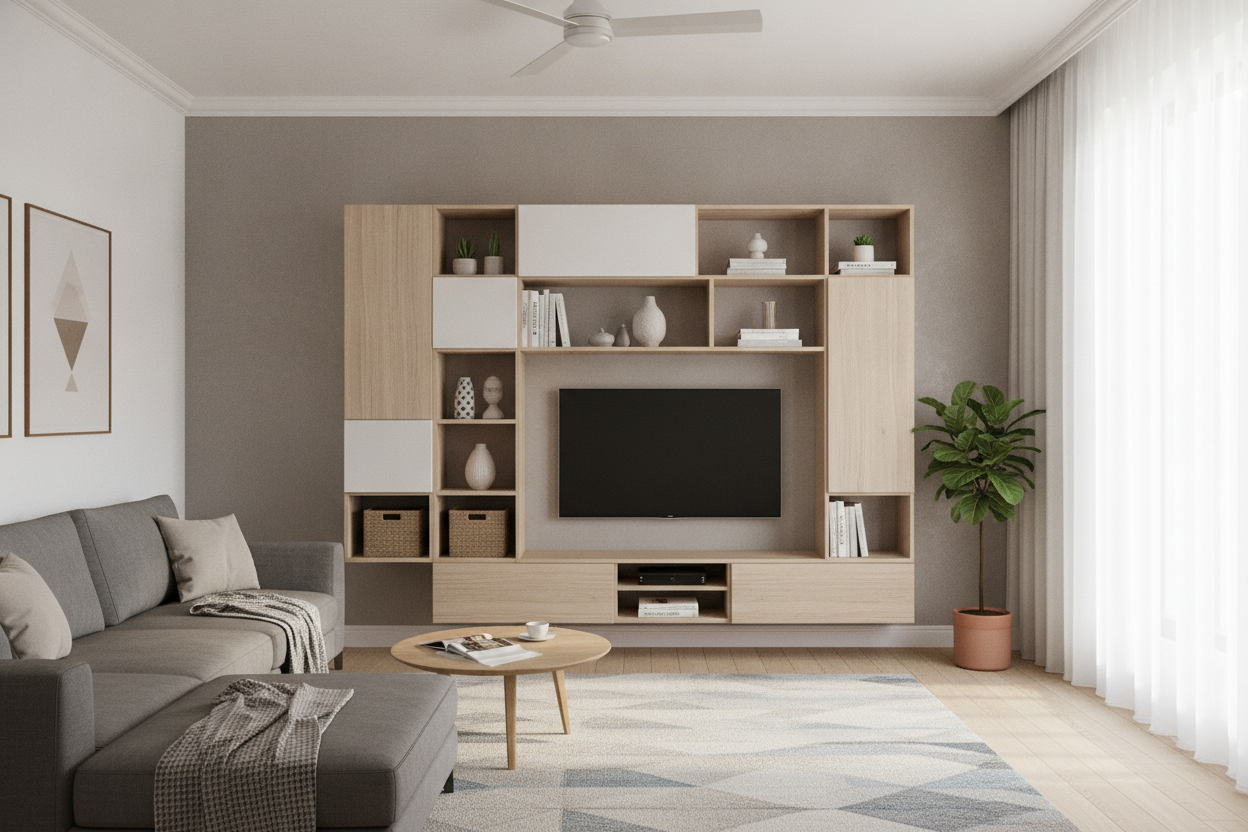
I remember staring at the living room wall of my first 'adult' apartment. It was a 600-square-foot walk-up with a giant, blank white wall that made my 40-inch TV look like a total afterthought. I desperately wanted those floor-to-ceiling built-ins you see in architectural magazines, but I was on a month-to-month lease and my landlord had a 'no holes bigger than a thumb' rule. Investing in a tv modular wall unit felt like a massive swing, but it ended up being the smartest check I ever wrote.
Quick Takeaways
- Modular systems grow or shrink based on your current square footage.
- High-quality hardware survives the 'disassemble-reassemble' cycle; cheap particle board doesn't.
- You get the high-end look of built-ins without losing your security deposit.
- One-time investments in solid materials outlast three cheap 'disposable' consoles.
The Built-In Dilemma When You Don't Own the Walls
I once spent $1,200 on custom-cut floating shelves for a rental in Brooklyn. I spent two weekends measuring, drilling, and leveling. When I moved eighteen months later, I had to leave them behind because the removal would have shredded the drywall. It was a total loss. Why I Traded Expensive Built Ins For A Tv Modular Wall Unit is basically my manifesto on why I stopped building things into walls I didn't own.
The frustration of renting is that you want your space to feel anchored and expensive, but you know you'll probably be packing it all into a U-Haul in a year or two. Leaving behind thousands of dollars in custom wood-work is a mistake you only make once. I needed something that felt permanent but was secretly a master of disguise.
Enter the TV Modular Wall Unit (My Rental Savior)
The turning point was realizing I didn't have to settle for a puny, waist-high console. A modular tv wall unit mimics the grand scale of a custom library but consists of separate, interlocking pieces. You get the height, the storage, and the visual weight without the permanent commitment.
By pushing separate towers together with a central bridge or console, you create a seamless wall of cabinetry. How I Faked Custom Built-Ins With a Modular TV Wall Shelf Unit explains the visual trickery I used. I chose a finish that matched my baseboards, and suddenly, the whole unit looked like it was part of the original 1920s architecture. It’s about creating an illusion of permanence.
How It Survived Three Totally Weird Layouts
My second apartment was a long, narrow loft where the only wall for a TV was squeezed between two massive windows. My third place? It had a fireplace that was awkwardly off-center. In both cases, a standard 70-inch sideboard would have looked ridiculous. Because I had a system similar to a 90 Wall Mounted And Freely Arranged Tv Stand With Led, I could pivot.
In the narrow loft, I split the towers and moved them to the opposite wall to hold books, keeping only the low-profile console under the windows. In the fireplace apartment, I stacked the modules asymmetrically to balance out the room's weird proportions. It looked like I’d bought new furniture specifically for the layout, but it was just the same gear rearranged. This flexibility is what separates 'furniture' from 'investments.'
Is It Actually Easy to Move?
Let’s be honest: moving sucks, and moving large furniture sucks more. But breaking down a modular unit is actually easier than moving a solid 300-pound sideboard. My secret? I keep a dedicated Ziploc bag for the cam locks and shelf pins, and I tape it directly to the back of the main panel.
The real key is construction. If you buy a unit made of actual MDF or solid wood with metal-to-metal connectors, the screw holes won't strip when you take it apart. I've seen cheap 'honeycomb' furniture literally crumble after one move. My unit has a few battle scars on the back panels, but the structural integrity is still 100% after three different ZIP codes.
The Cost of Keeping It vs. Buying Cheap Replacements
People often balk at spending $1,500 or $2,000 on a media setup. But do the math. If you buy a $300 'disposable' stand every time you move because the old one broke or doesn't fit the new vibe, you've spent the same amount in five years and you're left with nothing but a pile of sawdust in a dumpster.
When you look at high-quality Tv Stands and modular systems, you are paying for the ability to never shop for that category again. I haven't looked at a TV stand catalog in six years. That’s a lot of saved time and a lot less waste in a landfill. Buy it once, and let it adapt to you.
Frequently Asked Questions
Can one person assemble a large modular unit?
Technically yes, but I wouldn't recommend it. You'll want a second person to help level the pieces and hold the towers while you lock them together. It’s a two-beer job, not a solo marathon.
Will it look 'cheap' if the pieces don't perfectly align?
Only if your floor is uneven. Most high-end modular units have adjustable feet (levelers) hidden in the base. A quick turn of a wrench ensures the tops of the units align perfectly, even in old buildings with slanted floors.
How do you hide the wires in a modular setup?
Most units have pre-drilled cable management holes. I also use adhesive cord clips on the back of the modules to keep everything tidy. Since the units sit flush against each other, you can run wires horizontally between the cabinets without them being visible from the front.

Leave a comment
This site is protected by hCaptcha and the hCaptcha Privacy Policy and Terms of Service apply.