

















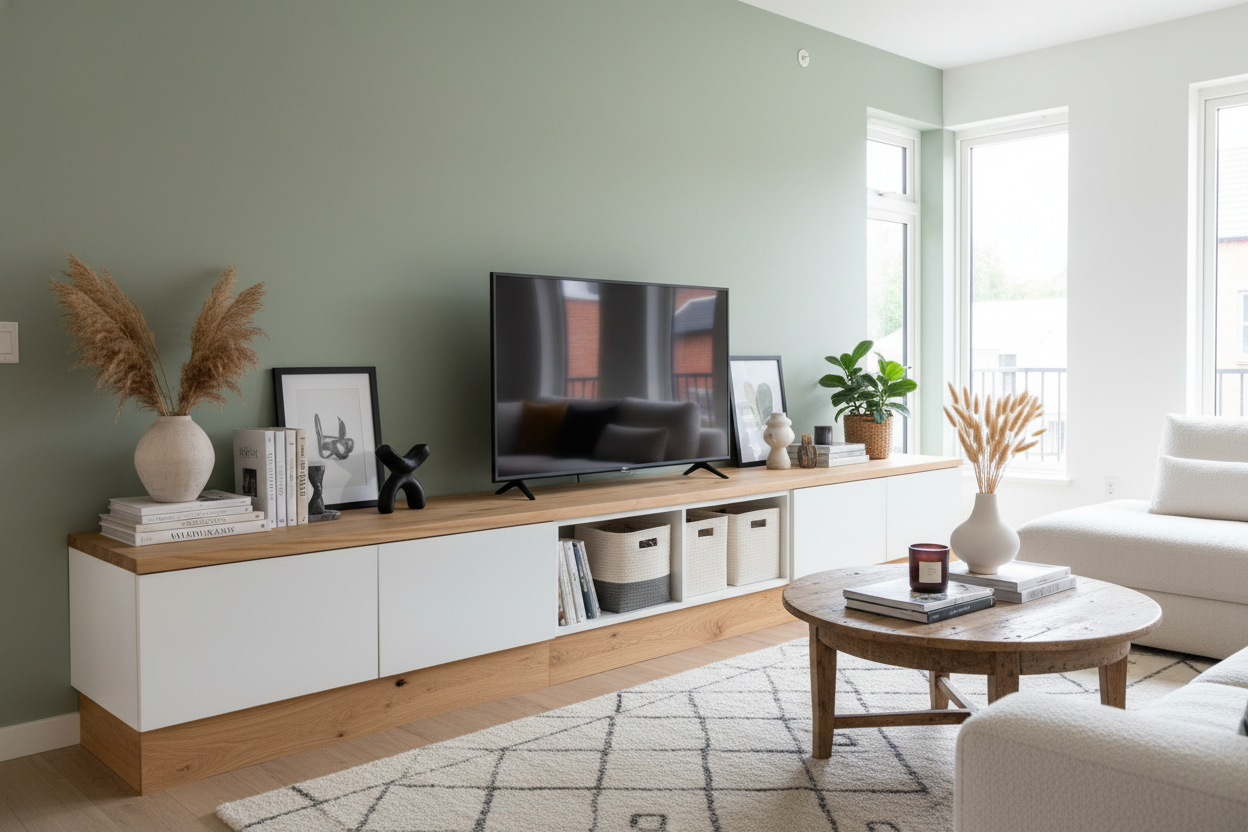
I spent three weeks staring at a 14-foot wall in my living room that felt like a vast, beige wasteland. Every standard 60-inch console I looked at online seemed like a postage stamp on a billboard. I knew I needed an extra long tv stand to ground the room, but when I called a local carpenter for a quote on custom built-ins, I nearly choked on my coffee. $5,200. For some MDF and paint. No thanks.
I decided to take a different route. I realized that if I could find an extra long media console that spanned almost the entire width of the wall, I could trick the eye into seeing 'architecture' instead of just 'furniture.' It took some trial and error (and one very annoying return of a unit that arrived in 400 pieces), but I finally cracked the code on faking that high-end, wall-to-wall look for about 20% of the cost of a contractor.
Quick Takeaways
- Measure your wall twice and aim for a piece that covers at least 80-90% of the horizontal space.
- Use an adjustable-length unit to avoid the 'awkward gap' in corners that aren't perfectly square.
- Choose a unit with legs to keep the room feeling airy and make cleaning a breeze.
- Opt for dark glass or tinted fronts to hide the blinking lights of routers and consoles.
The Reality Check of Custom Carpentry Quotes
I’m not saying contractors are scammers—they have the skills I clearly don't—but $5,200 for a living room storage wall felt like a personal attack on my bank account. When you start looking at custom work, you aren't just paying for wood; you're paying for the labor of scribing every edge to your wonky walls. I spent a weekend scrolling through Pinterest, convinced that if I didn't have floor-to-ceiling cabinetry, my house would always look 'unfinished.'
The problem with standard floating furniture is the scale. Most big-box stores sell units designed for apartments, not wide-open living rooms. A 60-inch long console table for tv looks fine in a bedroom, but in a main living area, it leaves these sad, empty stretches of baseboard on either side that just collect dust and cat toys. I realized I didn't need the ceiling-high shelves; I just needed the horizontal weight of an extra large media console to anchor the room.
The Faux Built-In Secret: Stretching Wall-to-Wall
Here is the visual trick: when an extra long tv cabinet fills nearly the entire wall, your brain stops seeing it as a standalone object. It starts to read as a structural element of the house. I stopped looking for 'TV stands' and started looking for a long media unit that could stretch at least 100 inches. The goal was to leave only about 6 to 10 inches of breathing room on either side.
By filling that horizontal plane, you create a sense of permanence. An extra long tv console table creates a massive surface area that you can style with books, lamps, and ceramics, which further pushes that 'custom' vibe. If you buy a piece that is too short, the TV looks like it's floating in a void. When the console is wider than the TV by at least a foot on each side, the proportions finally click into place. It’s the difference between a suit that fits and one you borrowed from your bigger brother.
The Adjustable Hack That Saved My Uneven Walls
My house was built in 1974, which means there isn't a single 90-degree angle in the entire building. I was terrified of ordering a massive, 110-inch extra long entertainment center only to find out it was a half-inch too wide for my alcove. This is where the 'expandable' design saved my sanity. I ended up sourcing a media console with an adjustable length that allowed me to slide the top section to perfectly fit my wall dimensions.
This flexibility is a lifesaver. If I move to a new place, I can shrink it down. In my current room, I pulled it out to its maximum width to hit those corners. It eliminated the need for custom filler pieces or crown molding to hide gaps. Plus, having a long media console cabinet that can shift and grow means you aren't locked into one specific layout forever. It’s the ultimate 'cheat code' for anyone living in a home where the walls are slightly bowed or the floors are uneven.
Why I Refused to Do a Flush Baseboard
Most 'pro' DIYers will tell you to rip out your baseboards and mount your extra long media cabinet flush to the wall to make it look built-in. I’m here to tell you: don't do it. Unless you are a master of the miter saw, you will end up with a mess of jagged trim and ruined drywall. I opted for a TV cabinet on legs instead, and it was the best aesthetic choice I made.
Keeping the unit slightly elevated does two things. First, it prevents the piece from looking like a giant, heavy block of wood that's eating your floor space. Seeing the floor continue underneath the extra long tv stand with storage makes the room feel larger. Second, it is a practical dream. I can actually run a vacuum under there. Nothing kills the high-end look faster than a 'built-in' that has a visible layer of gray fuzz growing along the bottom edge because you can't reach it to clean.
Hiding the Clutter in Plain Sight
The biggest downside of an extra long entertainment console is that it provides so much surface area that you're tempted to bury it in 'stuff.' I’ve got a PS5, a Nintendo Switch, a cable box, and a router that looks like a space alien. If those are all sitting out, the 'expensive' look evaporates instantly. I specifically looked for a black cabinet with glass doors that were tinted dark enough to hide the gear but still allowed the remote signals to pass through.
With an extra long media console table, you have enough internal volume to hide everything. I even tucked a small subwoofer inside one of the cabinets (pro tip: make sure you have ventilation). By keeping the top surface clean—just the TV and maybe two high-quality decorative items—the whole setup looks curated and intentional. It’s not just a place to put the TV; it’s a long media cabinet that organizes your entire digital life while looking like a million bucks.
Frequently Asked Questions
How long should a TV stand be for an 85-inch TV?
For an 85-inch TV, you want an extra long tv console that is at least 80 to 90 inches wide. Ideally, the stand should be about 10-20% wider than the TV itself so it doesn't look top-heavy. If the stand is exactly the same width as the TV, it looks cramped and unstable.
Can I combine two smaller units to make an extra long media console?
You can, but be careful. Unless they are designed to be modular, you will see a visible seam down the middle, and the wood grain rarely lines up. It's usually better to buy one tv console extra long unit or an adjustable one to keep the lines clean and professional.
Is a wall-mounted or floor-standing long media unit better?
Floor-standing units with legs are generally easier to install and can hold more weight. Wall-mounted units look incredibly modern, but they require serious blocking behind the drywall. If you have a massive media console extra long enough to cover a whole wall, the weight of the electronics plus the unit itself is often too much for standard studs without extra reinforcement.


Leave a comment
This site is protected by hCaptcha and the hCaptcha Privacy Policy and Terms of Service apply.