

















I once lived with a guy who thought my $80 night cream was 'just fancy lotion' for his dry elbows. I found the jar half-empty on the edge of the sink, and that was the moment I realized that 'shared space' is often a polite term for 'zero privacy.' You can like your roommates, but you don't always trust their boundaries—or their kids, or their guests. That is exactly when I started hunting for a narrow locking cabinet.
The goal wasn't to turn my bedroom into a high-security vault. I just wanted a place to put my stuff where 'out of sight, out of mind' was backed up by a literal key. After measuring every weird 12-inch gap in my apartment, I found that a slim locking cabinet could solve the boundary problem without making me feel like a paranoid bunker-dweller.
Quick Takeaways
- Standard safes are too heavy and ugly for a bedroom or bathroom; a cabinet offers security with a softer furniture look.
- Verticality is your best friend—look for units under 15 inches wide but at least 60 inches tall.
- Always, and I mean always, bolt these to the wall. Narrow furniture is prone to tipping.
- Steel cabinets are more secure, but wood-composite versions blend in better with existing decor.
The Reality of Living With Snoops (and Why Safes Suck)
There is a specific kind of low-level anxiety that comes with leaving your personal life out in the open. Maybe it is a prescription you do not want to explain, a journal that is for your eyes only, or just a stash of the 'good' snacks you do not want to share. When you live with roommates, the communal areas are a minefield. Even your bedroom can feel exposed if you have people over frequently.
Most people think the answer is a heavy metal floor safe. I tried that. It was a disaster. First, it weighed 80 pounds, which made moving out of my third-floor walk-up a nightmare. Second, it looked like I was hiding the Declaration of Independence. It was a giant, grey, industrial eye-sore that practically screamed, 'Look at the secrets inside me!'
A safe is hostile. It says you do not trust anyone. A cabinet, however, just looks like you are organized. It provides a psychological barrier as much as a physical one. Most 'snooping' is opportunistic—someone sees a bottle of pills on the counter and takes a peek. If that bottle is behind a locked door that looks like a normal pantry or linen tower, the temptation usually vanishes before it starts.
Why a Slim Locking Cabinet Was My Ultimate Fix
When you are dealing with a 100-square-foot bedroom or a bathroom shared by four people, you cannot afford to lose floor space to a bulky cupboard. I realized that the only unused space I had left was vertical. A tall, skinny unit can slide into the gap between your dresser and the wall, or sit behind a door without blocking the swing path.
By choosing something with a footprint of about 12 by 15 inches, I managed to fit all my sensitive items—tax documents, expensive skincare, and my Kindle—into one secure spot. It is the same logic as choosing a shallow cabinet for narrow halls; you are reclaiming 'dead' space that wasn't being used for anything anyway.
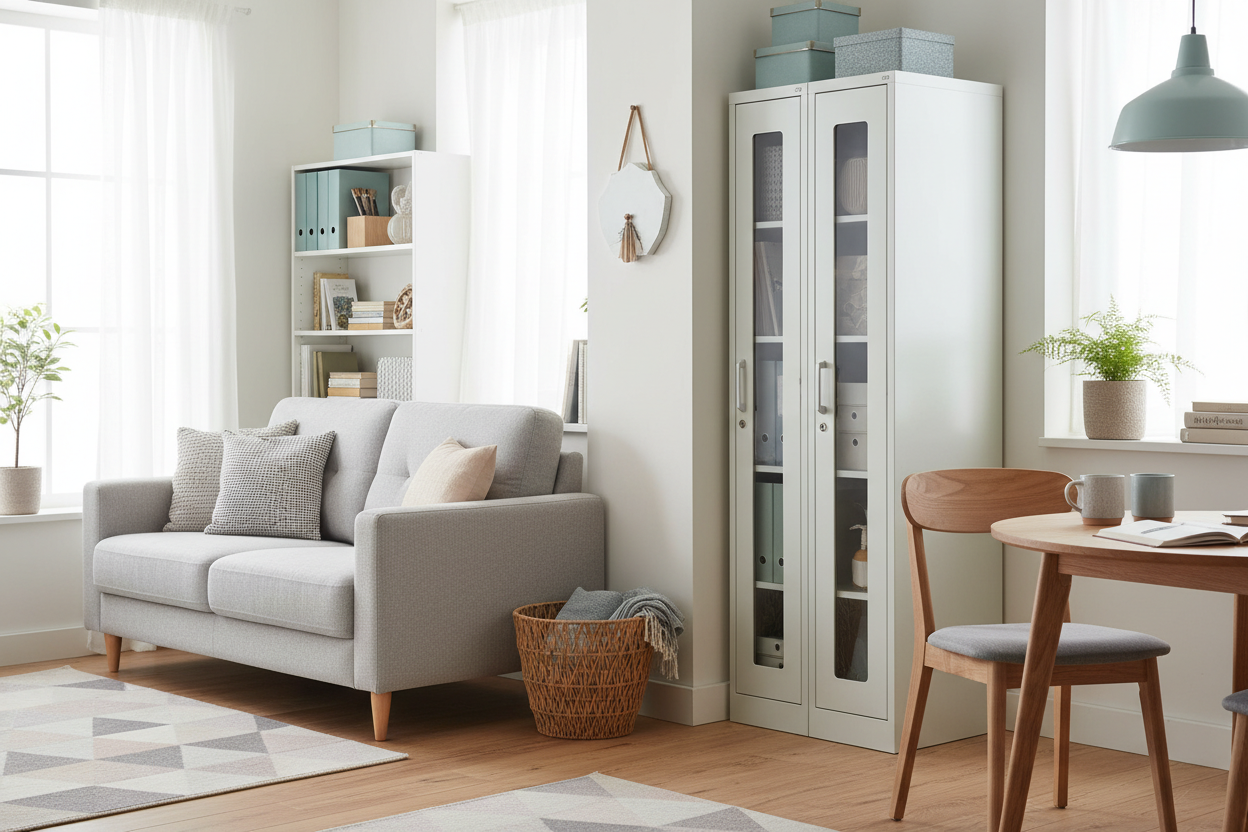
I settled on a powder-coated steel model that was 72 inches tall. It felt sturdier than the cheap particle board stuff you find at big-box stores. The slim profile meant I could tuck it into a corner of the bathroom. Suddenly, my morning routine was mine again. No more wondering if someone had used my expensive razor or moved my contact lens solution. Everything was exactly where I left it, under lock and key.
It Actually Blends In With Normal Furniture
The best part about modern secure storage is that it doesn't have to look like a locker from a high school gym. You can find units with clean lines, matte finishes, and recessed handles that disappear into the background. Unlike a black cabinet with glass doors where the whole point is to show off your collection, a locking cabinet is designed to be discreet.
I prefer solid doors for this exact reason. If people can see through the glass, they are going to ask why it is locked. A solid door keeps the mystery alive—or rather, it prevents there from being a mystery at all. It just looks like a place where you keep your towels or extra toilet paper. The keyhole is usually so small that unless someone is looking for it, they won't even notice it's there.
The Best Awkward Gaps to Stash Your Secure Storage
Finding the right spot for your cabinet is half the battle. If you put it right in the middle of a wall, it looks like a monolith. You want to 'anchor' it visually. The best spot I ever found was in a closet alcove. I removed one of the lower hanging rods and slid the cabinet right in. It was hidden by my coats, making it the ultimate stealth storage.
In the bathroom, look for that weird 10-inch gap between the vanity and the shower. Most builders leave that space open for no reason. A water-resistant metal cabinet fits perfectly there and keeps your toiletries dry and private. If you are putting a decorative locking cabinet for your bedroom, try placing it next to your nightstand. It can double as an extended surface for a lamp or your phone while keeping your private items within arm's reach while you sleep.
I’ve also seen people use these in home offices to separate 'work' from 'life.' If you handle sensitive client files, having a dedicated locking tower that sits flush against your desk keeps you compliant and organized without needing a full-sized filing cabinet that looks like it belongs in a 1990s accounting firm.
3 Non-Negotiables When Shopping for Secure Furniture
After assembling (and returning) a few of these, I’ve learned that not all locking cabinets are created equal. If you are going to spend the money, do not compromise on these three things:
- Lock Quality: Avoid the plastic 'child-proof' locks. You want a cam lock with a metal tongue. It doesn't need to be a biometric scanner, but it should feel like it requires more than a paperclip to open.
- Anti-Tip Hardware: I cannot stress this enough. A cabinet that is 12 inches wide and 60 inches tall is a tipping hazard. If you pull the top door open too fast, the whole thing can come down. Ensure it comes with a wall-anchor kit—and actually use it.
- Adjustable Shelving: Your needs will change. One month you’re storing tall bottles of shampoo; the next, you’re trying to fit a stack of legal documents. If the shelves are fixed, you’re going to hate the unit within six months. Look for 1-inch increment adjustments.
Personal Experience: The 'Cheap' Mistake
My first attempt at this was a $60 plastic unit I bought from a hardware store. It was a disaster. The frame warped within two weeks because I put too many heavy books on the middle shelf, and the 'lock' was so flimsy I could literally bend the door open with my thumb. I ended up spending $150 on a cold-rolled steel version. It was heavier, harder to assemble, and the instructions were clearly translated four times, but it has lasted through three moves and still looks brand new. Buy the metal one. You won't regret it.
FAQ
Is a locking cabinet fireproof?
Usually, no. Most furniture-style locking cabinets are made of steel or wood and offer zero fire protection. If you are storing deeds or birth certificates, put them in a small fireproof pouch inside the cabinet.
Can I change the lock if I lose the key?
Yes, most of these use standard cam locks. You can buy a replacement cylinder at any hardware store for about $10 and swap it out in five minutes with a wrench.
Are they hard to assemble?
The metal ones can be a bit 'fiddly' because the panels are thin and need to align perfectly to lock. I highly recommend having a second person to hold the panels upright while you screw them together, or you'll end up with a lopsided cabinet that rattles.


Leave a comment
This site is protected by hCaptcha and the hCaptcha Privacy Policy and Terms of Service apply.