

















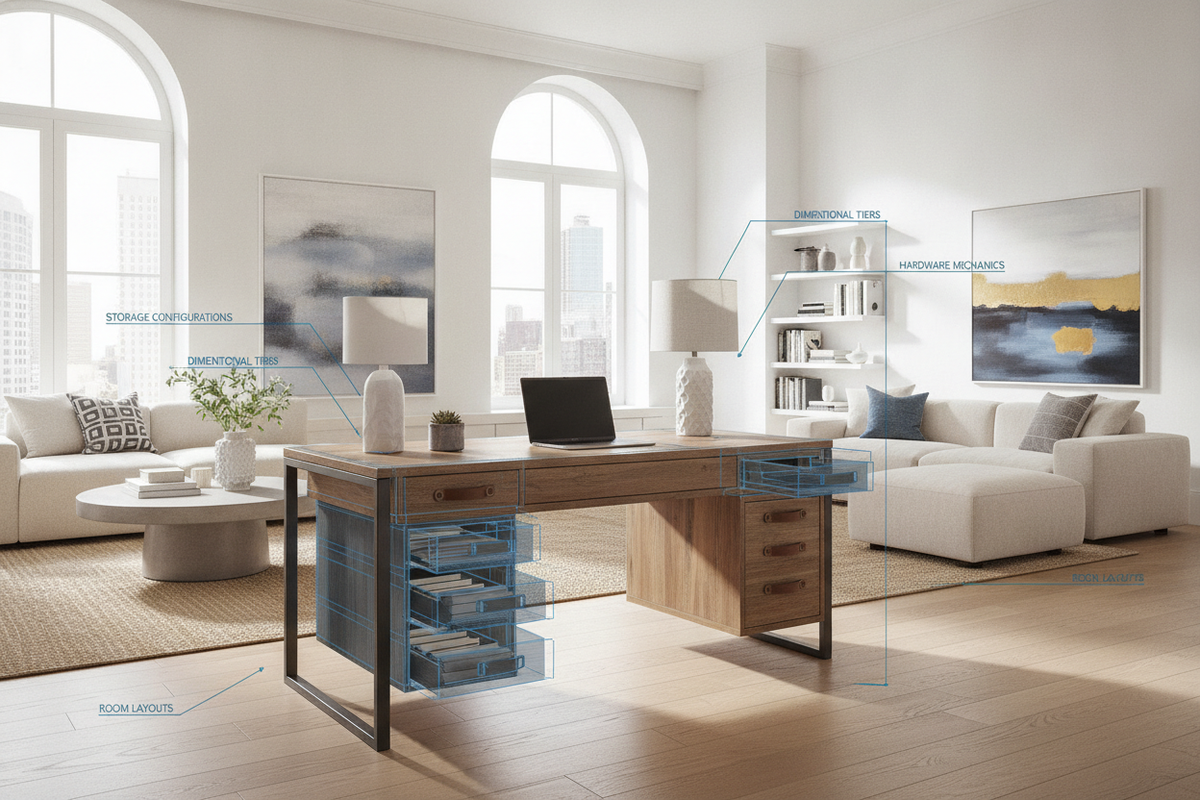
Deconstructing the Home Depot Desk with Drawers Category
Home-improvement-style office furniture balances everyday utility with structural practicality. Desks categorized under broad retail selections often feature a blend of minimalist frames and high-density compartmental storage. When planning a workstation setup, evaluating a home depot desk with drawers requires understanding how storage components integrate with the main work surface.
Utility-oriented desks generally fall into three architectural profiles:
- Single-Pedestal Desks: These units feature a vertical stack of storage compartments on one side balanced by open leg posts on the other, preserving lateral knee clearance while providing dedicated filing or supply storage.
- Double-Pedestal Desks: Flanked by symmetrical banks of drawers on both sides, this layout maximizes enclosed volume, making it suitable for dedicated administrative workflows.
- Apron and Lap Drawer Desks: Featuring shallow drawers mounted directly beneath the desktop span, these models offer a streamlined profile while keeping essential writing tools within reach. For modern aesthetic comparisons, exploring a contemporary desk with drawers guide provides helpful design context.
Dimensional Footprint Tiers and Spatial Planning
A successful workstation layout depends on choosing the correct spatial footprint for your room. Understanding desk dimensions ensures adequate perimeter clearance for task seating and natural circulation pathways.
Compact Writing Profiles
Designed for multi-purpose rooms, guest bedrooms, and tight alcoves, compact desks prioritize a narrow depth profile. These units fit comfortably along short walls while accommodating basic laptop setups and essential stationery in single or dual under-top drawers.
Executive and Mid-Sized Workbenches
Mid-sized desks offer expanded depth and width, accommodating dual monitors, desktop accessories, and side-mounted storage pedestals. In these configurations, ensuring sufficient clearance between the inner edge of the drawer pedestal and the opposite leg frame prevents restricted knee movement.
Expansive Corner Workstations
When tasks demand divided zones for computing, document review, and peripheral equipment, an L-shaped corner desk with drawers makes efficient use of underutilized room corners. Corner designs distribute storage modules along the return wing, keeping the primary work span clear.
Drawer Architecture: Suspension Hardware and Storage Geometry
The durability of home depot desk drawers largely depends on their internal framing, joinery methods, and mechanical suspension hardware. Evaluating these structural components helps ensure smooth daily operation.
Suspension Glide Mechanics
- Bottom-Mount Roller Runners: Common in entry-level flat-pack furniture, these tracks utilize nylon wheels gliding inside formed metal channels. While simple to install, they typically stop short of full extension.
- Side-Mount Ball-Bearing Slides: Featuring steel ball bearings running in lubricated raceways, these slides offer smooth travel, lateral stability, and full extension capability for effortless access to the back of the drawer box.
- Under-Mount Soft-Close Glides: Concealed beneath the drawer box, these systems provide clean side profiles and integrated dampening mechanisms to prevent slamming.
Internal Storage Proportions
Drawer depth and structural compartmentalization determine how effectively a desk organizes office essentials. Shallow top drawers work best for pens, notebooks, and charging cords. Lower filing drawers require reinforced baseboards and integrated hanging file rails to support vertical document folders. Implementing structured desk drawer organization strategies ensures that storage compartments remain clutter-free and balanced.
Material Performance: Engineered Composites, Laminates, and Solid Timber
Workstation longevity is shaped by core frame materials and protective surface finishes. Understanding material characteristics helps match a desk to its intended workload.
- High-Density Engineered Wood: Particleboard and medium-density fiberboard (MDF) provide a uniform, warp-resistant substrate for modular flat-pack furniture. Structural integrity depends on protective laminates and sealed edge banding that resist ambient moisture.
- Melamine and High-Pressure Laminates: Applied over composite cores, modern textured laminates resist scuffs, writing impressions, and light spills, making them well-suited for high-traffic home offices. A computer desk with drawers and charging station frequently utilizes these resilient composite surfaces to support heavy electronic gear.
- Solid Wood and Metal Structural Framing: Desks incorporating powder-coated steel leg assemblies or solid timber framing deliver strong racking resistance, preventing lateral wobble under typing pressure or shifting loads.
Room Placement and Ergonomic Flow Framework
Where you place your desk impacts both daily comfort and room accessibility. Balancing natural light sources, power outlets, and traffic lanes prevents cramped working conditions.
Wall Perimeter vs. Floating Center Placement
Placing a desk flush against a wall conceals power cords and minimizes the visual footprint. However, if space permits, floating a desk in the center of the room creates an open executive feel, provided the back panels of the desk and drawer pedestals are fully finished.
Corner Efficiency
Integrating a 3-drawer corner workstation into an alcove anchors the workspace within the natural boundaries of the room, leaving central floor space open for seating and storage cabinets.
Ergonomic Clearances
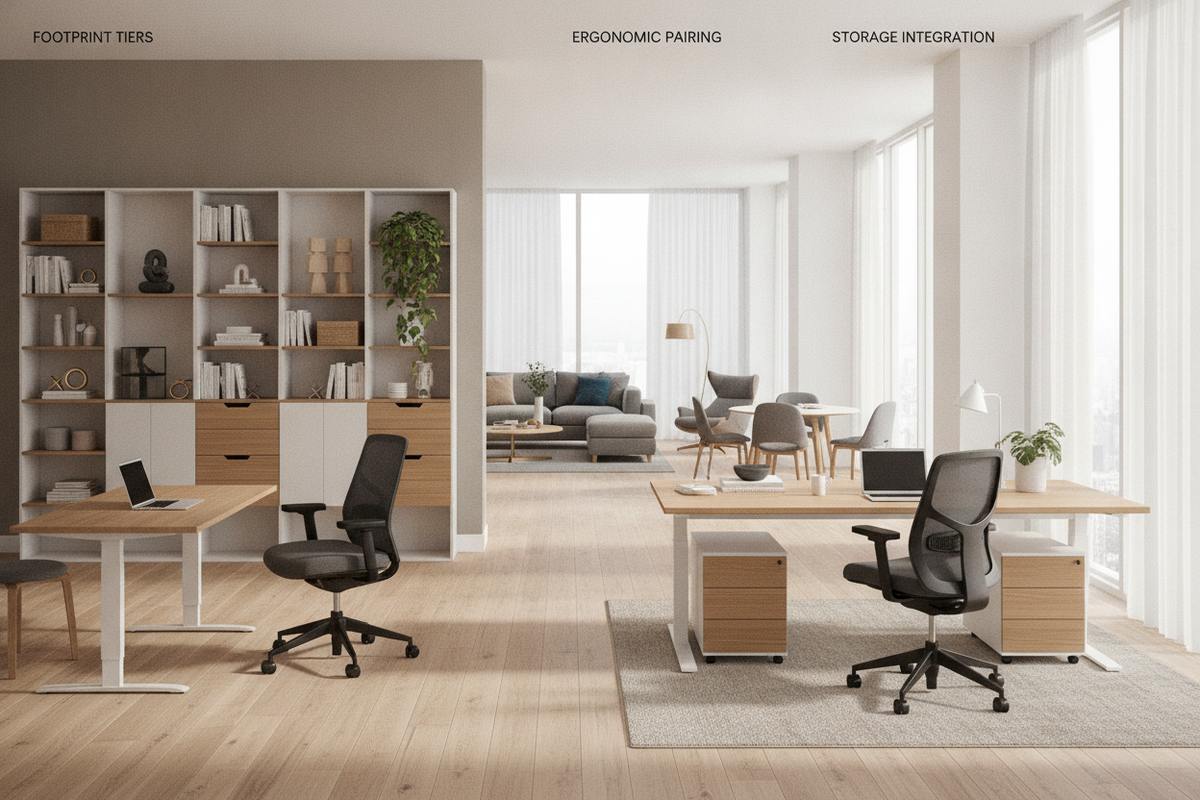
Maintain ample clearance behind the desk edge to allow your office chair to swivel, recline, and roll back without striking walls or adjacent cabinetry. Positioning the workstation perpendicular to windows helps minimize monitor glare while preserving natural ambient lighting.
Assembly Verification and Long-Term Maintenance Checklist
Proper assembly is essential for ensuring that drawers align squarely and slide smoothly over years of use.
- Square the Carcass: Before securing the back stabilizing panel, measure corner-to-corner diagonals to confirm the main frame is perfectly square.
- Calibrate Drawer Glides: Fasten glide brackets in exact alignment with pre-drilled pilot holes. Misaligned tracks cause uneven drawer gaps and binding along the cabinet frame.
- Adjust Leveling Feet: Uneven flooring can rack the desk frame, causing drawers to drift open or catch. Adjust screw-in levelers until the desktop is completely horizontal.
- Periodic Fastener Inspection: Routine seasonal tightening of cam locks, machine bolts, and drawer handle screws maintains structural rigidity over extended use.

Leave a comment
This site is protected by hCaptcha and the hCaptcha Privacy Policy and Terms of Service apply.