


A guinea pig cage should give at least 7.5 square feet of floor space for one or two guinea pigs, and 10.5 square feet (about 30 x 50 inches) is the preferred size for a pair, according to Humane World for Animals, the organization behind the Humane Society of the United States name. Floor space matters far more than height: guinea pigs do not jump or climb, so lofts and ramps add variety but do not replace room to run.
This guide sets out the published minimums by number of guinea pigs, shows the square-feet math, and explains what to check on an elevated cage. It covers rabbits and hamsters briefly, because their needs are often lumped together and they are not the same. At the end, we measure our own elevated cage from the FUFU&GAGA small pet habitats collection against those figures and say plainly where it falls short.
Key takeaways
- One or two guinea pigs: 7.5 sq ft is the bare minimum from Humane World for Animals, with 10.5 sq ft preferred for two.
- Floor, not height: do not count a loft or second level toward the minimum.
- Solid floor: every source used here rejects wire or grid floors for guinea pigs.
- Daily time out: Humane World, VCA and the MSD manual all ask for time outside the cage every day, in addition to a cage of the right size.
- Rabbits need far more: the RSPCA asks for at least 3 m x 2 m x 1 m (about 9.8 x 6.6 x 3.3 ft) for two rabbits.
How big should a guinea pig cage be? Sizes by number of guinea pigs
Humane World for Animals gives a minimum and a larger preferred size for each group. The MSD Veterinary Manual starts at 7 sq ft for one guinea pig and adds 2 to 4 sq ft for each additional one; its column below is that arithmetic.
| Guinea pigs | Humane World minimum | Humane World preferred | MSD Veterinary Manual |
|---|---|---|---|
| 1 | 7.5 sq ft (about 30 x 36 in) | Bigger is better | At least 7 sq ft (about 42 x 24 in) |
| 2 | 7.5 sq ft | 10.5 sq ft (30 x 50 in) | 9 to 11 sq ft |
| 3 | 10.5 sq ft | 13 sq ft (30 x 62 in) | 11 to 15 sq ft |
| 4 | 13 sq ft | 30 x 76 in (about 15.8 sq ft) | 13 to 19 sq ft |
VCA Animal Hospitals gives a smaller figure for one animal: an indoor cage of at least 24 x 36 inches (6 sq ft) should comfortably hold a guinea pig, and bigger is better. So the published minimum for one guinea pig runs from 6 to 7.5 sq ft. Where sources differ, the larger figure gives your guinea pigs more room.
Many owners keep a pair, and for two the practical target is about 30 x 50 inches, which also sits inside the MSD range. Humane World adds that larger spaces are easier to clean, because waste does not build up as quickly and guinea pigs can keep a separate toilet area.
How do you measure a cage in square feet?
Measure the inside length and width of the floor in inches, multiply them, and divide by 144 (square inches in a square foot). Use inside measurements, because frames and legs take up room.
- 30 x 36 in: 1,080 / 144 = 7.5 sq ft, the Humane World minimum for one or two.
- 30 x 50 in: 1,500 / 144 = about 10.4 sq ft, the preferred size for a pair (Humane World rounds it to 10.5).
- 24 x 36 in: 864 / 144 = 6 sq ft, the VCA figure for one.
Count only floor the guinea pigs can walk on at ground level. A hide, hay rack and bowls take some of it, which is one more reason to aim above the minimum.
Do lofts, ramps and second levels count?
Not toward the minimum. Humane World says guinea pigs do not jump or climb and rely solely on floor space, and that ramps and platforms at low heights provide variety but guinea pigs need room to exercise. The MSD manual suggests adding a second level with a solid ramp or a small barrier to encourage movement. Together: a low loft is a useful extra, but the floor below must meet the size on its own. The MSD manual also says not to give guinea pigs exercise wheels, which can injure them.
How tall should a guinea pig cage be?
Height matters less than floor area, but there is still a minimum. Humane World says the sides must be at least 12 inches high, VCA says the cage should be at least 10 inches (25 cm) tall, and the MSD manual suggests about 18 inches (46 cm). The RSPCA asks for enough height for guinea pigs to stand up fully on their back legs. Humane World says a top can be left open only if no other household pets can reach the guinea pigs.
Wire floor vs solid floor
Choose a solid floor. Humane World states that cages with wire floors are not acceptable as guinea pig housing. VCA explains that wire mesh floors can injure guinea pigs' feet and cause sores, a condition called bumblefoot (ulcerative pododermatitis). The RSPCA says grid floors let litter through and can hurt guinea pigs' feet, and the MSD manual asks for a smooth bottom. Wire sides and a wire lid are different: they let air move, and Humane World asks for good ventilation.
Bedding and cleaning
The sources agree on paper bedding and on avoiding cedar, but differ on other wood shavings. Humane World recommends paper bedding 2 to 3 inches deep and advises against cedar and pine shavings. VCA says shredded newspaper or recycled paper products make the best bedding and wood shavings should not be used. The MSD manual accepts paper-based products or kiln-dried pine but not cedar or raw pine. The RSPCA suggests dust-free wood shavings with hay, but no softwood such as pine. Paper-based bedding is the choice all four accept.
For cleaning, VCA says guinea pig cages need a spot-check every day and a thorough clean at least once a week. A pull-out tray makes the weekly job quicker, if it is deep enough to hold the bedding.
Where to put a guinea pig cage
Keep the cage indoors. Humane World gives an ideal range of about 65 to 75°F and advises a draft-free area, away from doors and windows and on an elevated surface, away from direct sunlight, fireplaces and heating vents, because guinea pigs are prone to heat stroke. VCA gives 65 to 80°F as ideal; the RSPCA gives 17 to 20°C (about 63 to 68°F), with heatstroke risk above 26°C (79°F).
An elevated cage fits the advice to use an elevated surface and lets you see and reach your guinea pigs without bending to the floor. It does not fix a bad spot: a cage beside a sunny window or a vent is still too warm.
When is a cage too small, and when does an exercise pen help?
A cage is too small when its inside floor is below the minimum for the number of guinea pigs in it: under 7.5 sq ft for one or two by the Humane World figures, or under 6 sq ft for one by VCA's. Humane World notes that most cages marketed for guinea pigs are way too small, so check inside measurements, ours included.
An exercise pen helps every guinea pig. Humane World asks for time outside the enclosure at least once a day, VCA for supervised time out of the cage each day to run around, and the MSD manual calls daily exercise essential, in a supervised, guinea pig-proofed area. A pen is a simple way to provide that. It does not turn an undersized cage into a full-size home, though: the minimums apply to where the guinea pigs live around the clock.
Rabbit cage size: rabbits need much more room
The RSPCA says two medium-sized rabbits need a living space no smaller than 3 m x 2 m x 1 m (about 9.8 x 6.6 x 3.3 ft, or 64.6 sq ft of floor), including shelter and exercise area, and that a traditional small hutch should never be the only home of any rabbit. Rabbits should be able to stand on their hind legs without their ears touching the roof, on a solid floor. VCA puts it bluntly: the biggest cage you can afford is too small. No small animal cage in our range is big enough to be a rabbit's home.
Hamsters and mice: floor space and levels differ again
The PDSA (the People's Dispensary for Sick Animals, a UK registered charity) notes there is not a lot of evidence on exact hamster cage sizes, but points to a minimum of 100 x 50 cm (about 39.4 x 19.7 in) from Germany's Veterinary Association for Animal Welfare. It asks for bedding at least 25 cm (10 in) deep, and says single-level, larger cages tend to be better than multi-level, tall cages, because hamsters have poor eyesight and can easily fall. The MSD manual asks for a solid floor and says to avoid cedar and pine bedding for hamsters.
Mice differ on levels: the PDSA's mouse advice says different levels let them climb and explore, alongside lots of space, a solid floor and deep, dust-free bedding. It gives no minimum size and warns that most mouse cages sold in pet shops are not nearly big enough.
What to check on an elevated small animal cage

- Inside floor area: length x width / 144, against the table above. Ignore the loft.
- Floor type: a solid floor or tray, not wire or grid.
- Tray depth: enough for 2 to 3 inches of bedding for guinea pigs, or far more for a burrowing hamster.
- Clear height: at least 10 to 12 inches on the ground level, so guinea pigs can stand up fully.
- Loft and ramp: low, with a solid ramp.
- Access: a lid and doors wide enough to lift an animal out with both hands and to reach every corner.
- Mesh spacing: small enough that your smallest animal cannot squeeze through or catch a foot.
- Placement: a level floor, away from windows, doors, vents and direct sun.
Our pick: the 34.9" elevated small animal cage, measured honestly
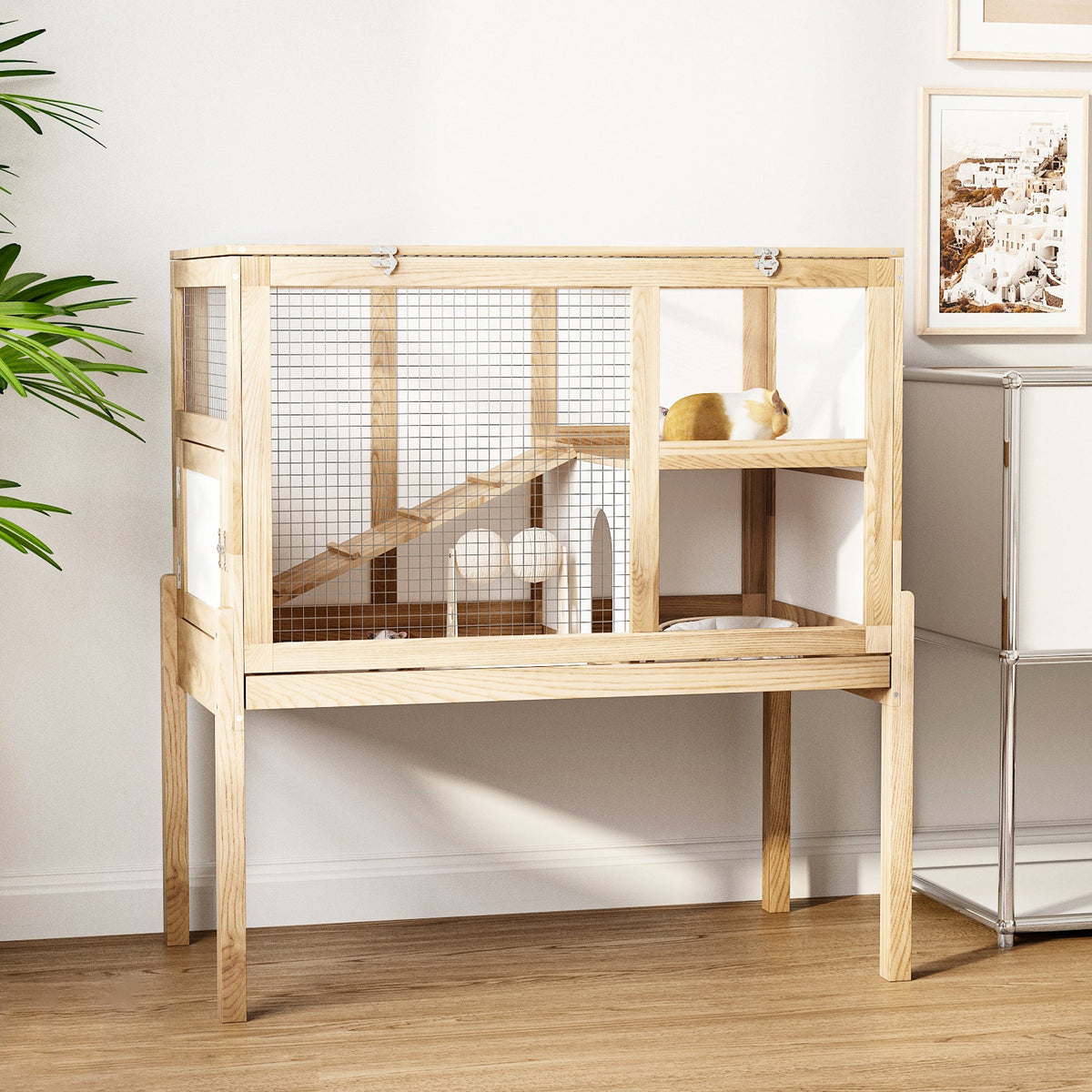
FUFU&GAGA carries one elevated small animal cage. Animal welfare comes first, so we compared it with the sources above before recommending it: it is smaller than their minimums for guinea pigs, rabbits and hamsters. Read the comparison table before you decide.
34.9" Elevated Small Animal Cage with 2 Level Play Area

This pine cage on legs measures 36.6" H x 34.9" W x 19.7" D overall, with an interior of 19.3" H x 33.5" W x 19.7" D, and weighs 29 lb in a beige finish. The listing describes two levels joined by a ramp (the spec lists a ladder and shelves), three doors including side and top openings, a bottom tray that slides out for cleaning, and tempered glass windows with metal mesh for viewing and airflow. Included pieces are listed as a pull-out tray, a floor and a door. It is listed as not portable and needs assembly; see our flat-pack assembly guide.
What works: the lid lifts fully and the tray slides out, so daily checks and the weekly clean are easy to reach, and the raised height suits placement on an elevated surface. The listing does not describe a wire floor.
What to know: the listing copy is written for hamsters, while its photos show guinea pigs. Its inside floor is below every guinea pig minimum in this guide, even for one guinea pig, and shorter than the PDSA hamster floor (see the table below). The listing does not give the loft size, the tray depth or the mesh spacing.
Best for: a short-term or secondary space, such as holding guinea pigs for a few minutes while you clean their main enclosure, or a climbing setup for mice, which the PDSA says benefit from levels, once our customer service team has confirmed the mesh openings are small enough for them.
Skip it if: you want a permanent home for any guinea pig, rabbit or hamster. For hamsters, the PDSA also prefers single-level cages and deep bedding, which the unlisted tray depth may not allow.
How the 34.9" cage compares with the published minimums
| Measure | 34.9" cage (listing) | Published guidance | Meets it? |
|---|---|---|---|
| Inside floor, one guinea pig | 33.5 x 19.7 in, about 4.6 sq ft | 6 sq ft (VCA) to 7.5 sq ft (Humane World) | No, 1.4 to 2.9 sq ft short |
| Inside floor, two guinea pigs | About 4.6 sq ft | 7.5 sq ft minimum, 10.5 preferred (Humane World) | No |
| Inside floor, hamster | About 85 x 50 cm | 100 x 50 cm minimum (PDSA) | No, about 15 cm (6 in) short |
| Inside height | 19.3 in, split between two levels | 10 to 12 in for guinea pigs (VCA, Humane World) | Check clear height under the loft |
| Floor type | Floor and pull-out tray listed, no wire floor described | Solid floor (all sources) | Appears so; confirm before buying |
The arithmetic: 33.5 x 19.7 = about 660 sq in, and 660 / 144 = about 4.6 sq ft; 33.5 in is about 85 cm and 19.7 in about 50 cm. If you already keep guinea pigs in this cage, the sources point to moving them to a floor-level enclosure of at least 7.5 sq ft for one or two, with daily time in a pen.
Browse every habitat in the small pet habitats collection, and compare inside dimensions with the tables above before you choose.
FAQ
Is a 30 x 36 inch cage big enough for two guinea pigs?
It meets the bare minimum: 30 x 36 inches is 7.5 sq ft, the Humane World minimum for one or two guinea pigs. Humane World prefers 10.5 sq ft (30 x 50 in) for a pair, and the MSD manual's figures work out to 9 to 11 sq ft for two, so a pair is better off in a larger cage.
How many square feet does one guinea pig need?
Published minimums run from 6 sq ft (VCA's 24 x 36 in cage) to 7 sq ft (MSD Veterinary Manual) and 7.5 sq ft (Humane World for Animals). All three say bigger is better, and if you may add a companion later, plan for the space a pair needs.
Are two-level guinea pig cages good?
Only if the ground floor alone is big enough. Humane World says guinea pigs rely on floor space and low ramps and platforms add variety; the MSD manual suggests a second level with a solid ramp. Count only the ground floor toward the minimum.
Can a guinea pig cage have a wire floor?
No. Humane World says cages with wire floors are not acceptable for guinea pigs, and VCA explains that wire mesh can cause foot sores called bumblefoot. The RSPCA and the MSD manual also call for a solid floor.

Leave a comment
This site is protected by hCaptcha and the hCaptcha Privacy Policy and Terms of Service apply.