


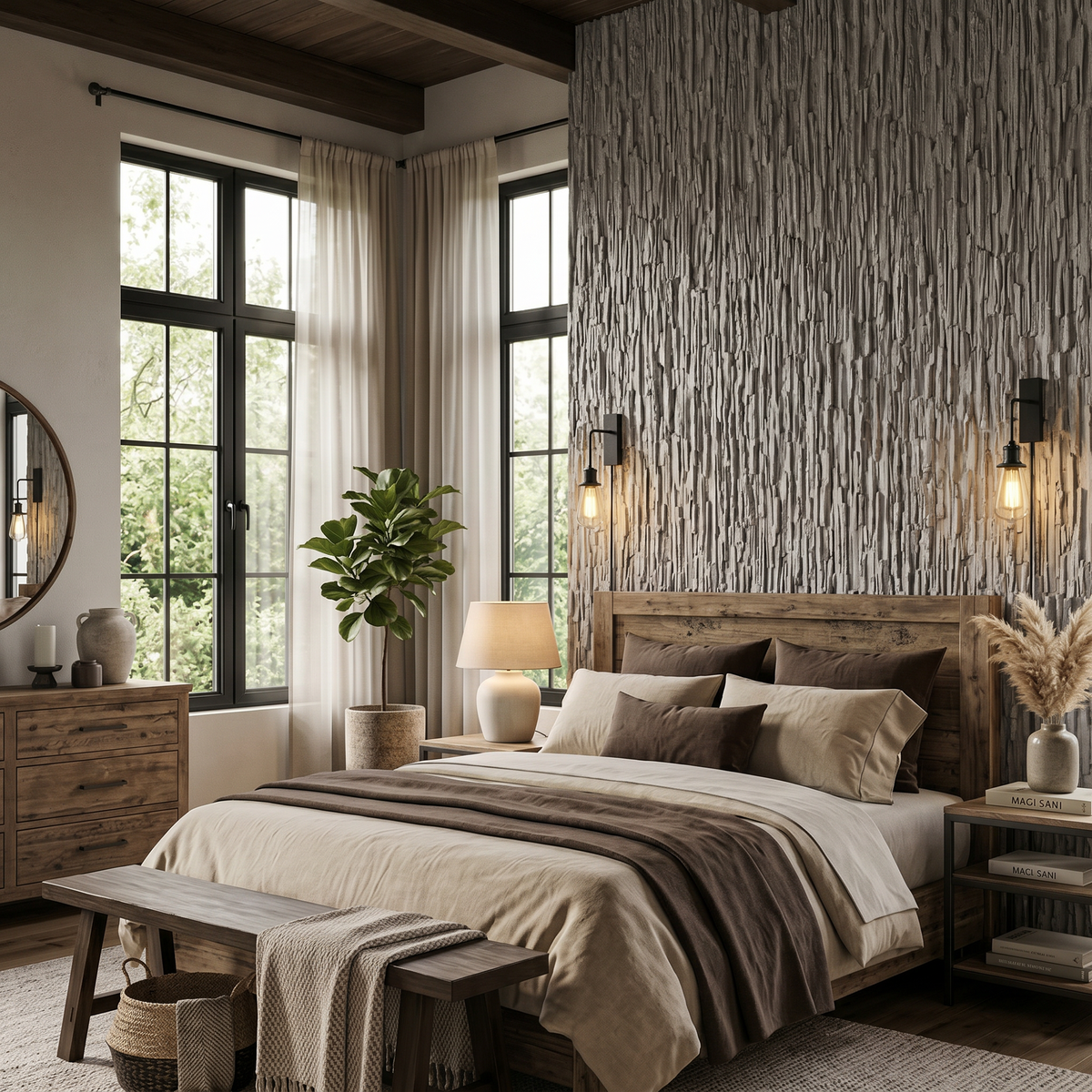
Faux stone wall panels are lightweight molded panels, usually polyurethane, that copy the look of real stone and go up in large sections with construction adhesive and screws instead of mortar. Stone veneer is different: it is natural stone or cast cement, it weighs far more, and it is set piece by piece in mortar.
Panels are a good fit for a feature wall or a quick decorative update. Near heat or on an exterior wall they need extra checks. This guide covers materials, where panels work, how to measure, and how to install faux stone panels, with worked numbers from the FUFU&GAGA 3D wall panels collection.
Key takeaways
- Weight: our sets work out to about 0.4 to 0.7 lb per sq ft (set weight divided by coverage). Manufactured stone veneer runs about 8 to 12 lb per sq ft.
- Coverage: a 47.2" x 23.6" panel covers 7.74 sq ft. Measure the wall, subtract openings, add 10 percent for cuts, then round up.
- Installation: start from a level line, use adhesive plus screws where the panel maker allows it, and stagger the seams.
- Heat: polyurethane is combustible. Before going near a fireplace or stove, check the product's fire rating, the appliance clearances and your local building code.
- Outdoors: panels are a decorative layer, not a weather barrier. The wall behind them still needs its own protection.
What are faux stone wall panels?
Faux stone wall panels are decorative wall coverings cast in molds, often molds taken from real stone, then colored to show natural variation. A stone veneer maker's FAQ sums up the difference well: faux stone panels are lightweight molded panels, while stone veneer is made from cement and installed piece by piece using masonry techniques.
Because faux stone panels attach directly to the wall in large sections, they are designed for quick decorative updates and are often a DIY project. They are light enough to skip the structural reinforcement real stone can need, which is why designers use them to create a stone look where masonry would be too heavy.
Are faux stone panels good?
They are a good, cost-effective choice for a stone look without masonry, within limits. They come in many styles, and sellers promote minimal maintenance, moisture and mold resistance, and thermal and acoustic insulation. Treat those as product-specific claims and read each listing. Our listings mention an added layer of insulation but give no R-value, so don't count on panels as insulation or soundproofing.
What are faux stone panels made of?
Most faux stone panels are polyurethane or a similar lightweight synthetic. Fixr describes polyurethane foam panels with a stone-shaped profile, coated with paint and a protective layer, and notes the color can scratch or chip. One polyurethane panel maker describes a high-density polyurethane cast from real stone and finished by hand. The sets in our collection are urethane, and the brick sets are described as urethane foam.
Don't confuse these with cement-based stone veneer panels. Fine Homebuilding covers a mortarless panel of that kind: a siding system that screws to framing over a water-resistive barrier, and makes silica dust when cut.
Faux stone panels vs. stone veneer: what's the difference?
The table compares the three materials shoppers usually weigh up. Faux stone wins on weight and easy installation. Real stone and cement veneer win on durability, heat and depth of detail.
| Faux stone panels | Manufactured stone veneer | Natural thin stone | |
|---|---|---|---|
| Material | Polyurethane or synthetic composite, molded and colored | Cement, aggregates and pigments | Thin-cut real stone |
| Weight | Our sets: about 0.4 to 0.7 lb per sq ft | About 8 to 12 lb per sq ft; one evaluated product stays at or under 15 lb | Heavier still; full-thickness stone is too heavy for typical wood-framed walls |
| Installation | Interlocking sections with adhesive, screws or both | Each piece set in mortar (one maker requires Type S) | Mortar, usually a mason |
| Look | Can look convincing, but also uniform; patterns can repeat | Deep variation in color and texture | The real thing |
| Durability | Less durable; color can scratch or chip | Holds up well outdoors; surface color can chip | Lasts as long as the home is maintained |
| Fire | Polyurethane is considered combustible | One maker classes its cement veneer as non-combustible | Durable against fire |
Cost is closer than many shoppers expect. Fixr's installed-cost ranges put natural thin stone highest, while the ranges for faux panels and manufactured stone overlap. A veneer maker also points out that higher-end faux panels can cost more per square foot than veneer, so compare the finished job, not just the box.
Where do faux stone wall panels work, and where don't they?
A faux stone accent wall indoors is the easiest job. The further you move toward heat, standing water or weather, the more you need to check the specific product.
| Location | Verdict | What to check |
|---|---|---|
| Interior feature wall | Best fit for faux stone panels for interior walls | Clean, flat, dry wall |
| Fireplace surround | Only after checks | Product's fire rating, appliance clearances, local building code |
| Kitchen wall | Fine away from the range | Keep panels off a stove backsplash unless the product's rating and local code allow it |
| Bathroom | Depends on the product | One maker allows panels around a bathtub but not in a shower |
| Exterior wall | Only if the product is listed for outdoor use | Solid sheathing and drainage behind the panels |
| Floors, countertops | No | These are wall finishes, not walking or work surfaces |
| Damp or leaking wall | No, until repaired | Panels will not stop a leak, so fix it first |
Fireplaces, stoves and fire ratings
Treat polyurethane panels as combustible unless the product's test data says otherwise. One panel maker states that polyurethane has burning characteristics similar to real wood. Foam sets deserve the same care. The word "fireplace" in any product listing, ours included, is not a fire rating and does not replace a clearance.
- Ask for the rating. A fire rating for a wall finish comes from an ASTM E84 test. In a summary of IRC 2024, Class A is a flame spread index of 0 to 25, and Class C (76 to 200) is the baseline for most rooms. Contact the seller for the report on that exact product.
- Follow appliance clearances. Even a Class A rating does not change them. Factory-built fireplaces, inserts and stoves follow their own installation instructions.
- Masonry fireplaces. Under the model code, combustible material stays at least 6 in. from the opening, and within 12 in. above it can project only 1/8 in. per inch of distance. By that math a 1.18" panel starts 9.4 in. above the opening (1.18 divided by 0.125), and a 1.97" panel starts 12 in. above it.
- Ask your building department. Model code language quoted by North Carolina's State Fire Marshal separates foam plastic from a building's interior with a thermal barrier such as 1/2-in. gypsum board, with exceptions. Ask how your local office treats foam decorative panels, especially on a commercial job.
Outdoor faux stone wall panels
Many outdoor faux stone wall panels are sold for exterior walls, and all nine of our sets are listed for indoor and outdoor use. Still, one maker's guide is clear that panels are not a weather-resistant layer: exterior walls need the building's own membranes, flashings and sealants. Another maker requires solid sheathing with a drainage mat fastened to it.
How many faux stone panels do I need?
Work out the wall area, subtract openings, add a waste allowance, then divide by one panel's coverage and round up. A panel calculator uses the same method with 10 percent for cuts and trim.
- Measure wall width and height in feet and multiply them.
- Subtract each window, door and other opening.
- Multiply by 1.10 to add 10 percent for waste.
- Divide by the panel area: width x height in inches, divided by 144.
- Round up to whole panels, then to whole sets.
Worked example: a 12 ft x 8 ft wall
This example uses our gray faux stone set of 10, where each 47.2" x 23.6" panel covers 7.74 sq ft and a set covers about 77 sq ft.
- Wall: 12 x 8 = 96 sq ft.
- Minus one 3 ft x 4 ft window: 96 - 12 = 84 sq ft.
- Plus 10 percent: 84 x 1.10 = 92.4 sq ft.
- Panels: 92.4 / 7.74 = 11.9, so 12 panels.
- Sets: 12 / 10 = 1.2, so 2 sets, leaving 8 spare panels.
Then check the layout, because area math alone can hide awkward cuts. On this wall, 144 in. / 47.2 in. is 3.05 panels, so each row is three panels plus a 2.4-in. sliver. The height is 96 in. / 23.6 in., or four rows plus a 1.6-in. strip. Plan to cover strips that thin with trim, or shift the layout so no piece ends up that small.
Panels needed by wall size
This table uses the same 10 percent allowance for our three panel sizes.
| Wall area after openings | With 10 percent waste | 47.2" x 23.6" panels (7.74 sq ft) | 47.2" x 22" panels (7.21 sq ft) | 47.2" x 11.8" panels (3.87 sq ft) |
|---|---|---|---|---|
| 40 sq ft | 44 sq ft | 6 | 7 | 12 |
| 60 sq ft | 66 sq ft | 9 | 10 | 18 |
| 80 sq ft | 88 sq ft | 12 | 13 | 23 |
| 100 sq ft | 110 sq ft | 15 | 16 | 29 |
| 150 sq ft | 165 sq ft | 22 | 23 | 43 |
| 200 sq ft | 220 sq ft | 29 | 31 | 57 |
How to install faux stone panels
Panel systems differ, so the maker's instructions always come first. These steps reflect what polyurethane panel guides have in common, mainly one maker's installation page and a second guide. Our sets are listed as adhesive mount or adhesive and interlocking, except the brick sets, which are listed simply as wall mounted.
- Acclimate. Lay the panels flat in the room for 24 hours so they don't bow.
- Prepare the surface. The wall must be clean, flat, dry and sound. Remove loose paint, wallpaper, grease and anything that blocks adhesion.
- Plan and dry-fit. Lay out panels from more than one box so the color looks blended, not banded. Dry-fit each row until you are happy with it.
- Snap a level line. Start from a level line, not the floor, because floors slope. Trim or shim the bottom edge where needed.
- Cut from the back. Mark cuts on the flat back, not the textured face. A fine-tooth blade with 80 or more teeth gives the cleanest cut on polyurethane. Wear eye, hearing and dust protection.
- Apply adhesive. Use a high-strength construction adhesive that is compatible with polyurethane. Run vertical beads across the back and a continuous bead around the entire perimeter, not a few dabs. Plan on 1 tube per 3 to 4 panels, depending on the guide, so our 12-panel example needs 3 to 4 tubes.
- Add fasteners. Drive screws along the tongue or other hidden spots. One guide calls for a screw every 16 in., four per panel: deck screws into wood, masonry screws into concrete, brick or stucco, and drywall screws into drywall.
- Work up in rows. Finish each row before starting the next. Slide each panel into its neighbor so the joint closes.
- Stagger the seams. Offset vertical joints from row to row, like brickwork. Use offcuts to start and finish rows.
- Turn the corners. Outside corners use corner pieces or a mitered cut. Inside corners can be mitered; keep the joint tight and fill any gap. Our listings show no separate corner pieces, so plan on miters.
- Work around outlets. Shut off power before cutting a hole for an outlet or switch, and use a licensed electrician where required. Never cover vents, access panels or movement joints.
- Finish the seams. Caulk joints to hide them, fill each screw hole and miter, and let it dry. If your panel takes paint, touch up the color; painting over existing paint can darken the area.
For the best results, work with a second person on large panels. Install videos and customer reviews help too, as long as they show the same panel type.
Faux stone panel buying checklist
- Panel size: does it divide well into your wall?
- Real coverage: multiply panel area by panels per set and compare it with the stated coverage.
- Thickness: 1.18" to 1.97" in these picks. Thicker panels project further from the wall.
- Edge type: jigsaw or shiplap edges decide how the seams look.
- Water claim: "waterproof" and "water resistant" are different claims.
- Fire rating: no test report means no install near heat.
- Paint: some sets take paint or stain, others can't.
- Trim and corners: determine how you will finish exposed edges before ordering.
Our picks: faux stone panel sets for common projects
These five sets cover the main looks and project sizes. Coverage is stated in the listing for the first two; for the others it is simple arithmetic (panel area x panels per set). Use the filters on the collection page to see all nine.
Gray faux stone wall panel set of 10
A neutral gray with the most coverage of these five. Each panel is 47.2" W x 23.6" H x 1.18" thick, and the set of 10 covers about 77 sq ft at 39 lb. Jigsaw edges interlock, it's an adhesive mount, and the listing rates it waterproof for indoor and outdoor use.
Best for: a full bedroom or living room feature wall.
Dark speckled faux stone wall panel set of 8
The thickest of these picks at 1.97", in a dark speckled finish. Eight 47.2" x 23.6" panels cover about 61.88 sq ft at 39 lb, with jigsaw edges and adhesive mounting. It's listed as waterproof for indoor and outdoor use.
Best for: a dramatic accent wall where strong texture matters.

Gray stacked faux stone wall panel set of 9
Classic stacked stone in gray. Nine 47.2" x 23.6" x 1.18" panels weigh 31 lb and cover about 70 sq ft (9 x 7.74). Shiplap edges interlock, and the panels can be painted or stained. The listing rates them water and weather resistant for indoor and outdoor use.
Best for: a project where you may want to change the color later.
Mixed color river rock faux stone wall panel set of 6
A warmer, multi-color river rock in a smaller set. Six 47.2" x 22" x 1.57" panels weigh 29 lb and cover about 43 sq ft (6 x 7.21). It's paintable and stainable, and listed as water and weather resistant for indoor and outdoor use.
Best for: a smaller wall or a kitchen accent away from the range.

Brown 3D artificial brick wall panels, set of 18
Not stone, but the same idea in brick. Eighteen 47.2" x 11.8" x 1.2" urethane foam panels weigh 43.89 lb and cover about 70 sq ft (18 x 3.87). Jigsaw edges link them, and the listing rates them waterproof for indoor and outdoor use. They can't be painted or stained, so choose the color you want from the start. Keep this foam set away from heat sources unless you have confirmed the rating and local code.
Best for: a warm brick feature wall in a living room or bedroom.

| Set | Panel size | Panels | Coverage | Set weight | Edge | Listed water rating |
|---|---|---|---|---|---|---|
| Gray | 47.2" x 23.6" x 1.18" | 10 | 77 sq ft | 39 lb | Jigsaw | Waterproof |
| Dark speckled | 47.2" x 23.6" x 1.97" | 8 | 61.88 sq ft | 39 lb | Jigsaw | Waterproof |
| Gray stacked | 47.2" x 23.6" x 1.18" | 9 | About 70 sq ft | 31 lb | Shiplap | Water resistant |
| Mixed river rock | 47.2" x 22" x 1.57" | 6 | About 43 sq ft | 29 lb | Shiplap | Water resistant |
| Brown brick | 47.2" x 11.8" x 1.2" | 18 | About 70 sq ft | 43.89 lb | Jigsaw | Waterproof |
FAQ
Do faux stone panels look real?
Good ones can look convincing, because they are cast with realistic texture and colored with natural variation. Up close they can look more uniform than stone veneer, and repeating patterns can give them away. Staggered seams and panels mixed from several boxes help the finish.
Can faux stone panels be used outside?
Yes, if that product is listed for outdoor use. The panels are a decorative layer, so the wall behind them still needs its own weather protection as your code requires. Follow the maker's exterior instructions, and check the UV and water claims for that exact set.
How long do faux stone panels last?
There is no standard lifespan, and the sources reviewed for this guide give no reliable number of years. Fixr rates faux panels as less durable than real or manufactured stone, and notes that the color can scratch or chip. Check the warranty and, outdoors, the UV claims of the product you choose.
Can faux stone be installed on drywall?
Generally yes, on a sound, flat, dry wall. One panel guide lists drywall screws for drywall, and another maker says interior panels can often be fastened directly to existing walls. Use an adhesive that is compatible with the panel, and follow its maker's fastener advice.
Do faux stone panels have to be glued?
It depends on the system. Some guides call for adhesive and screws together, others allow adhesive alone over concrete or masonry, and mortarless cement panels use fasteners only. Most of our sets are listed as adhesive mount. Skimping on adhesive can let joints open later, so follow your panel's instructions.
Can you put faux stone panels over siding?
Sometimes. One maker allows installation over vinyl or wood plank siding that is clean, in good condition and firmly attached, and calls flat, unpainted plywood ideal. Confirm it with the maker of your panels first.
Ready to plan your wall? Measure it, run the numbers above, then compare sets in the FUFU&GAGA 3D wall panels collection.

Leave a comment
This site is protected by hCaptcha and the hCaptcha Privacy Policy and Terms of Service apply.