

















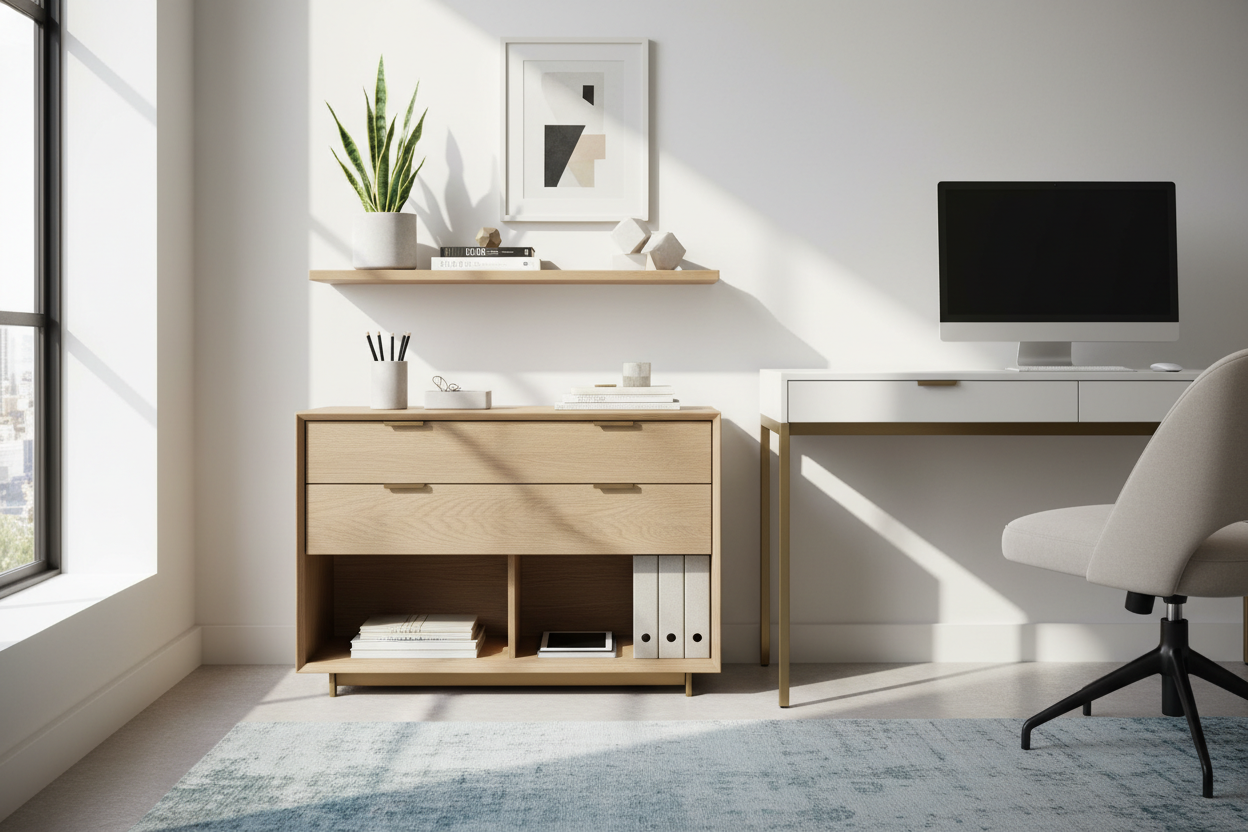
There is a specific kind of visual noise that kills productivity. It isn't just the papers on your desk; it is the overflow of items that have no designated home. As an interior designer, I often see clients invest heavily in a premium desk and ergonomic chair, yet they neglect the secondary storage that actually maintains the room's order. The right side cabinet for office use is not merely a box for files; it is the anchor that defines your workspace's spatial flow and aesthetic capability.
Key Features to Look For
- Footprint vs. Capacity: Always measure the swing radius of your office chair. A narrow office storage cabinet is preferable if you have less than 48 inches of clearance behind you.
- Material Integrity: Look for commercial-grade laminates or sealed wood veneers if the top will hold a printer or coffee machine.
- Configuration: A mix of shallow drawers for stationery and deep cupboards for bulky items offers the best versatility.
- Hardware Quality: Soft-close hinges and full-extension drawer slides are non-negotiable for daily use.
Defining Your Storage Strategy
Before selecting a finish or style, we must audit what you actually own. A common error is buying storage that doesn't fit the specific items you use daily. If you are a graphic designer or architect, you might need an office storage chest with wide, flat drawers for blueprints or proofs. Conversely, a general administrative setup usually requires a stationery storage cabinet with dedicated dividers for pens, staplers, and tech accessories.
The goal is to clear the desktop surface completely at the end of the day. This "reset" is vital for mental clarity, and it is only possible if your cabinet has the internal volume to accept your daily clutter.
Materiality and Visual Weight
In a professional environment, the cabinet acts as a visual counterweight to your desk. If your desk is a light, floating glass or metal structure, a heavy, solid wood cabinet can ground the space. However, be wary of matching everything perfectly. The "suite" look is outdated. Instead, coordinate textures.
For a modern, sleek aesthetic, consider office furniture cabinets with doors that feature push-to-open mechanisms. This eliminates visual clutter caused by handles and creates a seamless silhouette. If your office leans traditional, a cabinet with routed details or brass hardware adds a layer of sophistication.
The Hybrid Solution: Display vs. Concealment
Not everything needs to be hidden. Office shelving with doors offers a hybrid solution. The lower section—usually an enclosed cupboard—hides the unsightly router, reams of paper, and cables. The upper shelving allows you to display books, awards, or plants, which softens the utilitarian feel of the room. This verticality is excellent for drawing the eye upward, making compact offices feel loftier.
Optimizing for Small Footprints
In urban home offices, floor space is premium real estate. Here, office cupboard storage must be vertical rather than horizontal. A tall, slender unit provides the same cubic footage of storage as a credenza but occupies half the floor area. Ensure the unit is anchored to the wall, especially if it is loaded with heavy files.
My Personal Take on side cabinet for office
I learned a hard lesson early in my career regarding side cabinet for office placement. I designed a stunning executive suite where I placed a beautiful, deep credenza directly behind the client's desk. On paper, the dimensions worked. In reality, I hadn't accounted for the "lean back" factor.
Every time the client reclined in their ergonomic chair to think, the headrest would bump the cabinet hardware. It drove him crazy. I had to swap the unit for one with recessed pulls and a slightly shallower depth.
Another unpolished detail people forget: vibration. I once placed a heavy-duty laser printer on a cheap, particle-board cabinet. The vibration eventually caused the top to bow and the laminate to crack at the seams. Now, I always perform the "lean test." If I can't lean my full weight on the corner of the cabinet without it creaking or wobbling, it isn't sturdy enough for heavy office equipment. Always check the back panel, too—if it's just a flimsy piece of cardboard nailed on, walk away. You want a solid back for structural rigidity.
Conclusion
Investing in the right storage transforms your office from a temporary workspace into a professional command center. By balancing the technical requirements of storage with the aesthetic needs of your home, you create an environment where focus comes naturally.
Frequently Asked Questions
How tall should my side cabinet be?
Ideally, it should match the height of your desk (approx. 29-30 inches) if you want to extend your work surface. However, a slightly lower cabinet (around 24-26 inches) can fit neatly under a window or allow for a printer to sit on top without being too high to reach.
Can I use a kitchen cabinet as office storage?
While possible, kitchen cabinets often lack the specific dimensions needed for office supplies. Office cupboard storage is typically designed to accommodate standard binder heights and letter/legal file folders, whereas kitchen shelves might require adjustment or lack the necessary depth for files.
What is the best way to organize the inside of a deep cabinet?
Deep cabinets can become black holes for clutter. Use clear, labeled bins or pull-out internal trays. If you are using an office storage chest style unit, use drawer dividers to prevent small items from rolling to the back.


Leave a comment
This site is protected by hCaptcha and the hCaptcha Privacy Policy and Terms of Service apply.