
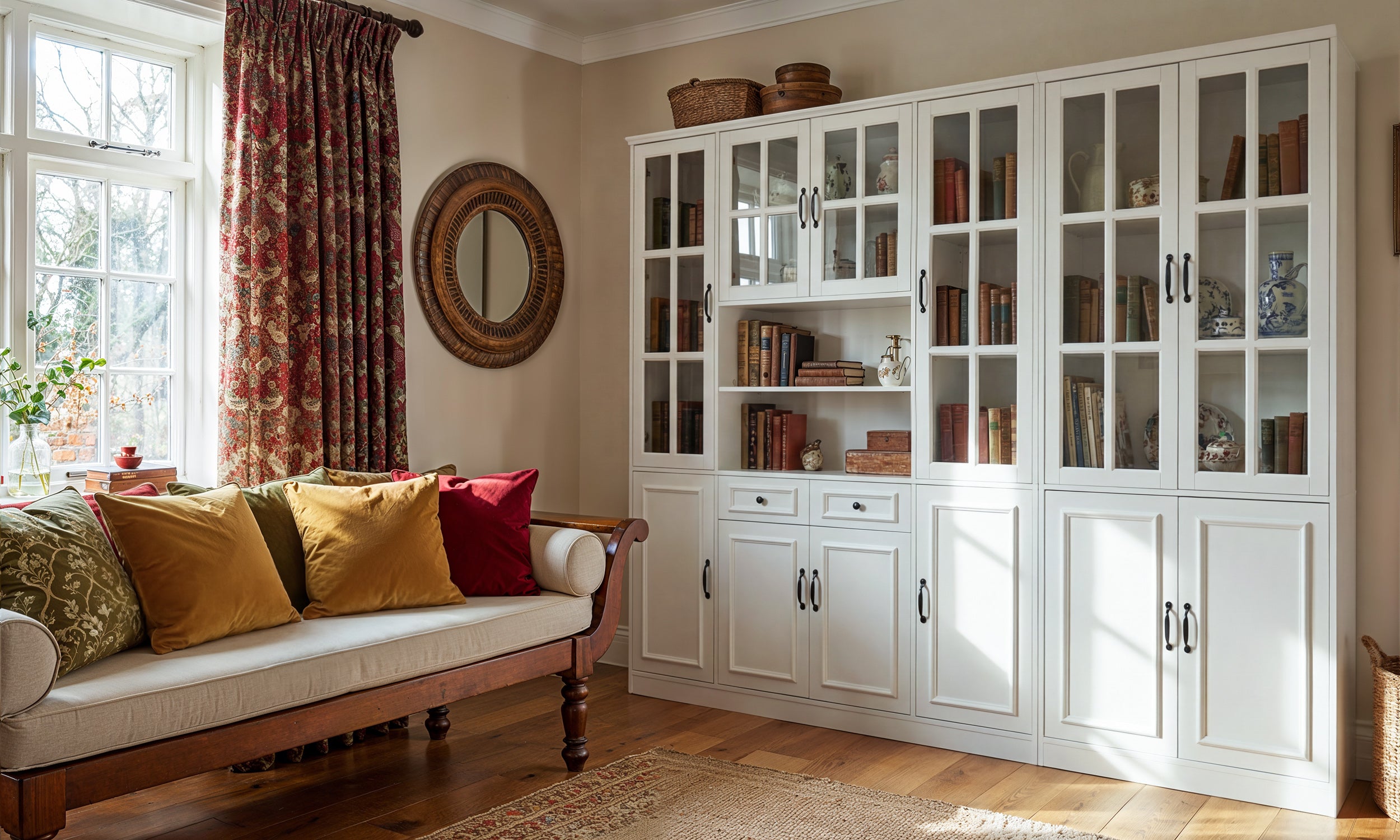
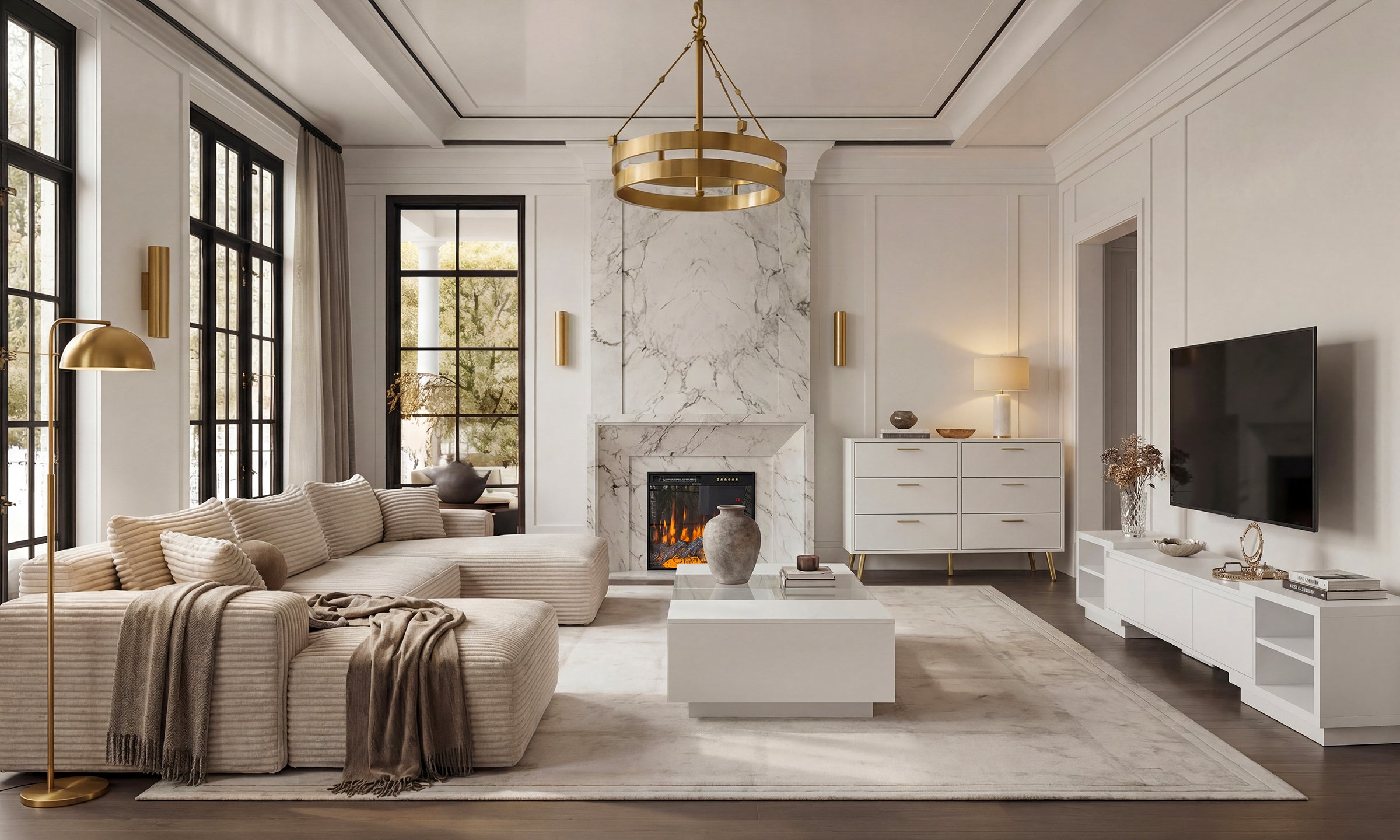
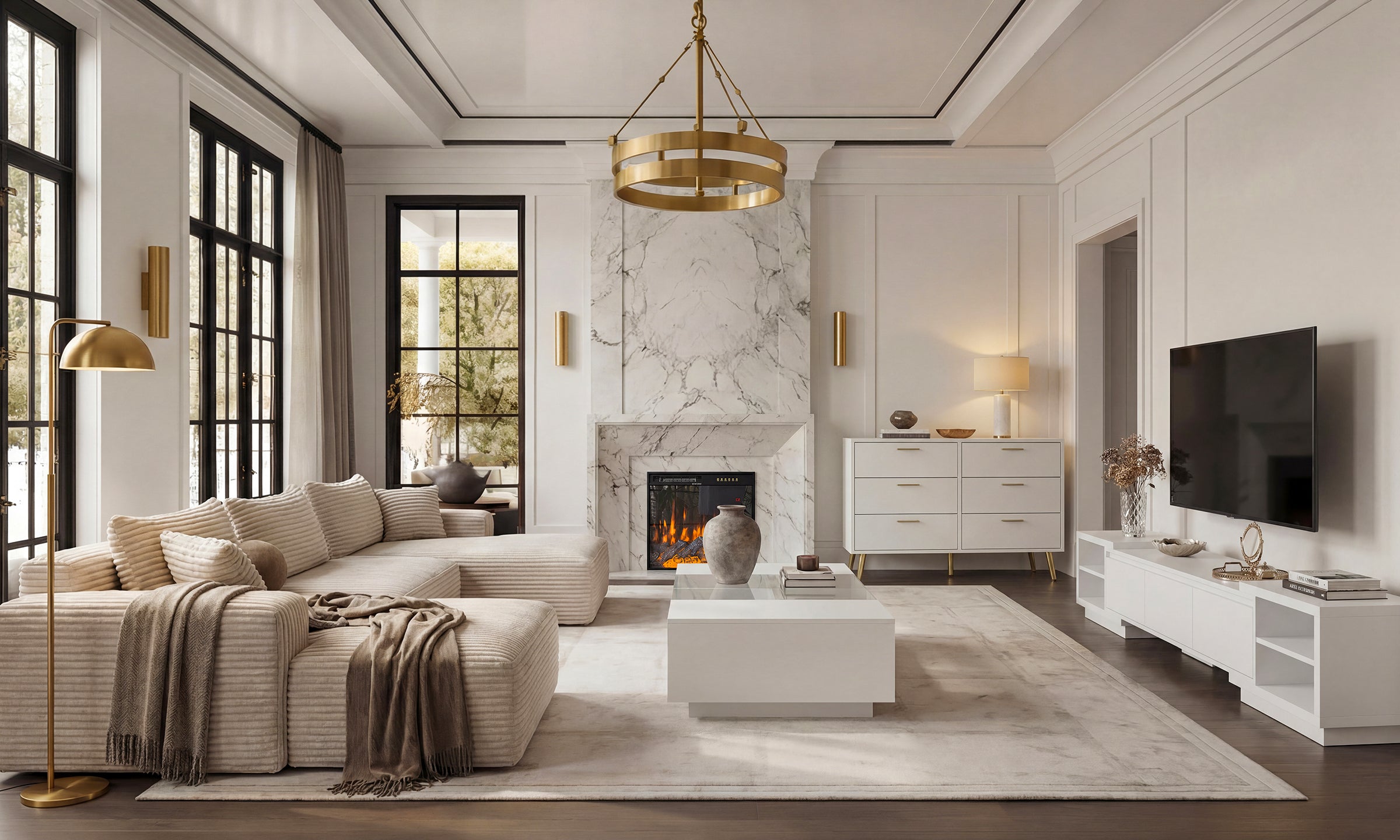


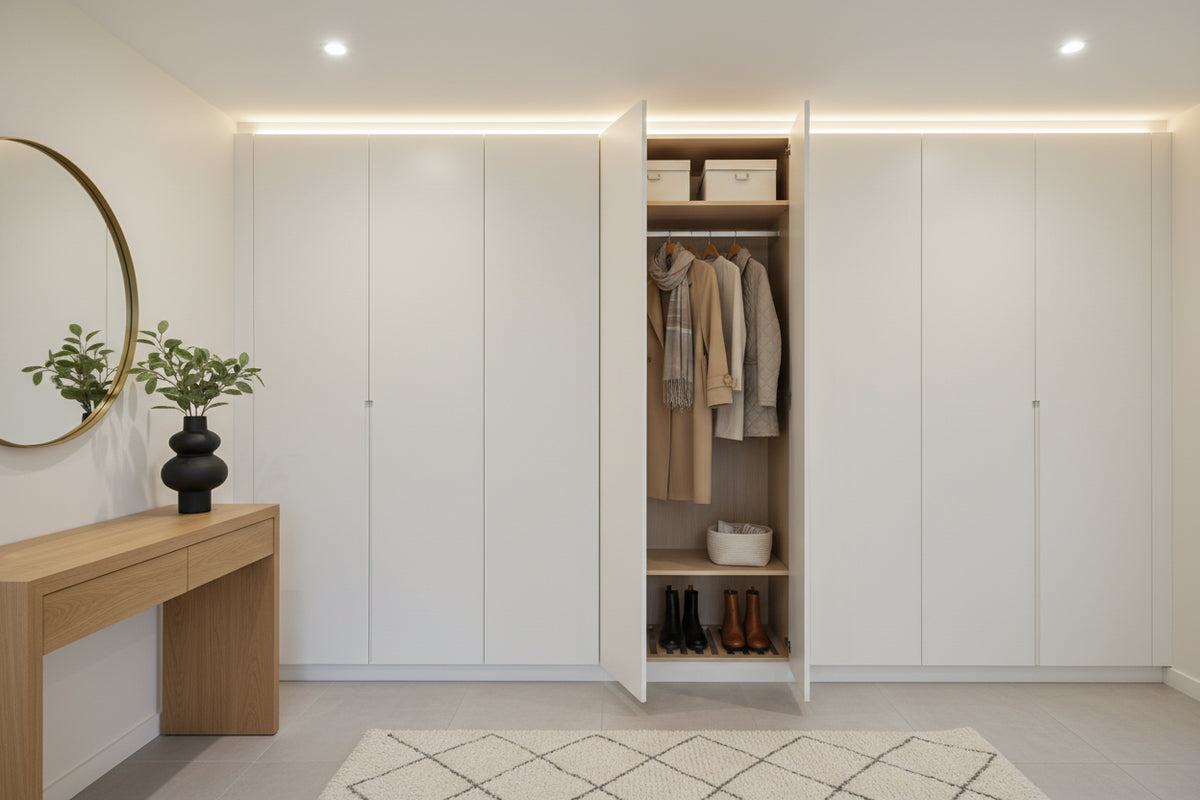
An entryway coat closet with doors does not have to be built into the wall. If your home has no closet by the front door, a freestanding wardrobe, a narrow coat cabinet or a hall tree with closed cabinets can hang coats behind doors, as long as it is deep enough for hangers (about 20 inches at minimum, 24 inches for comfort), tall enough inside for your longest coat, and anchored to the wall.
Below: hanging depth, rod height, door swing, boots and bags, airflow for wet coats, safety, and five picks from the FUFU&GAGA entryway furniture collection and our wardrobe range, with who each one suits and who should skip it.
Quick answer
- Depth: 20 inches is the minimum for hangers and 24 inches is the comfortable depth, per Dimensions.com. Most freestanding wardrobes are shallower, so measure your widest hanger.
- Hanging height: long coats need a tall, open hanging section. Compare the clear height under the rod with your longest coat on its hanger.
- Width: pick the widest cabinet that fits the free wall. Our coat cabinets with a rod run from 15.7 to 31.7 inches wide.
- Doors: each hinged door needs about its own width of free floor in front to swing open.
- Safety: anchor any tall cabinet to the wall, even if it feels stable.
What is an entryway coat closet with doors?
An entryway coat closet with doors is any enclosed storage near the front door where coats hang on a rod or hooks behind a door. In many homes that is a small reach-in closet built into the wall. When there isn't one, the same job falls to furniture: a freestanding wardrobe or armoire, a tall coat cabinet, or a hall tree with closed side cabinets.
The furniture names overlap. Dictionary.com defines a wardrobe as "a piece of furniture for holding clothes, now usually a tall, upright case fitted with hooks, shelves, etc.", and an armoire as "a large wardrobe or movable cupboard, with doors and shelves." So a freestanding clothes closet is usually called a wardrobe or an armoire, and stores often sell the same piece as a coat cabinet or coat closet cabinet when they show it in a hallway. Our armoire vs wardrobe guide explains where the two terms differ.
Doors are the point. Coats, bags and umbrellas disappear from view, dust stays off a good coat, and the clutter is gone the moment you walk in. Open hooks are faster, but everything on them stays on display.
Entryway closet ideas when you have no closet
Most homes without a coat closet end up with one of four setups. The right one depends on wall width, how many coats you hang, and whether you also need a bench and shoe space.
| Option | How coats hang | Closed storage | Good fit | Watch for |
|---|---|---|---|---|
| Freestanding wardrobe or armoire | Rod behind doors | Doors, shelves, often drawers | A free wall of about 30 inches or more | Depth under 20 in, short hanging sections |
| Narrow coat cabinet | Short rod behind one or two doors | Doors and shelves | A gap of about 16 inches or more beside the door | Few coats per cabinet; must be anchored |
| Hall tree with closed cabinets | Hooks in an open center, cabinets at the sides | Side cabinets, bench storage | Families who need a seat and shoe space too | Coats on hooks stay visible |
| Wall hooks plus a shoe cabinet | Hooks only | Shoe cabinet only | Very shallow halls | No doors over the coats |
If your entry is a slim hallway where every inch of depth counts, read our narrow entryway cabinet guide first. It covers shallow storage cabinets and walkway clearance, which this post does not repeat.
How deep does a coat closet need to be?
A coat closet needs about 20 inches of depth for hangers to fit, and 24 inches is the comfortable depth, according to Dimensions.com. That figure is for a rod running side to side, with hangers facing the doors.
Freestanding wardrobes are often shallower than a built-in closet. The wardrobes in our picks measure 19.1 to 23.6 inches deep overall, and the inside is a little less once you take off the back panel and doors. In a 19-inch cabinet, a wide coat hanger may sit at a slight angle or touch the doors. Before you buy, measure your widest hanger with a bulky coat on it and compare it with the interior depth if the listing gives one.
Built-in closets follow the same logic. Our entryway coat closet dimensions guide covers built-in sizes, and the closet dimensions guide lists depths, rod heights and shelf sizes for reach-in closets in one table.
Rod height and long-coat drop
For a single rod in a closet, Bob Vila recommends mounting it 66 inches above the floor so long garments such as coats and dresses don't brush the floor, and putting a lower rod at about 40 1/2 inches for shirts and folded pants. The same source says to set the rod at least 12 inches from the rear wall.
Inside a wardrobe, what matters is the clear drop below the rod, not the rod's height from the room floor. Many wardrobes put the rod over a shelf or drawers, so the hanging section can be much shorter than the cabinet. Here is a simple test:
- Hang your longest coat and measure from the top of the hanger hook to the hem.
- Find the hanging-section height in the product diagram or specs.
- If the coat is longer than the section, it will fold on the shelf below. That may be acceptable for a jacket you grab daily, but a good overcoat will crease.
If the family mostly wears short jackets and hip-length coats, a split cabinet with a rod above and shelves below uses the height better. If you own several knee-length or longer coats, look for one tall open hanging section.
Door swing vs sliding doors in a small entryway
A hinged door sweeps an arc as wide as the door itself, so it needs about that much clear floor in front. On a 31.5-inch cabinet with two equal doors, each door is roughly 15.75 inches wide (31.5 / 2), so you need about 16 inches of floor in front of it, plus room to stand. A single-door cabinet of the same width needs nearly twice that.
That is why pairs of doors, or upper and lower doors, suit tight entries better than one wide door. Check two more things before you place a cabinet:
- The front door's swing. Open the entry door fully and mark where it stops. The cabinet doors should open without hitting it.
- The walkway. Hallway width minus cabinet depth is the path you keep. In a 42-inch hallway, a 19.3-inch cabinet leaves 22.7 inches (42 - 19.3) before the doors open.
Sliding doors need no swing space, which helps in narrow corridors, but a two-panel slider opens only half the cabinet at a time. Mirrored doors are a bonus near the front door: they give you a last outfit check and bounce light around a dark entry.
Shelves, drawers and adjustable shelves for boots and bags
The lower part of an entry cabinet does as much work as the rod. Plan it around what actually lands by the door:
- Boots: measure your tallest pair against the shelf height in the specs. The Rena cabinets below list 15.5 to 15.6 inches between shelves; taller boots need a floor spot or a tray. Our shoe cabinet guide covers pair counts and boot height in detail.
- Bags and backpacks: a shelf at about waist height is easier to use than the floor of the cabinet.
- Hats, gloves and scarves: drawers or bins keep small items from sliding behind coats. Upper shelves are a good home for seasonal accessories.
- Adjustable shelves: if a cabinet offers them, they let you change the boot space between winter and summer. Check the listing, because many shelves are fixed.
Ventilation: storing wet coats behind doors
A closed cabinet keeps coats tidy, but it also keeps moisture in. The EPA's guide to mold, moisture and your home says it is important to dry water-damaged areas and items within 24 to 48 hours to prevent mold growth, and advises keeping indoor humidity below 60 percent, ideally between 30 and 50 percent.
In practice, that means a soaked raincoat or snowy parka should dry before it goes behind closed doors:
- Hang wet coats on an open hook or rack until dry, then move them into the cabinet.
- Leave the cabinet doors open for a while after a wet day.
- Put wet boots on a tray outside the cabinet, not on a closed shelf.
- Don't pack the rod tight; air needs to move between coats.
Style and color: making a coat cabinet look built in
A freestanding cabinet looks most like part of the entry when its color matches the walls or trim. White or light gray pieces fade into pale walls, a wood tone such as walnut or oak adds warmth, and black works as an accent beside a dark front door or stair rail.
Small changes help too. Swapping knobs for longer pulls updates a plain cabinet, a few wall hooks beside the cabinet add space for scarves and wet coats, and a battery motion light makes a dark cabinet easier to use. Keep the top clear or use one basket, so the piece reads as furniture rather than overflow.
Anchoring and the tip-over rule
A tall, shallow cabinet full of heavy coats can tip if someone pulls on an open door. The CPSC's Anchor It campaign says anchoring all furniture with drawers, doors and shelves to the wall prevents tip-over injuries and deaths.
Wardrobes and armoires are clothing storage furniture, so the federal tip-over rule applies to them when they meet its size thresholds. The CPSC clothing storage unit rule (16 CFR part 1261, under the STURDY law) covers free-standing units at least 27 inches tall and 30 pounds with at least 3.2 cubic feet of enclosed storage, lists armoires among its examples, and applies to units manufactured after September 1, 2023. Covered units must pass stability tests and come with an anti-tip device.
Whatever you buy, anchor it into a stud or with anchors rated for your wall. Our anchoring guide walks through the bracket-and-strap steps, which are the same for a wardrobe.
Small entryway coat closet with doors: a checklist
- Wall width: door trim to the nearest corner, switch or vent.
- Depth: 20 inches or more, or a hanger that fits the interior.
- Hanging drop: longer than your longest coat on its hanger.
- Rod capacity: check the rated weight for heavy winter coats.
- Door swing: about one door width of clear floor per hinged door.
- Front door: it must still open fully.
- Walkway: hallway width minus cabinet depth.
- Boots: tallest pair vs shelf height.
- Wet gear: an open hook or tray to dry first.
- Anchoring: hardware in the box, and where the studs are.
Our picks: storage cabinets with doors that fit an entry
Each FUFU&GAGA pick below has doors and either a hanging rod or closed cabinets. Most are listed as bedroom wardrobes and armoires, but the measurements, not the room name, decide whether one works by the door. Sizes are overall exterior dimensions from the specs.

Rena 31.7" Modern White 4-Door Armoire with Hanging Rod
One of our most-ordered armoires, and a good all-round coat cabinet. Two sets of doors, upper and lower, let you open only the section you need, which keeps the swing small in a tight entry. A removable 30.2-inch rod holds up to 30 lb, and three shelves rated for 30 lb each take bags, hats and shoes. Size: 74.8" H x 31.7" W x 19.3" D. The listing says a wall anchor is included.
Best for: jackets and everyday coats in a small entry with about 32 inches of free wall.
Skip it if: you need full-length hanging for long coats; the rod sits in the upper section above the shelves, so check the diagram against your longest coat.
Rena 15.7" Modern White Compact Wardrobe with Dual Doors
Also one of our most-ordered wardrobes, and the narrowest piece here. At 15.7 inches wide it fits beside a door frame or in a short stretch of hall wall. A removable rod up top holds up to 30 lb, and three shelves below (30 lb each) take shoes and accessories. Size: 74.9" H x 15.7" W x 19.3" D. A wall anchor is included, per the listing.
Best for: one or two people's coats in a very narrow gap.
Skip it if: you need to hang a whole family's winter coats, or knee-length and longer coats; the hanging section is short, so check the diagram against your longest coat.
31.5" Textured Beige Armoire with Pants Rack and Hanging Rod
The deepest pick at 23.6 inches, within half an inch of the 24-inch comfortable closet depth, so bulky coats have the most room here. Behind four doors there is a hanging section with a rod rated for 33 lb and a pull-out pants rack. The linen-textured finish reads as furniture rather than a utility cabinet. Size: 77.1" H x 31.5" W x 23.6" D. A tipover restraint is included.
Best for: puffer jackets and thick hip- or thigh-length coats.
Skip it if: your hallway is narrow; its extra depth takes about 4 more inches of walkway than the Rena cabinets (23.6 - 19.3 = 4.3), or you hang long coats; the rod sits above the pants rack, so check the diagram.

31.5" Modern Brown 2-Door 2-Drawer Armoire
A warm brown option with two doors over a removable rail (30 lb) and one large shelf (13.3 inches high, rated for 50 lb), plus two drawers on ball-bearing slides with safety stops. The drawers are a natural home for gloves, hats and dog leashes, and 5.8-inch legs lift the cabinet off the floor. The product description names hallways as a good fit. Size: 70.9" H x 31.5" W x 19.1" D. A tipover restraint is included.
Best for: short jackets plus small accessories in drawers, in a wood-tone entry.
Skip it if: you hang long coats or tall boots; the drawers are 5.5 inches high inside, and the hanging section sits above them.
63" Black Farmhouse 4-in-1 Hall Tree with Rattan Side Cabinets
The pick for a family entry that needs closed cabinets, hooks and a seat in one unit. Wicker-look side cabinets hide bags, shoes and outerwear, four hooks in the center take the coats you wear daily (and let wet ones dry in the open), and the bench holds up to 220 lb with shoe storage below. Size: 76.8" H x 63" W x 15.8" D. An anti-tipping device is included. For more hall tree sizes, see our hall tree buying guide.
Best for: a wide entry wall where the household needs a bench and shoe space as well.
Skip it if: you want every coat behind a door; the center hooks are open.

Compare the picks
| Pick | H x W x D (in) | Doors | Hanging | Best for |
|---|---|---|---|---|
| Rena 31.7" 4-door | 74.8 x 31.7 x 19.3 | 4 (upper and lower) | Rod, 30 lb | Everyday jackets |
| Rena 15.7" compact | 74.9 x 15.7 x 19.3 | 2 | Rod, 30 lb | Very narrow gaps |
| Textured beige | 77.1 x 31.5 x 23.6 | 4 | Rod, 33 lb, pants rack | Bulky coats |
| Brown 2-door | 70.9 x 31.5 x 19.1 | 2 plus 2 drawers | Rail, 30 lb | Jackets and accessories |
| Black hall tree | 76.8 x 63 x 15.8 | Side cabinets | 4 hooks | Families, bench and shoes |
For more widths and finishes, browse our armoires and wardrobes or the full entryway collection.
FAQ
What is a freestanding coat closet called?
It is usually called a wardrobe or an armoire, and stores also sell it as a coat cabinet or coat closet cabinet. Dictionary.com describes a wardrobe as a tall, upright case fitted with hooks and shelves for holding clothes. A hall tree is different: it hangs coats on open hooks and may add closed side cabinets.
How small can a coat closet be?
Depth is the hard limit: about 20 inches lets hangers fit, and 24 inches is comfortable, per Dimensions.com. Width is flexible. A cabinet as narrow as 15.7 inches can hold a few coats on a short rod, while a 31.5-inch cabinet roughly doubles the rod length.
Where do you put coats without a coat closet?
Use a freestanding wardrobe or coat cabinet by the door if you want coats behind doors, or a hall tree if you also need a bench and shoe storage. Wall hooks over a shoe cabinet work in very shallow halls. Whatever you choose, keep an open spot where wet coats can dry first.
What type of door is best for a small entryway closet?
Doors that need little swing space. Pairs of narrow doors, or separate upper and lower doors, need about half the floor space of one wide door. Sliding doors need none, but a two-panel slider opens only half the cabinet at a time.
How do you keep coats from smelling musty in a cabinet?
Let wet coats dry before you close them in. The EPA advises drying wet items within 24 to 48 hours and keeping indoor humidity below 60 percent to prevent mold. Leave space between coats on the rod and open the doors after a wet day.


Leave a comment
This site is protected by hCaptcha and the hCaptcha Privacy Policy and Terms of Service apply.