

















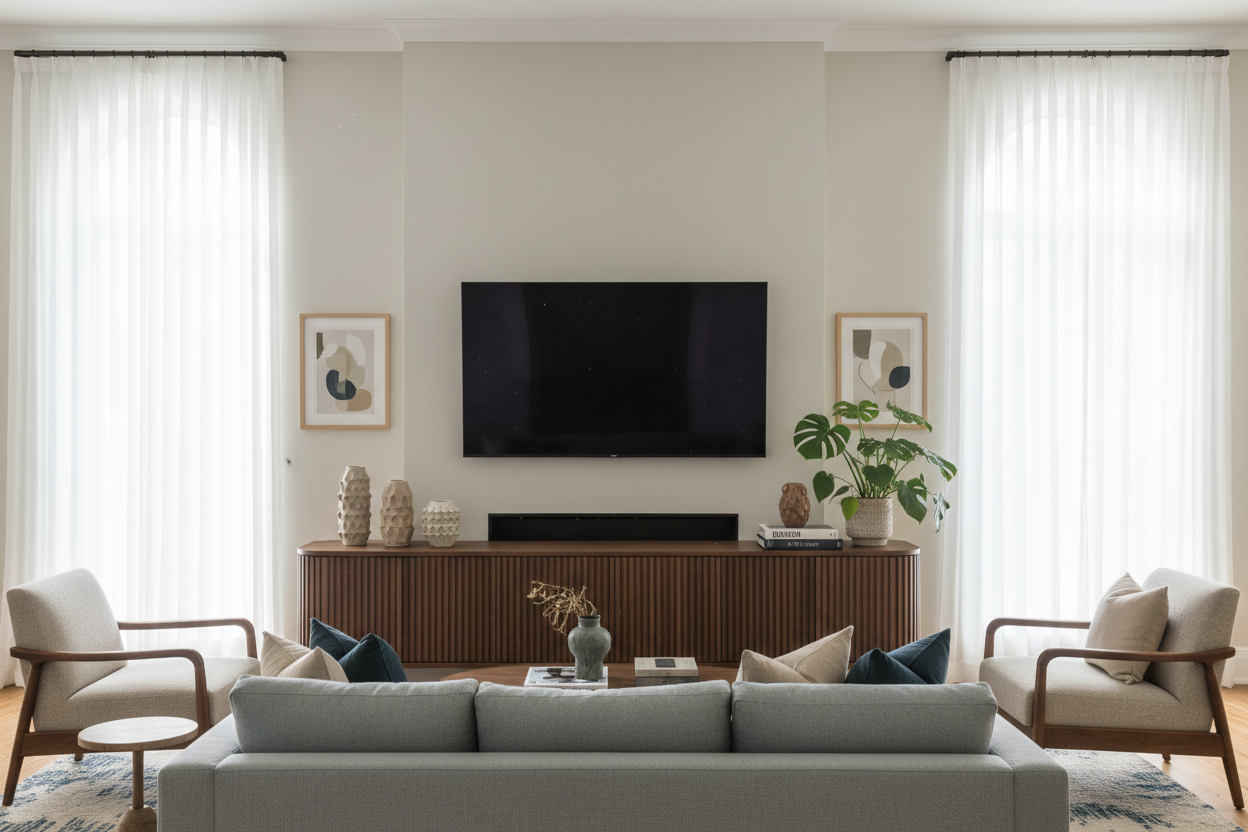
I spent three hours last night scrolling through Reddit threads where people get roasted for their TV placement. It is a specialized kind of internet cruelty. But honestly, I get it—nothing ruins a room's vibe like a screen that feels like it is floating away toward the ceiling. When I first considered a sideboard with tv above, I was terrified I would end up with a stiff neck and a living room that looked like a local Buffalo Wild Wings.
Quick Takeaways
- Aim for a 4 to 6-inch gap between the top of the sideboard and the bottom of the TV.
- Most standard sideboards are 30-34 inches tall; anything higher requires a very deep sofa to maintain viewing angles.
- The sideboard should always be wider than the TV to avoid a top-heavy 'mushroom' look.
- Use low-profile decor like coffee table books to bridge the visual gap without blocking the screen.
The Fear of the 'TV Too High' Police
The internet's obsession with 'TV mounting crimes' has made us all a little paranoid. We have been conditioned to think that if a screen isn't hovering exactly 24 inches off the floor on a low-slung media console, it is a failure. But let's be real: those ultra-low units often look like they belong in a college dorm, not a grown-up home. People are terrified of moving away from standard media stands because they fear the ergonomics police, but a taller piece of furniture adds a level of sophistication that a 15-inch tall particle board bench just can't match.
Why I Chose a Sideboard With TV Above Anyway
I ditched my low-profile media unit two years ago. It felt like a visual black hole in my living room. I wanted something with weight, something that didn't look like it was made of toothpicks. I found that a buffet makes the perfect tv stand because it actually hides the clutter of routers, gaming consoles, and those random HDMI cables we all hoard. A 70-inch sideboard makes a 55-inch TV look intentional and anchored. It turns the TV into part of a 'vignette' rather than just a piece of tech stuck to a wall.
The Math: Getting the TV Above Sideboard Gap Right
Let's talk real numbers. Most dining sideboards sit around 30 to 34 inches high. If you want to hang a tv above sideboard units, you want the bottom of the screen to sit about 4 to 8 inches above the furniture surface. If you go higher, you get that 'floating into space' look that makes the room feel disjointed. The goal is to have your eye level hit the bottom third of the screen when you are sitting on your sofa. If your sideboard is 32 inches tall and your TV is 30 inches tall, the center of your screen will be around 48 inches high—which is perfectly fine for most modern living rooms.
Styling the Awkward Gap (Without Blocking the Sensor)
The gap is where most people panic. They leave it empty, and the TV looks like it is trying to escape. Or they put a massive vase of pampas grass in front of it that blocks the IR sensor. I like using a storage credenza with sliding glass doors to keep the base interesting but clean. On the surface, stick to horizontal items. Think a stack of two thick art books, a long marble tray, or a very low, wide wooden bowl. These items bridge the distance between the wood and the glass without competing with your Netflix menu.
Does This Look Actually Work in Small Rooms?
In small apartments, floor space is gold. We are often told to buy 'small' furniture, but a sea of tiny pieces makes a room look cluttered. A tall, narrow sideboard often has a smaller footprint than many traditional TV stands that are built deep to accommodate old-school tech. By drawing the eye up, you are actually making the ceiling feel higher. It is a classic styling trick: use verticality to distract from a lack of square footage. Just make sure the piece isn't so deep that it eats up your walkway.
My Biggest Mistake
I once bought a vintage 36-inch tall mahogany buffet for my tiny living room. I loved the wood grain, but I mounted the TV way too high—about 12 inches above the surface because I wanted to display a pair of tall candlesticks. For three months, I watched movies with my chin tilted up like I was in the front row of a movie theater. It was miserable. I eventually ditched the candlesticks, lowered the TV to just 4 inches above the wood, and the room finally felt balanced. Trust me, the 'math' matters more than the decor.
FAQ
How high is too high for a sideboard under a TV?
Anything over 36 inches is pushing it. Unless you have a massive room where the sofa is 15 feet away, a 36-inch base plus a 5-inch gap will put the screen too high for comfortable viewing.
Should the TV be wider than the sideboard?
Never. Your sideboard should be at least 6 to 10 inches wider than the TV. If the TV is wider, the whole setup will look top-heavy and unstable.
How do I hide the wires?
Since sideboards don't always have cable management holes, you'll want to use a recessed cable box behind the TV or a simple cord cover painted the exact color of your wall to keep it clean.


Leave a comment
This site is protected by hCaptcha and the hCaptcha Privacy Policy and Terms of Service apply.