

















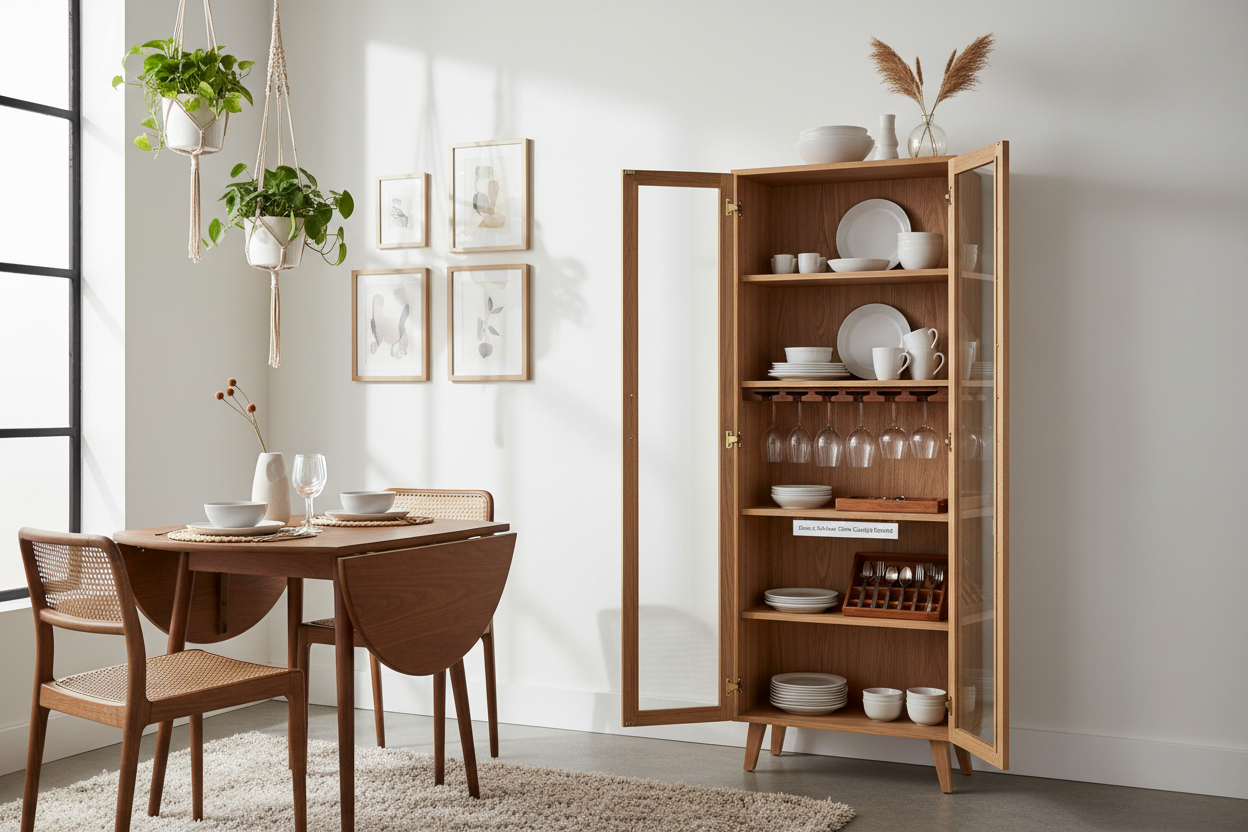
I spent three years shimmying sideways past my grandmother’s cherry wood hutch every time I wanted to host a dinner party. It was a beautiful piece of craftsmanship, but at 20 inches deep, it was basically a parked SUV in my 11-foot-wide dining room. I finally hit my breaking point when a guest accidentally elbowed a glass of Malbec because the clearance between their chair and the cabinet was roughly the width of a credit card.
That’s when I started obsessing over the shallow china cabinet. I was terrified I’d have to get rid of my favorite serving platters or that a slimmer unit would look like a glorified medicine cabinet. I was wrong. After swapping the heirloom for a 13-inch deep model, I realized we’ve been over-estimating how much depth we actually need for dishes.
- Most standard dinner plates are only 10.5 to 11 inches wide, leaving plenty of room in a 13-inch cabinet.
- Trading depth for height preserves your total storage volume without eating up floor space.
- Shallow cabinets prevent the lost in the back syndrome where you forget about the bowls behind the bowls.
- You gain vital walk-around space, which is the difference between a cramped room and a comfortable one.
The Problem With Standard 18-Inch Deep Hutches
Traditional dining furniture was designed for a world where houses had dedicated, cavernous formal dining rooms. In those spaces, a massive 18-to-22-inch deep hutch acted as an anchor. But most of us are living in apartments or modern builds where the dining room is really just a slightly wider section of the hallway or a corner of the kitchen.
When you put a standard-depth hutch in a small room, you lose the ability to pull out chairs comfortably. You’re essentially sacrificing 20% of your floor plan to store things you only use twice a year. I’ve found that stealing back just a few inches of floor space can completely change the flow of a room with a shallow depth display cabinet.
The extra six inches I gained didn't just make the room look bigger—it made it functional. I no longer have to ask people to suck it in so I can get to the kitchen. If your room feels like an obstacle course, the furniture is the problem, not the square footage.
How Deep Does a Cabinet Actually Need to Be?
Let’s look at the actual math, because furniture marketing loves to sell heft as a proxy for quality. I took a tape measure to my entire kitchen. My standard dinner plates? 10.5 inches. My oversized fancy chargers? 12 inches. Even my stack of heavy stoneware bowls only needs 9 inches of clearance. The 18-inch depth of traditional hutches is mostly dead air or a graveyard for mismatched Tupperware you will never use.
A narrow depth china cabinet usually clocks in between 11 and 14 inches. That is the Goldilocks zone. You have enough room for a stack of 12 plates without the edges touching the glass, but not so much room that things get buried in the dark recesses of the shelf. It forces you to stay organized, which is a hidden blessing.
If you’re worried about losing total storage capacity, look up. I’m a huge fan of going for a 74 inch tall china cabinet to gain back the storage volume you lose in depth. Verticality is your best friend when square footage is at a premium. A tall, slim piece feels intentional and architectural rather than bulky and intrusive.
What Actually Fits Inside a Narrow Depth China Cabinet?
I managed to fit my entire 12-person service set into a 13-inch deep unit, and it actually looks better than it did before. In a deep cabinet, you tend to stack things three rows deep. In a shallow one, everything is front-and-center. I have my dinner plates stacked on the bottom shelves, salad plates on top of those, and my glassware arranged in neat rows of four.
Wine glasses are usually only 3 inches wide, so you can fit a surprising amount of stemware in a slim case. I even tucked in my bulky pasta bowls—which are 9 inches in diameter—without any overhang. The only things that didn't make the cut were my massive turkey platter and a literal punch bowl. Those went into the top of the pantry where they belong 364 days a year anyway.
I recently helped a friend set up a white display case with glass doors because the bright interior makes her vintage green glassware pop. Because the cabinet is shallow, the light actually hits the back of the unit. In her old deep hutch, the back corners were always in shadow, making the whole room feel darker.
Styling Tricks So It Doesn't Look Like a Medicine Cabinet
The biggest risk with a shallow piece is that it can look a bit flat or clinical if you just line things up like a grocery store shelf. To avoid this, you need to play with layers. Lean a few decorative salad plates against the back wall instead of stacking them all flat. This creates a sense of depth even when there isn't much physical space to work with.
Lighting is also non-negotiable. If your cabinet doesn’t come with built-in LEDs, buy some battery-powered puck lights. Illuminating the glass shelves prevents that medicine cabinet vibe by creating highlights and shadows. I also suggest choosing a piece with some high-contrast framing. Choosing a black cabinet with glass doors creates a shadowbox effect that adds visual depth and makes white porcelain look much more expensive.
Mix in a few non-dish items too. A small potted plant or a few leather-bound cookbooks can break up the monotony of glass and ceramic. In a shallow space, every object is high-visibility, so curate it like a gallery. If it’s ugly, hide it in a drawer or don’t put it in the cabinet.
My Verdict: Is the Space Savings Worth It?
After a year with my slimmed-down setup, I can confidently say I will never go back to a full-depth hutch. The trade-off is simple: I gave up the ability to store a giant roasting pan in my dining room, and in exchange, I gained three feet of walkable space. That is a bargain in any zip code. My dining room feels like a room again, not a storage unit with a table shoved in the middle.
The best part? These pieces are so versatile that they are often narrow enough for a hallway if you ever move to a place with a bigger dining area. I’ve seen people use them for books in a home office or even linens in a wide bathroom. It’s a piece of furniture that actually adapts to your life instead of demanding you build your life around it.
Will my 12-inch chargers fit?
Check the internal dimensions carefully. Most 13-inch cabinets have about 11.5 to 12 inches of actual shelf depth once you account for the back panel and the door frame. If your chargers are exactly 12 inches, they usually fit if you don't mind them being flush against the glass.
Do shallow cabinets tip over easily?
Yes, more so than deep ones because their center of gravity is higher and the base is narrower. You absolutely must use the anti-tip wall anchors that come with the unit. I have mine bolted into a stud; do not trust drywall anchors alone for a cabinet full of heavy glass.
Can I store small appliances in one?
Probably not. Most stand mixers and air fryers need 14-16 inches of depth. Keep the shallow cabinet for your plates, glassware, and booze, and leave the heavy machinery for the kitchen counters or a deeper pantry.


Leave a comment
This site is protected by hCaptcha and the hCaptcha Privacy Policy and Terms of Service apply.