

















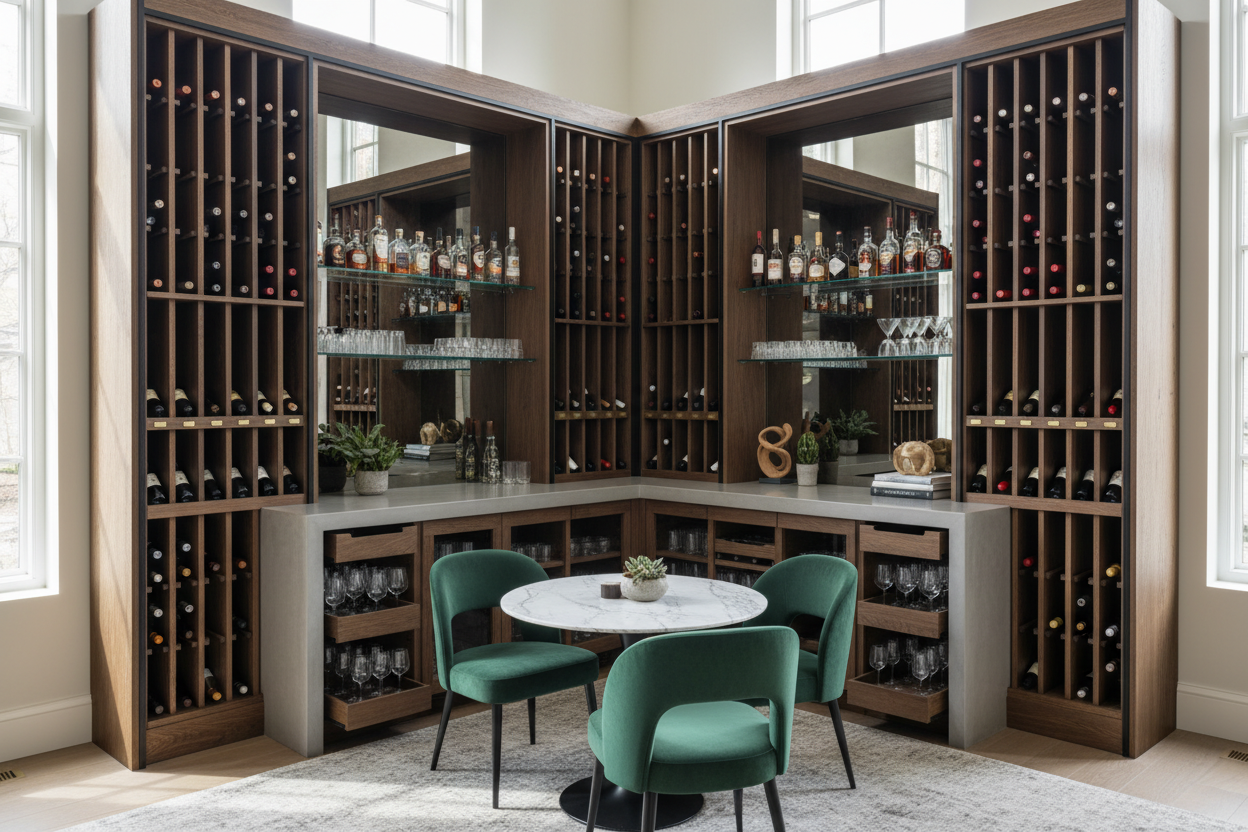
I once spent three hours trying to angle a mid-century armchair into a corner of my living room, only to realize I’d created a literal trap for dust bunnies and a visual dead zone. Most of us have that one weird 90-degree angle that defies logic—too small for a bookshelf, too awkward for a floor lamp. If you are staring at an empty wedge of drywall, stop thinking about filler and start thinking about utility. Corner wine racks are the ultimate spatial hack for disjointed rooms because they turn a structural necessity into a destination.
- Maximizes vertical space in rooms with limited square footage.
- Eliminates kitchen counter clutter by moving bottles to the perimeter.
- Provides a dedicated 'bar zone' without the footprint of a full sideboard.
- Anchors the room visually, making awkward corners feel intentional.
The 90-Degree Dilemma (And Why Fake Plants Aren't the Answer)
I’ve seen people shove a dusty faux olive tree into a corner and call it decor. It’s not decor; it’s a surrender. When you have a dead corner in an open-concept space, your first instinct is to hide it. But in a small apartment or a packed dining room, you can't afford to waste 4 square feet on a plastic plant. This is where functional corner wine storage comes in. It takes that 'void' and gives it a job.
If you’re like me, I refuse to keep bottles on the counter because it makes the kitchen look like a frat house basement. Moving your collection to a dedicated corner wine rack cabinet clears up your prep space and actually makes your home feel like an adult lives there. It’s about taking a problem area and making it the most sophisticated spot in the room.
My Favorite Corner Wine Rack Ideas for Weird Spaces
Not every corner requires the same vibe. If you’re working with a bright, airy kitchen, a white corner wine rack blends into the walls and keeps things feeling light. For those of us with a bit more of an industrial or 'library' aesthetic, a metal corner wine rack offers a slim profile that doesn't feel heavy. I personally love a rustic corner wine rack made of solid mango wood or reclaimed oak; the texture adds warmth to a part of the room that usually feels cold and neglected.
When browsing corner adapted storage, look for pieces that don't just sit in the corner but actually hug the walls. A modern corner wine rack with clean lines and glass accents can act as a focal point, whereas a wooden corner wine rack feels more like a built-in feature. The goal is to make the piece look like it was commissioned specifically for that 90-degree angle.
Small vs. Tall: Sizing Your Wine Rack Corner Unit
Size matters here. A small corner wine rack or a small corner wine cabinet is great if you just want a landing pad for six bottles and a corkscrew. It acts as an accent piece—perfect for under a window or next to a low-slung sofa. But if you have high ceilings, you are doing yourself a disservice by staying low. A tall corner wine rack draws the eye upward, making the whole room feel more expansive.
I’ve tested a few tall corner wine cabinet options that reach nearly six feet high. They function almost like a corner wine cellar, providing enough room for 20+ bottles without taking up more than two feet of floor width. If you want to go big, look for a large display cabinet corner shelf that offers a mix of bottle cubbies and open shelving for your decanters and cocktail books.
Why You Should Combine Your Stemware and Bottles
There is nothing more annoying than grabbing a bottle of Malbec from the dining room and then having to trek back to the kitchen for a glass. A corner wine glass cabinet or corner cabinet wine storage with built-in hanging racks solves this. It creates a self-contained station. When I’m hosting, I want everything in one spot so I’m not constantly leaving the conversation to hunt for a clean Bordeaux glass.
I always tell my clients to get a wine rack and drinks cabinet hybrid if they can. A wine rack corner unit that features a small prep surface is a total win. You can pour the wine right there, which prevents those inevitable red wine drips on your main dining table or kitchen island. It’s about efficiency as much as it is about style.
Don't Forget the Baseboards (A Quick Measuring Warning)
Here is the mistake I made early on: I bought a gorgeous corner wall wine rack and realized it wouldn't sit flush because of my 5-inch Victorian baseboards. Whether you choose a wine rack corner shelf or a floor-standing unit, measure the thickness of your trim. Most corner wine rack shelves are designed with a slight inset at the bottom, but some cheaper models are just straight blocks that leave a weird 1-inch gap against the wall.
Check if the unit has leveling feet. Floors are rarely perfectly flat, especially in older buildings. A metal corner wine rack with adjustable feet is much easier to stabilize than a heavy wooden one that might need shims. Take the extra five minutes to measure the 'depth' from the corner out to the edge of your door frames—you don't want your new furniture sticking out into the walkway.
FAQ
Do corner wine racks need to be anchored?
Yes, especially if they are tall and narrow. Once you load 15 bottles of wine onto a rack, it becomes top-heavy. Always use the anti-tip kit that comes with the unit, particularly if you have kids or live in an earthquake-prone area.
How many bottles can a small corner wine rack typically hold?
Most small units hold between 6 and 12 bottles. If you need more than that, you should look into a tall cabinet or a modular system that uses the entire height of the wall.
Can I put a wooden corner wine rack in a basement?
Only if the basement is climate-controlled. High humidity can warp the wood and ruin your labels (or worse, the corks). For damp basements, a powder-coated metal rack is a much safer bet.

Leave a comment
This site is protected by hCaptcha and the hCaptcha Privacy Policy and Terms of Service apply.