

















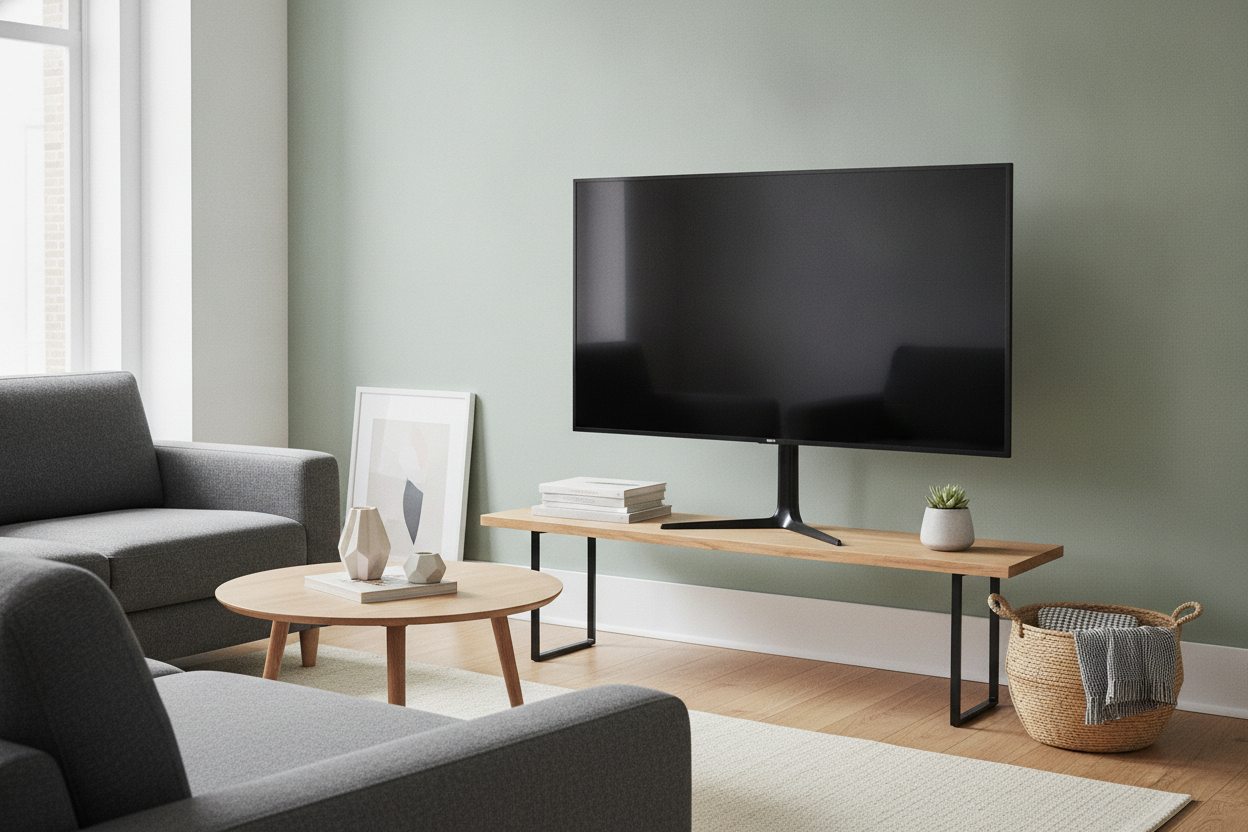
I still remember the gut-punch feeling of unboxing my first 65-inch OLED. I had spent three weeks researching refresh rates and black levels, only to realize I’d forgotten the most basic law of physics: the thing actually has to sit on something. I hoisted that massive glass panel onto my favorite mid-century credenza and watched in horror as the left leg dangled precariously over the edge. My 'perfect' setup was two inches away from a thousand-dollar disaster on the floor. That is when I discovered the tabletop tv stand 65 inch replacement base, and quite honestly, I haven't used factory legs since.
Quick Takeaways
- Universal VESA mounts allow a 65-inch TV to sit on a base as narrow as 12 inches.
- Replacement stands offer height adjustability that factory legs lack.
- Swivel functions help manage glare from windows or side-angle viewing.
- Heavy tempered glass bases provide a lower center of gravity for better stability.
The Edge-Mounted Leg Epidemic (And My Near-Disaster)
Manufacturers have a weird obsession with what I call 'chicken legs.' Instead of a sturdy central base, most modern 65-inch screens come with two spindly plastic feet that you have to screw into the far corners of the frame. It’s an engineering choice meant to save them money on shipping weight, but it’s a nightmare for anyone living in a real-world apartment. If your TV is 57 inches wide and your dresser is only 50 inches wide, you are effectively stuck. I tried the 'diagonal' placement for about ten minutes before realizing it looked like I was living in a dorm room.
The panic is real. You’ve just spent a significant chunk of your paycheck on a screen that promised a cinematic experience, but now it’s sitting on the carpet because your furniture is 'too small.' I see people making the mistake of buying a whole new $600 media console just to accommodate the 55-inch spread of the factory legs. Don't do that. You don't need a longer table; you just need a better anchor point. A central pedestal fixes the footprint problem instantly by moving the support from the edges to the middle.
When I finally swapped my factory legs for a heavy-duty base, the relief was immediate. No more measuring the distance between the feet and praying the wood wouldn't splinter under the concentrated pressure at the very edges of the console. It also just looks more expensive. There is something about a central pedestal that mimics the look of high-end gallery displays rather than a budget plastic stand.
What Exactly Is a Replacement Pedestal Base?
Think of a replacement base as a wall mount that doesn't require a drill. It uses the same four VESA mounting holes on the back of your TV—the ones usually hidden by little plastic caps. You bolt two vertical brackets to the TV, then hook those brackets onto a heavy steel pillar that is bolted to a weighted base. It sounds complicated, but it’s usually just eight bolts and about fifteen minutes of your life. The beauty is that the base itself usually only takes up about 15 to 20 inches of horizontal space.
This setup is incredibly versatile. If you eventually decide that 65 inches isn't enough (we’ve all been there), many of these mounts are cross-compatible. I’ve seen people use a similar table top tv stand 75 inch base for their massive theater-room upgrades. The mechanics are the same: you’re shifting the weight to a central point, which gives you total freedom over what kind of furniture you put underneath. You can put a massive screen on a small, antique side table if the weight capacity allows it.
3 Reasons to Ditch the Factory 'Chicken Legs'
First, let’s talk about the 'Soundbar Gap.' Factory legs are almost always too short. If you have a decent soundbar, it’s going to sit right in front of the IR sensor or, worse, block the bottom two inches of the screen. A replacement tabletop tv stand 65 inch mount lets you height-adjust the screen. I usually set mine about six inches above the console, which leaves plenty of room for my Sonos Arc without cutting off the subtitles during a movie.
Second, is the swivel factor. Most factory legs are static. If the sun hits your screen at 4 PM and causes a massive glare, you’re stuck physically dragging the whole console across the floor. With a pedestal base, you can usually swivel the screen 30 degrees in either direction with one finger. It’s a lifesaver for open-concept apartments where you might want to turn the TV toward the kitchen while you’re cooking dinner.
Third, and most importantly, is the cost. You can find a high-quality steel and glass stand for less than the price of a nice dinner. Compare that to the cost of traditional living room TV stands, which can easily run into the hundreds or thousands if you need something wide enough for a 65-inch screen's factory footprint. You’re essentially spending $40 to save $400, and you get better features in the process. It's the ultimate furniture hack for renters who can't mount things to the wall.
The Wiggle Test: Is It Actually Secure?
I get this question a lot: 'Is it going to tip over?' It’s a valid fear. A 65-inch TV is basically a giant sail made of glass. However, these replacement stands are often more stable than the factory feet. The bases are usually made of heavy tempered glass or solid steel, weighing 10 to 15 pounds on their own. This lowers the center of gravity significantly. When I did the 'wiggle test' on my table top tv stand 65 inch setup, the TV barely moved. The factory legs, by comparison, felt like they were made of recycled soda bottles.
To ensure it’s sturdy enough for a 65 inch, you need to check two things: the VESA pattern and the weight limit. Most 65-inch TVs weigh between 45 and 65 pounds. Most stands are rated for 80 to 110 pounds. As long as you aren't trying to mount a plasma TV from 2008, you’re well within the safety margins. Just make sure the bolts are tightened properly and the base is sitting on a flat, level surface. If you have kids or rowdy pets, you can even find models that include a safety cable to tether the stand to the back of your furniture.
When You Actually *Should* Buy a New Console
While I love a good pedestal base, it can’t solve everything. If your current media stand is made of thin particle board and is already bowing in the middle, adding a heavy 65-inch TV—even with a central base—is a recipe for a collapse. In that case, it’s time to look for something structurally sound. If you want a clean, minimalist look that hides all the wires, a high gloss entertainment center is a great way to lean into that modern aesthetic while providing a much wider, more stable platform.
There’s also the 'vibe' check. Sometimes a replacement stand looks a bit too industrial for a cozy, traditional room. If you’re looking to make the TV area a focal point rather than just a screen on a stick, you might want something with more presence. A white TV stand with a built-in fireplace can add that warmth and architectural detail that a metal stand simply can't. It’s all about whether you’re trying to solve a functional problem or if you’re ready for a total room refresh. If your furniture is sturdy and you just hate the legs, get the stand. If your furniture is ugly and falling apart, get the console.
FAQ
Will a universal stand fit my specific TV brand?
Yes, as long as your TV has VESA mounting holes on the back. Almost every Samsung, LG, Sony, and Vizio made in the last decade uses these standard holes. Just check your manual for the VESA size (like 400x400).
Can one person assemble this alone?
You can assemble the stand itself alone, but you definitely need a second person to help you lift a 65-inch TV onto the stand. Trying to do it solo is a fast track to a cracked screen.
Does the glass base break easily?
It’s tempered safety glass, so it’s incredibly tough. It’s designed to hold a lot of weight, but like any glass, you should avoid dropping heavy metal tools on it during assembly.

Leave a comment
This site is protected by hCaptcha and the hCaptcha Privacy Policy and Terms of Service apply.