
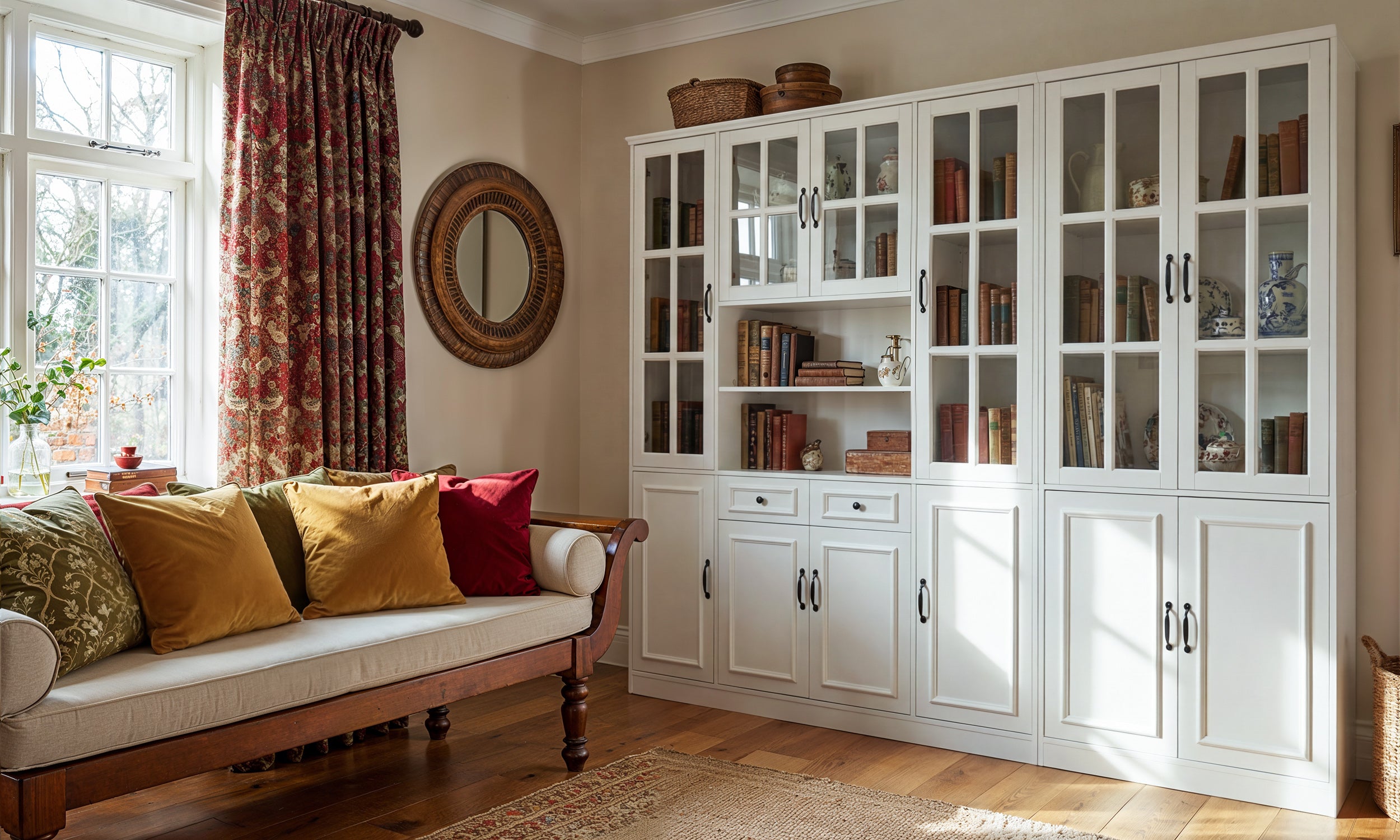
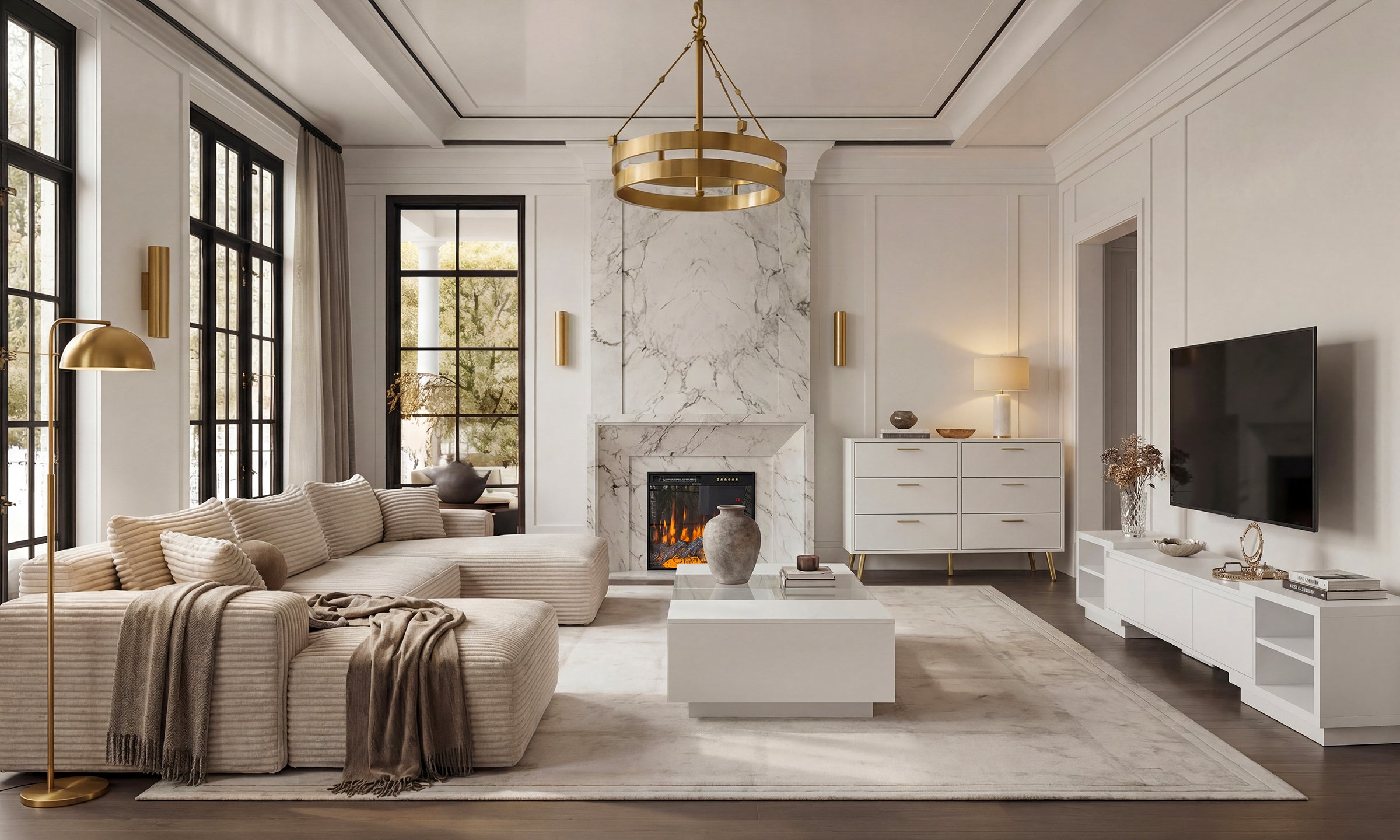


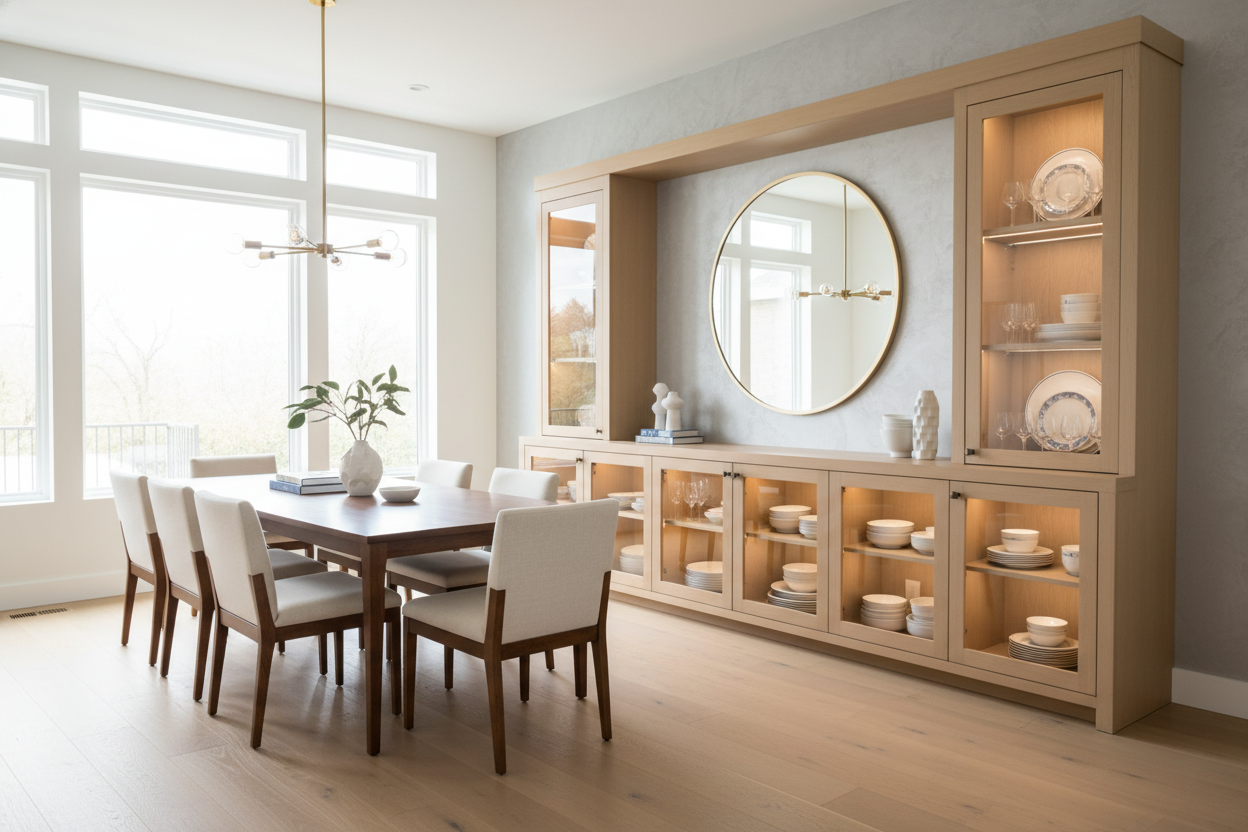
Yes, you can put a china cabinet in the living room. A china cabinet is simply "a cabinet or cupboard for storing or exhibiting chinaware" (Dictionary.com lists it as a variation of "china closet"), and nothing in that ties it to the dining room. It works in a living room when the wall is wide enough, the doors can open without blocking a walkway, it sits out of direct sun and away from heat, and it is anchored to the wall.
Below: where a china cabinet in the living room goes, the clearance arithmetic, what a TV, a window and a fireplace change, and six picks from the FUFU&GAGA living room collection.
Key takeaways
- Floor space: cabinet depth plus a 36-inch walkway. A 15.7-inch-deep cabinet needs 51.7 inches from the wall.
- Doors: a hinged door needs about its own width of clear floor, roughly 16 to 18.5 inches on our picks.
- Sun and heat: china barely fades, but books, photos and wood finishes do. Avoid direct sun, fireplaces and heat vents.
- Anchoring: the U.S. Consumer Product Safety Commission (CPSC) says to anchor furniture with drawers, doors and shelves to the wall.
Can you put a china cabinet in the living room?
Yes, and often it is the better room. An heirloom cabinet may have no dining room to go to, a small dining area may not spare the 12 to 16 inches of depth a cabinet takes, and the living room usually has the longest unbroken wall.
It also gives the cabinet more to do: the glass section shows the pieces you like looking at, while drawers or a closed base take board games, photo albums, blankets and barware. To stop it looking like dining furniture that lost its room, choose the spot on purpose and display more than dinner plates.

Where to put a china cabinet in the living room: 6 ideas
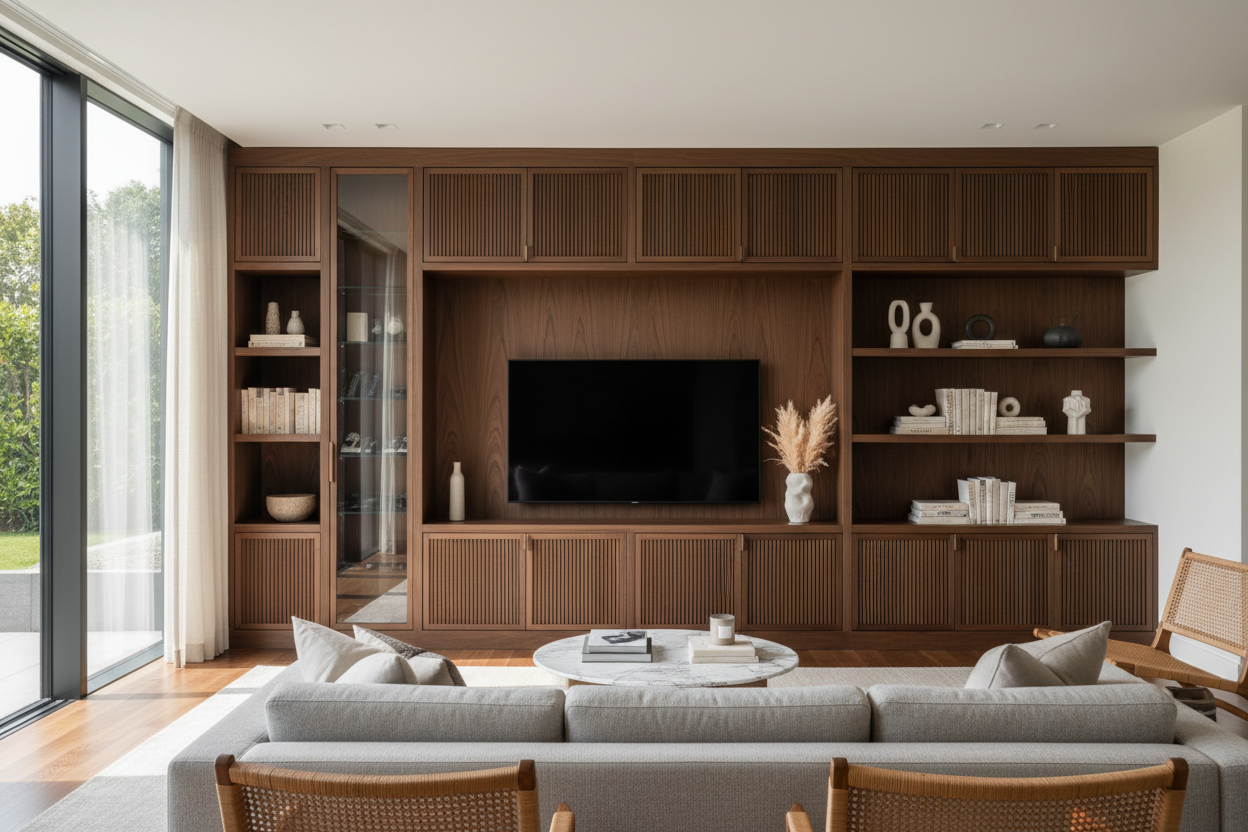
- Beside the TV. A tall, narrow cabinet on one or both sides of the console turns a bare media wall into storage. Measure the wall, subtract the console and halve the rest.
- Flanking the sofa. Two matching narrow cabinets frame a sofa the way bookcases would.
- Beside a fireplace. The recesses either side of a chimney breast suit display cabinets, but only where the fireplace is decorative or seldom used.
- In an alcove. Measure the width at the floor, the middle and the top, and buy for the narrowest figure. A door that opens against a side wall stops at about 90 degrees.
- Between two windows. Measure between the window casings, not the glass, and check that curtains still close.
- Facing the sofa, or near a corner. Opposite the sofa, the cabinet is what the room looks at when the TV is elsewhere. Near a corner it sits out of the main path.
How much floor space does it need? Walkway and door swing
The clearest published walkway figure is an accessibility rule. The U.S. Access Board's guide to accessible routes says the continuous clear width must be at least 36 inches, with 32 inches allowed for short distances such as doorways. It is written for public buildings, not homes, but it is a sound benchmark for a living room's main path.
So set aside the cabinet's depth plus 36 inches, then check the doors: a hinged door swings out by about its own width. Figures are in inches. Door width is the overall width divided by the doors across, so real doors are slightly narrower.
| Pick | Depth | Depth + 36 | Doors across | Door width (estimate) | Reach, doors open |
|---|---|---|---|---|---|
| 15.7" slim bookcase | 11.5 | 47.5 | 1 | 15.7 | 27.2 |
| Geyma 31.5" | 15.7 | 51.7 | 2 | 15.8 | 31.5 |
| 37" 4-tier | 15.9 | 51.9 | 2 | 18.5 | 34.4 |
| Varda 47" | 14.2 | 50.2 | 3 | 15.7 | 29.9 |
| Sofna 63" | 15.7 | 51.7 | 4 | 15.8 | 31.5 |
| Varda 79" | 14.2 | 50.2 | 5 | 15.7 | 29.9 |
With its doors open, the Geyma cabinet reaches about 31.5 inches from the wall (15.7 + 15.8), so a coffee table or sofa arm closer than that stops the door. If you allowed 51.7 inches in total, an open door leaves 20.2 inches of path (51.7 - 31.5), which is fine only while you lift out a plate.
What size china cabinet suits the wall and the sofa?
The wall. On a 12-foot wall (144 inches), a 31.5-inch cabinet covers 22 percent, a 47.2-inch one 33 percent, a 63-inch one 44 percent and a 78.7-inch one 55 percent. There is no standard; as a plain guide, a quarter of the wall looks like an accent and half looks like a wall unit.
The sofa. For a cabinet at each end of a sofa, subtract the sofa's width from the wall and halve the rest. If the wall is 144 inches and the sofa 84, that leaves 30 inches a side: a 31.5-inch cabinet does not fit, but the 15.7-inch slim bookcase does, with 14.3 inches spare (30 - 15.7). A 72-inch loveseat leaves 36 inches a side, enough for a 31.5-inch cabinet.
The ceiling. Four of our picks are 78.7 inches tall, which leaves 17.3 inches under an 8-foot (96-inch) ceiling. If you build one lying down and tip it upright, it needs its diagonal: about 80.3 inches at 15.7 inches deep.
For a cabinet that may move to a dining area later, see our small china cabinet guide.

A china cabinet beside the TV: glare and reflections
Glass doors act like a dark mirror: they reflect whatever is opposite and brighter than the cabinet's interior. These points are plain observation, not a published standard, so test them in your room.
- Same wall as the TV: the glass reflects the room behind the sofa, not the screen. A lit interior beside a dark film scene distracts, so switch the cabinet lights off while you watch.
- Wall opposite the TV: the cabinet's lights or pale contents can reflect in the screen. Before you anchor it, sit in each seat with the TV off and look for the cabinet in the black screen.
- Side wall: at a right angle to the screen, neither problem arises.
To size the console between two cabinets, use our TV stand size chart. Do not stand a TV on the cabinet, and above a tall one the screen would sit far over seated eye level. The CPSC's Anchor It! guidance says "Televisions should only be placed on furniture designed to hold a television, such as television stands or media centers."

Sunlight and heat: what fades and what does not
The china is the least of your worries. The Canadian Conservation Institute (CCI) page on light, ultraviolet and infrared puts the colors of ceramics and true glass enamels in its "no sensitivity" group. Its note on ceramics and glass adds that this holds only for pieces in good condition, and that glass should never sit "in a sunny place or under spotlights where it might become very warm."
What shares the shelves is more fragile. CCI's light page says some colors can disappear "within as little as a few hours of direct sunshine". The Library of Congress guidance on light rates all color photographic processes as very light sensitive.
The cabinet matters too, especially an heirloom. CCI's basic care for wooden furniture says light "can turn light woods dark, and bleach out dark woods", and advises: "Do not place furniture in direct sunlight (the use of blinds or curtains will help limit direct sunlight)" and "Avoid placing pieces next to fireplaces or baseboard heaters, or over heat vents."
In practice, choose a wall the sun does not land on, or close curtains or blinds during the hours it does, and keep books, photographs and textiles on the shelves farthest from the window. Near a working fireplace or stove, treat the manual's clearance to combustibles as the minimum.
Lighting the cabinet
Four of the six picks below have LED lighting built in, which matters in a room used mostly in the evening. Check where the nearest outlet is before you choose the wall. Our display cabinet lighting guide covers light color, placement and adding lights to a cabinet that has none.
What to display besides china
Give one or two shelves to the china or the heirloom set, then mix in:
- Books: upright and in short flat stacks. They are heavy, so check the shelf rating.
- Glassware: decanters, colored glass and stemware; our glassware display guide covers spacing.
- Collectibles: figures, models and travel finds, which stay cleaner behind doors.
- Framed photos: on the shelves that get the least daylight.
- Everyday storage: games, albums and chargers in drawers or behind solid lower doors.
Our picks are rated for 25 to 35 lb per shelf, as listed. If unsure about a stack of plates or books, weigh it on a bathroom scale first.
Safety: glass doors, children and tip-over
Tip-over. The CPSC's Anchor It! campaign states that "Anchoring all furniture with drawers, doors, and shelves to the wall prevents tip-over injuries and deaths." A CPSC release from February 2026 counts an average of 17,800 tip-over injuries a year treated in U.S. emergency departments (2020 to 2022), 44 percent of them to people under 18. It advises anchoring furniture to the wall, keeping heavier items on lower shelves, and not storing tempting items such as toys and remotes on higher shelves.
All six picks list a tip-over restraint or anti-tip hardware. Fit it the day you build the cabinet; our guide to anchoring a bookcase to the wall covers wall types.
Glass. Glass maker Cardinal's glossary describes tempered glass as heat-treated safety glass that shatters into very small particles, reducing the risk of serious injury. Treat a door as tempered only where the listing says so.
Children. Push-to-open glass doors, as on the Geyma and Varda 47" cabinets, open for a toddler as easily as for you, and none of the six lists a lock. Keep breakables high and heavy pieces low.
How to style a china cabinet in the living room
Edit before you arrange. A cabinet packed edge to edge looks like storage; one with empty space on every shelf looks like a display. Vary the heights, mix the china with books and a few objects, and repeat one color or material from the room.
Then deal with the wall around it. A cabinet alone on a long blank wall looks stranded, so hang art, a mirror or a pair of sconces beside it, or add a plant or a chair. If a dark heirloom cabinet feels heavy, lining the inside in a pale color brightens the display.
Buying checklist
- Wall width: clear wall between corners, door casings and windows.
- Floor depth: cabinet depth plus 36 inches for a main walkway.
- Door swing: reach with doors open, against the coffee table and sofa.
- Sun and heat: no direct sun on the doors; not beside a working fireplace or over a vent.
- Shelf rating: listed weight per shelf against what you will load.
- Glass, lights, anchoring: as the listing states them, with an outlet in reach and a wall you can fix into.
Our picks: six glass-door cabinets for a living room
All six arrive flat-packed. Features and ratings are as each listing states them; sizes are in the table that follows.
15.7" White Slim Bookcase with Glass Door
The narrowest and shallowest pick (11.5" deep), for the strip of wall beside a TV console, sofa or doorway. A glass door covers the top three of its 5 tiers and a solid door hides the rest. Shelves are listed at 14" W x 11" D and 35 lb each, and a tip-over restraint is included. The title says tempered glass; the specifications say only "glass".
Best for: a pair flanking a TV or sofa, or one in a narrow alcove.
Skip it if: you want to show full place settings (measure your largest plate against the 11" shelf depth) or want built-in lighting.
Geyma 31.5" Display Cabinet with LED Lights and 3 Drawers
The narrow-wall pick with lights and hidden storage. Two clear glass doors open with a push latch onto three wood shelves, each listed at 15" high and 30.3" wide and rated for 33 lb, under LED lighting. Three drawers sit below, and a tip-over restraint is included. The listing does not state the glass type or how the lights are powered.
Best for: a short wall between two windows or beside a doorway.
Skip it if: you need more than three display shelves, shelves you can move (not listed as adjustable), or doors a toddler cannot push open.
37" Gray Oak 4-Tier Display Bookcase with Lights
The shorter pick at 69.3" high, which leaves wall above for art. Two clear glass doors and glass side panels enclose four compartments, each listed at 15" H x 29.9" W x 15.5" D and rated for 25 lb, with warm LED lighting. A tip-over restraint is included; the glass type is not stated.
Best for: a display seen from the side as well as the front, such as at the end of a sofa.
Skip it if: you need closed storage, or plan heavy loads: 25 lb per shelf is the lowest rating of the six.
Varda 47" Display Cabinet with LED Lights and Open Shelf
One of our most-ordered display cabinets, in black or white. Six push-to-open glass doors in aluminum frames, described in the listing as tempered, sit above and below an open center shelf and three drawers. LED strips switch between cool white, warm white and neutral. Shelves are listed at 30" W x 13.5" D and 30 lb each, on 4 tiers. Wall mounting is required, with hardware and a tip-over restraint included; the lights' power source is not stated.
Best for: a black, lit display wall beside the TV or facing the sofa.
Skip it if: you cannot fix furniture to the wall (the listing requires it), or a toddler can reach the push-to-open doors.
Sofna 63" White 2-Drawer Bookcase with Glass Doors
The wide pick with a closed base. The top has four clear glass doors around two open shelves (31" W x 10.8" H), and it is the only pick whose specifications list tempered glass as the door material. Below are two drawers and four cabinet doors. The listing counts 13 adjustable shelves, each rated for 33 lb. Anti-tip hardware anchors it to the wall, and three people are recommended for assembly.
Best for: an heirloom china set plus everyday living room storage on one wall.
Skip it if: you want built-in lighting (none is listed) or the wall cannot spare 63".
Varda 79" Bookcase with Glass Doors and 3-Color Lights
The full-wall pick, in black or white. Eight clear glass doors, five drawers and an open countertop share the front, with 12 shelves rated for 33 lb each and LED strips in warm yellow, neutral and cool white. Its two parts can stand together or apart, and tip-restraining hardware is included. The glass type and the lights' power source are not stated.
Best for: a long wall where one piece holds books, china and collectibles.
Skip it if: the wall has less than 78.7" clear, or you want solid doors to hide clutter: most of the front is glass.
The six picks compared
| Pick | W x D x H | Per shelf | Glass as listed | Lights |
|---|---|---|---|---|
| 15.7" slim bookcase | 15.7" x 11.5" x 70.9" | 35 lb | Tempered in title only | None listed |
| Geyma 31.5" | 31.5" x 15.7" x 78.7" | 33 lb | Clear | LED |
| 37" 4-tier | 37" x 15.9" x 69.3" | 25 lb | Clear | Warm LED |
| Varda 47" | 47.2" x 14.2" x 78.7" | 30 lb | Described as tempered | 3-color LED |
| Sofna 63" | 63" x 15.7" x 78.7" | 33 lb | Tempered | None listed |
| Varda 79" | 78.7" x 14.2" x 78.7" | 33 lb | Clear | 3-color LED |
More widths and finishes are in the full FUFU&GAGA living room collection.
FAQ
Can you put a hutch in the living room?
Yes, on the same terms as a china cabinet: enough wall, a clear walkway, no direct sun, and an anchor to the wall. Our china cabinet vs hutch guide explains how the two pieces differ.
Are china cabinets still in style?
The idea has not gone away, but the look has changed: slimmer frames, simpler doors and built-in lights are common, as several of the picks above show. Our modern china cabinet guide covers the styles and how to update an older piece.
What if a full china cabinet is too much for a small living room?
Go narrower and shallower first: our picks start at 15.7 inches wide and 11.5 inches deep. Otherwise use a wall shelf or plate rack for a few favorite pieces, or prop two or three plates on stands at the back of a sideboard.

Leave a comment
This site is protected by hCaptcha and the hCaptcha Privacy Policy and Terms of Service apply.