

















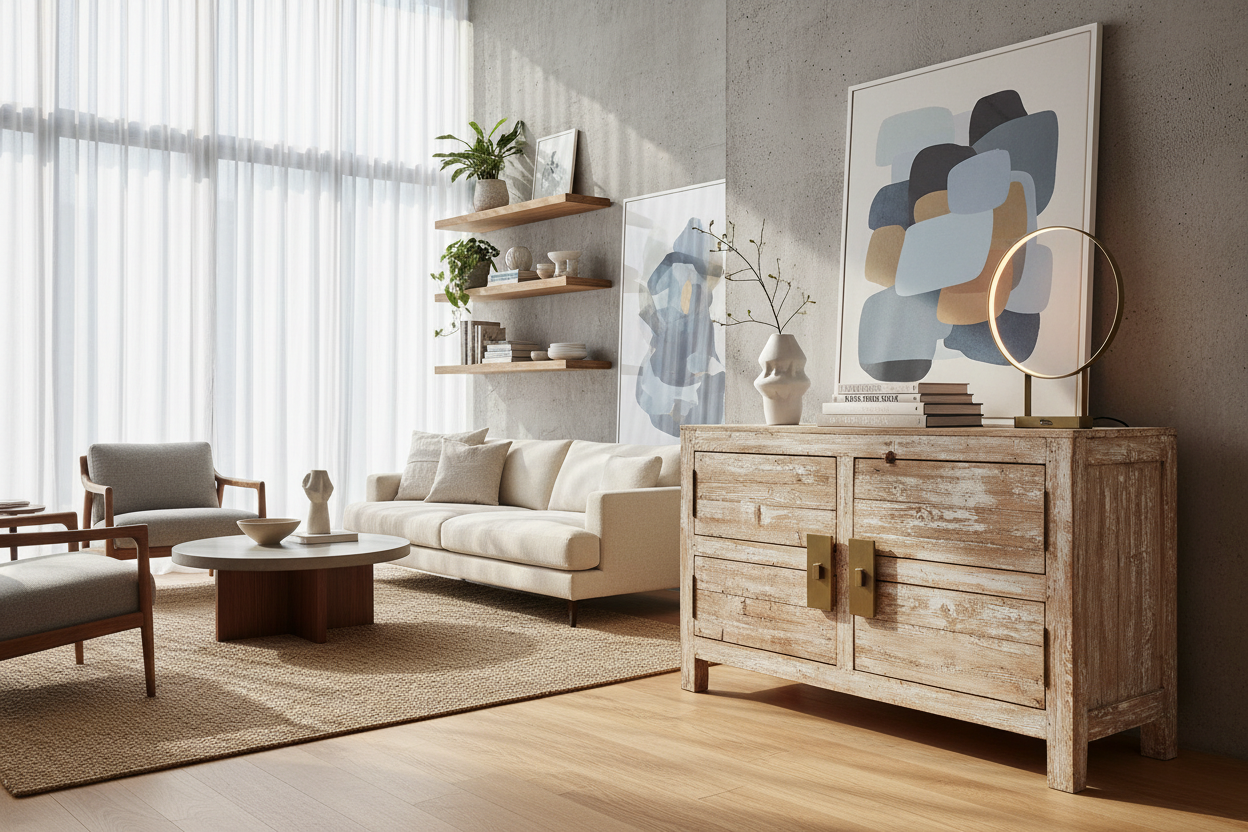
I spent three hours last night scrolling through minimalist lofts on Instagram, and honestly, I felt cold just looking at them. Everything was so white, so smooth, and so... sterile. It’s the 'new house' curse where every surface looks like it was manufactured five minutes ago in a factory that hates character. It makes me want to go out and buy the roughest, most weathered piece of wood I can find just to prove a human actually lives here.
That is why I keep coming back to the idea of a distressed storage cabinet. People get scared of the 'D' word because they think it means they have to live in a barn with 'Live, Laugh, Love' signs, but that is a massive design lie. You can have the grit and the soul of weathered wood without the farmhouse clichés. It’s all about the tension between the old and the new.
- Avoid symmetrical 'machine' scratches—real wear is random and messy.
- Pair rough textures with hyper-smooth surfaces like glass or polished metal.
- Keep the surrounding furniture lines sharp and geometric to ground the space.
- Swap out dated hardware for matte black or brushed brass to instantly update the look.
The 'Farmhouse' Elephant in the Room
Let’s be real: the 'modern farmhouse' look has been beaten to death. We’ve all seen the mass-produced cabinets that look like they were dragged behind a truck for exactly three minutes before being shrink-wrapped. It’s understandable why people are running toward mid-century modern or 'quiet luxury' to escape the shiplap nightmare. But in our haste to delete the farmhouse aesthetic, we’ve started making our homes look like hotel lobbies.
A weathered piece of furniture isn’t just a trend; it’s a texture. When you put a piece of furniture that has 'lived' into a room filled with flat drywall and IKEA-smooth finishes, the room suddenly has a pulse. The trick is to stop treating the cabinet like a rustic centerpiece and start treating it like a sculptural element. I’m talking about solid reclaimed pine or oak with genuine knots and grain, not that flimsy 1/2-inch MDF with a wood-grain sticker that peels at the corners. You want something with weight—something that feels like it could survive another fifty years.
What Makes a Distressed Storage Cabinet Look Fake?
I have a visceral reaction to bad distressing. You know the kind—where a machine has stamped the exact same 'wormholes' into every corner of the door, or where there’s fake rust painted onto perfectly shiny hinges. It’s the uncanny valley of furniture. Real distressing happens where hands touch the wood: around the handles, along the edges of the drawers, and on the feet where vacuum cleaners have bumped into them for a decade. If the 'wear' is in the middle of a flat panel where nothing ever touches, it’s fake, and it looks cheap.
Check the joinery. If a cabinet claims to be vintage-inspired but uses plastic cam-locks and staples, walk away. A quality piece will have dovetail joints or at least solid wood frames. Also, watch out for 'gray-wash' finishes that look like wet concrete. Real old wood has a warmth to it, even if it’s silvered. Look for finishes that allow the natural amber or brown tones of the wood to peek through. If it looks like it was spray-painted by a robot trying to imitate a driftwood log, it’s going to look like a prop in your living room rather than a piece of furniture.
The Secret is High Contrast (Please Step Away from the Mason Jars)
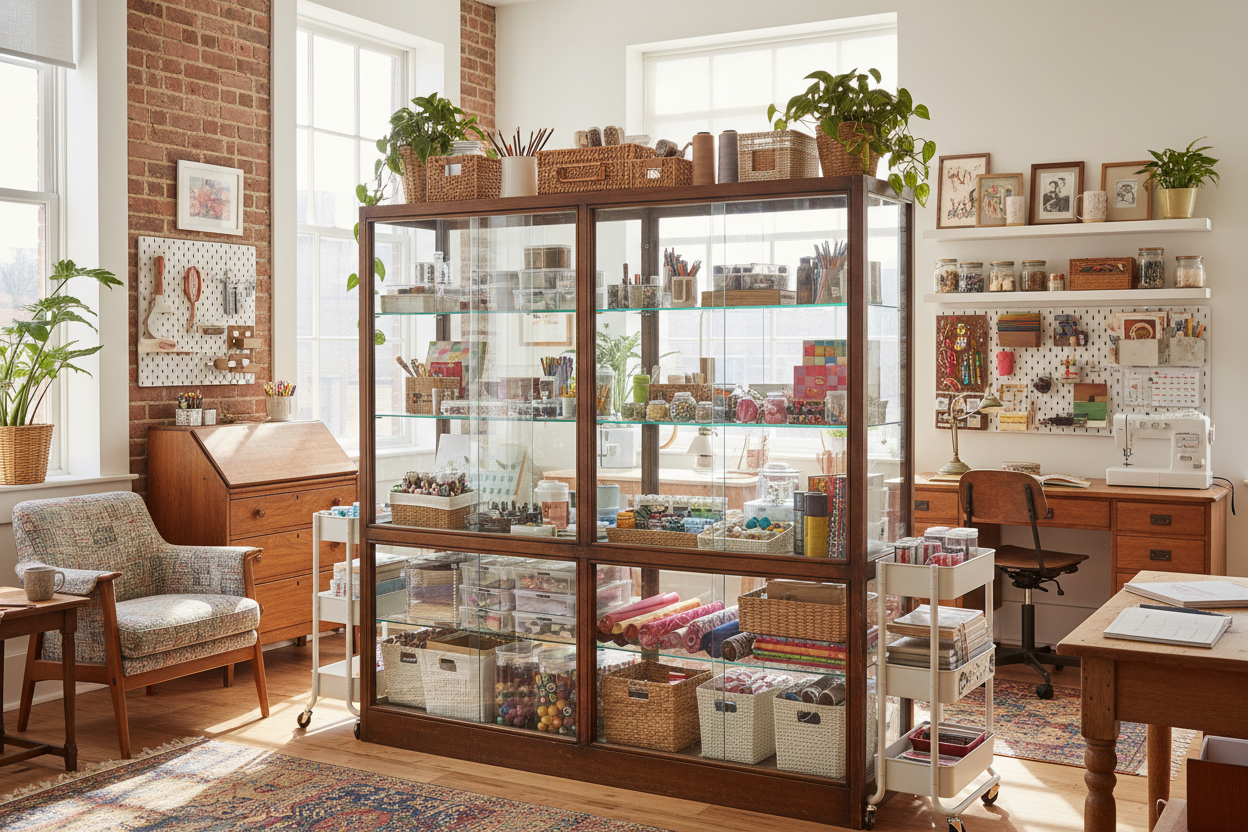
The fastest way to make a distressed piece look 'old lady' is to surround it with other 'shabby chic' items. If you put a weathered cabinet next to a wicker chair and a bowl of potpourri, you’ve lost the battle. The secret is friction. You want to place that rugged, chipped wood next to something that feels like it belongs in a high-end gallery. I love the idea of placing a chunky, weathered piece in the same visual field as a sleek black cabinet with glass doors. The black metal and clear glass act as a foil to the wood’s chaos, making the distressing look intentional and curated rather than accidental.
Think about your lighting, too. A distressed cabinet under a rustic chandelier is a cliché. But put that same cabinet under a linear LED pendant or a polished chrome swing-arm lamp, and suddenly it looks like a piece of art. You aren't building a cabin; you're building a home that has layers. Stop thinking about 'matching' and start thinking about 'balancing.' Wood needs metal. Rough needs smooth. Old needs new.
Grounding it With Clean Lines
If your storage cabinet is the 'wild' element in the room, the rest of the furniture needs to be the 'ordered' element. You don't want a room full of heavy, chunky pieces, or it will feel like a cave. I usually suggest balancing the visual weight by using a low-profile, clean-lined piece on the opposite wall. For example, a 59 W sideboard cabinet buffet storage cabinet with a flat front and hidden handles provides the perfect architectural 'rest' for the eyes. It lets the distressed piece be the star without making the whole room feel cluttered or heavy.
Where to Actually Put It (Hint: Not the Kitchen)
Most people default to putting distressed cabinets in the dining room or kitchen because that’s what the catalogs show. But if you want it to look modern, move it somewhere unexpected. A weathered cabinet in a home office filled with tech and monitors looks incredible. It breaks up the 'office' vibe and makes the space feel more personal. Or, try it in a hallway. While a modern glass cabinet in your foyer is a classic choice for showing off decor, a distressed piece can serve as a heavy-duty mudroom organizer that actually looks better the more it gets kicked by boots.
Transitional spaces like landings or wide hallways are perfect for these pieces because they don't have to compete with a sofa or a bed. They just sit there, holding your extra linens or board games, looking like a found object. By taking it out of the 'dining' context, you strip away the farmhouse associations and let the piece stand on its own merits as a functional bit of history.
Personal Experience: My 'Robot Attack' Mistake
A few years ago, I bought a 'distressed' sideboard online because the price was too good to pass up. When it arrived, the 'weathering' consisted of four perfectly straight, identical gouges on every single drawer front. It looked like a robot had attacked it with a flat-head screwdriver. It was embarrassing. I ended up having to sand the entire thing down, fill the holes with wood putty, and re-stain it. The lesson? If you can’t see the actual piece in person or at least see high-res photos of the *exact* unit you’re getting, you’re gambling with 'factory-distressed' garbage. Now, I only buy pieces where the distressing is either genuine (reclaimed wood) or done by hand with some level of artistry.
FAQ
Is distressed furniture going out of style?
The 'fake' mass-produced version is definitely on its way out. However, authentic weathered wood and reclaimed pieces are timeless. They add a layer of texture that purely modern furniture can't replicate. The key is how you style it—keep it away from other rustic tropes.
Can I mix a distressed cabinet with mid-century modern furniture?
Absolutely. In fact, that’s one of my favorite pairings. The tapered legs and smooth finishes of MCM furniture provide a great contrast to the ruggedness of a distressed cabinet. It keeps the room from looking like a time capsule.
How do I clean a distressed surface without snagging my cloth?
This is the one downside: dust loves those little nooks and crannies. Use a vacuum with a soft brush attachment rather than a rag. For deeper cleans, a slightly damp microfiber cloth works, but be careful not to scrub, or you might lift a splinter of the finish.


Leave a comment
This site is protected by hCaptcha and the hCaptcha Privacy Policy and Terms of Service apply.