
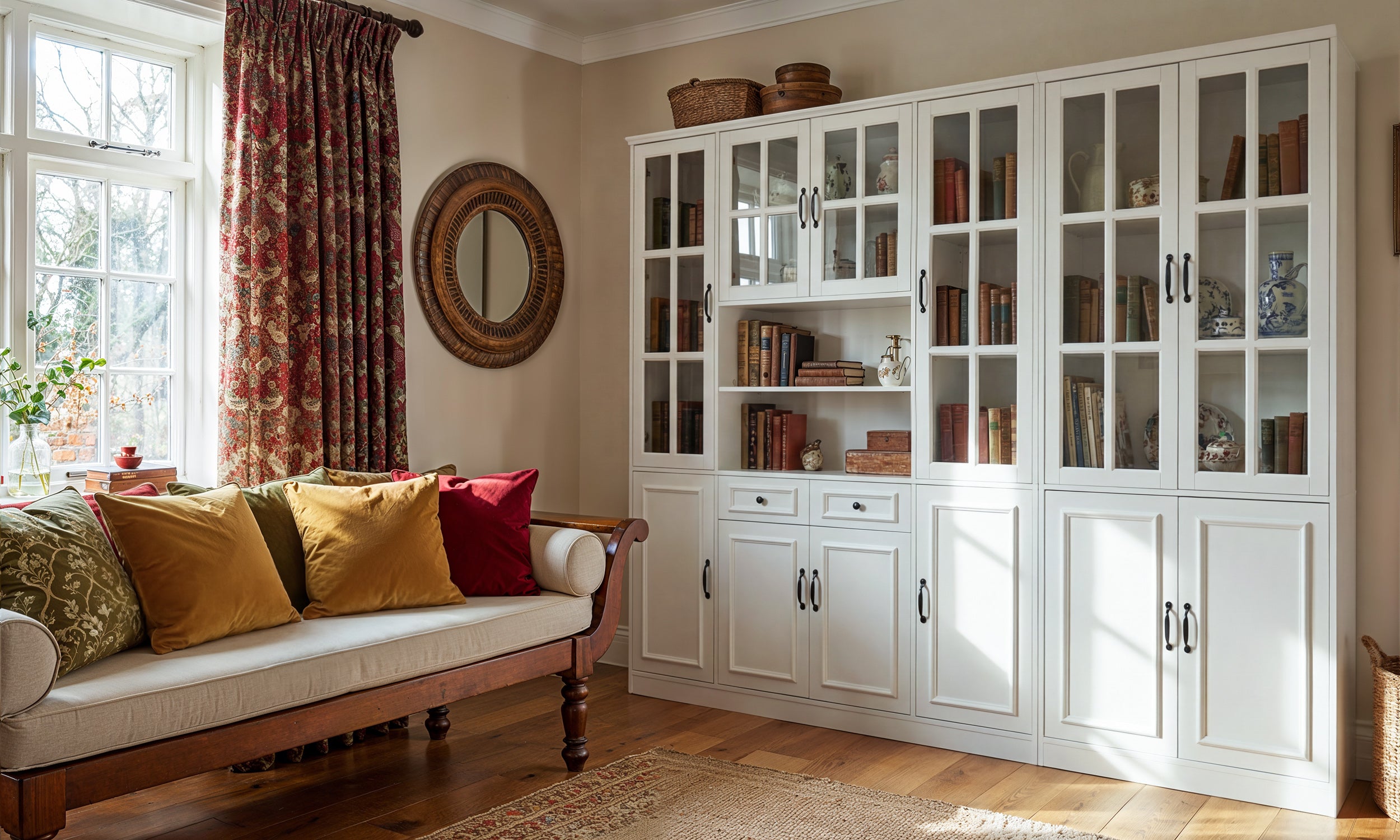


An open shelf cabinet is a cabinet with one or more shelves left without doors, so part of what you store stays in view and within reach while the rest sits behind doors or in drawers. It beats fully closed storage when you want quick access or a place to display things, and it beats an all-glass cabinet when you reach for the same items every day and don't want to open a door each time. The cost is dust: anything on an open shelf needs regular wiping.
Below are the common configurations, the rooms they suit, shelf depth and load, and anchoring, then six picks from the FUFU&GAGA storage cabinets collection with a note on who should skip each one.
Key takeaways
- Layout: open shelves on top with doors below is the most common layout and the easiest to keep tidy, because clutter goes in the base.
- Depth and load: the tall picks below are 12 to 18.4 inches deep, with per-shelf ratings from 20 to 55 lb across the picks.
- Dust: open shelves gather dust faster than closed cabinets, and near a stove they also collect grease.
- Safety: anchor any tall cabinet to the wall, even one that feels solid.
What is an open shelf cabinet?
Dictionary.com defines a cabinet as "a piece of furniture with shelves, drawers, etc., for holding or displaying items." An open shelf cabinet is that same piece with some shelves left uncovered. Stores also sell it as a cabinet with open shelves, an open shelving cabinet, an open storage cabinet, a hutch (when the open part sits above a closed base) or a display cabinet. If every shelf is open and there are no doors at all, it is really a bookshelf or an étagère.
Most homes need both kinds of storage: closed space for things that look messy, such as cords, paperwork and cleaning supplies, and open space for what you use every day or want to see.
Open shelves vs closed doors vs glass doors
| Factor | Open shelves | Solid doors | Glass doors |
|---|---|---|---|
| Dust | Collects dust fastest; wipe often | Contents stay clean | Contents stay clean; the glass needs wiping |
| Kitchen grease | Collects a film near the stove | Contents protected | Contents protected; glass shows smudges |
| Access | Reach straight in | Open a door first | Open a door first |
| Display | Everything on show | Nothing on show | On show, behind glass |
| Clutter | Any mess is visible | Hides mess | Any mess is visible |
| Small children and pets | Everything within reach | A small barrier, not a lock | A small barrier, not a lock |
Tasting Table's look at open kitchen shelving puts the main drawback plainly: items on open shelves gather dust more quickly than items in closed cabinetry, and in a kitchen the grease from regular cooking is worse than the dust. Its suggested compromise is to keep your best pieces in a glass-fronted cabinet. That is why so many cabinets mix all three fronts. If glass is the better fit for you, our bookcase with glass doors guide covers that choice.
Common open shelf cabinet configurations
Cabinet with open shelves on top
Open shelves above, doors or drawers below. This is the layout people search for most, and it works well: the open upper shelves sit near eye level, where books and display pieces are easy to see, and the closed base takes bulky, heavy or untidy things. It also fits the CPSC's advice to store heavier items on lower shelves. Tall bookcases with a cabinet base and hutch-style pieces fall into this group.
Open middle
Cabinets sit above and below one open shelf or countertop. That open band becomes a landing spot: a microwave or coffee machine in a kitchen, keys in an entry, everyday toiletries in a bathroom. The Vila 63" and Varda 47" picks below use this layout.
Open sides
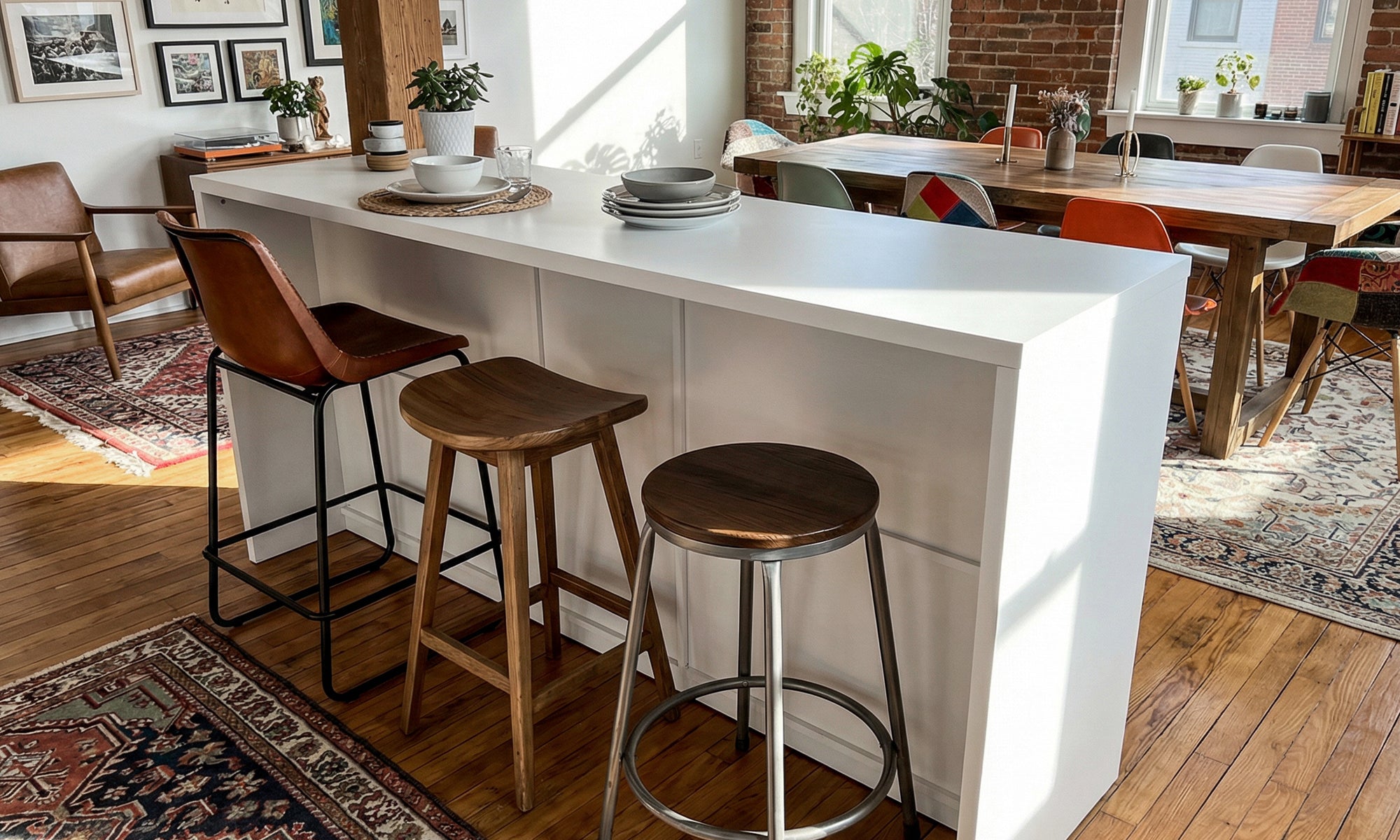
A closed center with open shelves at one or both ends is common on TV consoles, sideboards and kitchen islands. The open ends hold media devices, cookbooks or decor. Check that an open end won't face a busy walkway, where things on it get knocked.
Cabinet with drawers and open shelves
Drawers handle small, loose items such as remotes, coasters, chargers and utensils, which look scattered on an open shelf. Doors suit bulky things like board games, small appliances or spare blankets. Pair drawers with open shelves when most of what you need to hide is small.
Floating shelves are the wall-hung alternative: open storage with no floor footprint, but no closed storage at all, and everything depends on the wall fixings.
Where an open shelf cabinet works best
Kitchen storage and coffee bars
In a kitchen, open shelves work best for things you use and wash often: everyday plates, bowls, mugs, glasses and pantry jars. Things that sit untouched for weeks pick up a dusty, greasy film, so keep occasional-use pieces behind doors and keep the open shelves away from the stove where you can. A freestanding cabinet with an open middle also makes a simple coffee bar: the machine on the open shelf, mugs above and filters in a drawer. It won't replace built-in kitchen cabinets, but it adds pantry space to a kitchen that has run out. Pots and pans are heavy, so give them a low shelf or a cabinet with doors.
Living room and home office
Books, framed photos, plants and a few decor pieces belong on the open shelves, while cables, games and paperwork go behind doors. For books, This Old House recommends shelf space about 10½ inches high and 8 inches deep for standard hardcovers. Our bookcase dimensions guide covers widths and heights in more detail.
Bathroom, entryway and bedroom
In a bathroom, rolled towels, spare toilet paper and everyday toiletries work on open shelves; keep medicines and cleaning products behind doors or in drawers, out of children's reach. Most of the manufactured wood cabinets in this guide list "wipe clean with a dry cloth" as their care instruction, so place them outside the splash zone. By the front door, an open shelf holds a tray for keys while a drawer takes the mail. In a bedroom, open shelves suit books and a reading lamp.
How deep should an open shelf cabinet be?
Choose depth by the largest item you plan to store, with a little room so nothing hangs over the edge. Among the tall picks in this guide, overall depth runs from 12 inches (a bookcase) to 18.4 inches (a slim display stand), and listed shelf depths are 11.5, 13.5 and 15.7 inches.
| What you store | Shelf space to look for | Source |
|---|---|---|
| Paperbacks | 8 in high, 5 in deep | This Old House |
| Standard hardcovers | 10½ in high, 8 in deep | This Old House |
| Coffee-table books | 15 in high, 11 in deep | This Old House |
| Plates, platters, folded towels | Your largest item, plus a little | Measure at home |
| Microwave or coffee machine | Appliance depth plus the clearance its manual asks for | Appliance manual |
Depth also comes out of the floor in front. In a narrow hall or galley kitchen, a 12-inch-deep cabinet leaves 6.4 inches more walkway than an 18.4-inch one.
How much weight can an open shelf hold?
Use the listing's per-shelf rating, not a guess. Among the picks below, ratings run from 20 lb per shelf (the 70.9" bookcase) to 55 lb (the 55.1" kitchen island). Material matters too. This Old House says a 3-foot 1-by-12 MDF shelf holds about 87 pounds before sagging a quarter inch, against 129 pounds for plywood and 313 for solid oak. The woodworking reference Woodbin uses about 0.02 inch of sag per foot as its target for a shelf that looks flat, and sag grows as the span gets longer. Keep heavy books, stacked plates and small appliances on the lowest, shortest shelves, and lighten any shelf that starts to bow.
Adjustable shelves and fixed compartments
Adjustable shelves let you match the spacing to tall vases or short stacks. None of the six listings below mention adjustable shelves, so plan around the compartment heights they give: 10.5 inches on the 70.9" bookcase and the kitchen island, 13.3 inches on the curio cabinet and 15 inches on the Vila 63".
How to style open shelves without clutter
- Give each shelf one job, such as everyday dishes, cookbooks or display.
- Put heavy, large items low and light, small items high.
- Leave some space. A shelf filled edge to edge reads as storage, not display.
- Group small objects, or put them in a lidded box or woven basket, instead of lining them up.
- Keep toys and remotes off high shelves. The CPSC warns that children may climb to reach tempting items.
Dust and cleaning
Daily-use dishes get washed anyway, but display pieces and shelf surfaces collect dust, so wipe the open shelves whenever you dust the room. Follow each listing's care line: most cabinets here call for a dry cloth, while the kitchen island's listing says mild soap and water. If dust is your main worry, choose a cabinet with only one open shelf, or glass doors over the display section.
Anchoring an open shelf cabinet
The CPSC's Anchor It campaign says anchoring all furniture with drawers, doors and shelves to the wall prevents tip-over injuries and deaths, and a 2026 CPSC release reports 217 tip-over deaths from 2013 to mid-2023, 71% of them children aged one to three.
Open shelves make climbing easier, and loading the top shelves raises the center of gravity. Height divided by depth is a quick way to see how much a cabinet relies on its anchor: the 70.9" bookcase below is 78.7 inches tall and 12 deep (about 6.6), the Varda 47" is 78.7 by 14.2 (about 5.5), and the 21.4" display stand is 70.9 by 18.4 (about 3.9). The higher the number, the more the anchor matters. All five tall picks list a tip-over restraint or wall anchors in their specs. Our guide on how to anchor a bookcase to the wall covers hardware and wall types.
Our picks: open shelf cabinets for every room
These six FUFU&GAGA cabinets cover the main configurations and rooms. Facts come from each product listing.
70.9" White Tall Bookcase with 3-Cabinet Base and 4-Layer Open Storage Shelves
Twelve open compartments in four tiers sit above three cabinets with six paneled doors: the classic cabinet with open shelves on top, at full-wall scale. Each compartment is 10.5" H x 22.8" W x 11.5" D, which fits standard hardcovers with little to spare, and each shelf is rated for 20 lb. It measures 78.7" H x 70.9" W x 12" D, comes in natural or white, and includes a tip-over restraint.
Best for: a living room or home office wall of books and display pieces, with files hidden below.
Skip it if: you plan to load it with heavy art books or stacked dishes, or you have less than about 71 inches of wall.

Varda 47" Modern White/Black Display Cabinet with LED Lights, Open Shelves, and Glass Doors
The Varda is one of our most-ordered display cabinets. Six push-to-open tempered glass doors in aluminum frames surround an open center shelf and a row of three drawers, and built-in LED strips switch between cool, warm and neutral light. Shelves are 30" W x 13.5" D, rated for 30 lb each. It measures 78.7" H x 47.2" W x 14.2" D, comes in black or white, and includes wall-mounting hardware and a tip-over restraint; the listing says installation is required and suggests it for a living room, home office or bathroom.
Best for: collectibles or books behind glass, with one open shelf for the things you reach for every day.
Skip it if: you want mostly open storage, or you can't fix it to the wall.

Vila 63" White Display Cabinet & Bookcase with Open Shelf and 3 Drawers
The Vila is built as a kitchen and dining cabinet: glass-front cabinets above, an open countertop section in the middle that the listing says can hold a microwave, and three drawers and closed cabinets below. Nine wooden shelves are rated 33 lb each, and each drawer is 5.8" H x 28.3" W x 11.8" D inside. It measures 78.7" H x 63" W x 15.7" D, has a hand-painted white finish on MDF, and includes a tip-over restraint. If a microwave goes on the open section, follow its manual's clearance instructions.
Best for: a kitchen or dining room that needs dish and pantry storage plus an open counter for a microwave or coffee bar.
Skip it if: your wall is narrower than 63 inches, or you prefer a handle-free modern look.
55.1" Modern Kitchen Island with 2 Drawers and Open Storage Shelves
This island has six open shelves under the top, each 10.5" H x 20.4" W x 13.8" D and rated for 55 lb, the highest per-shelf rating in this guide, plus two drawers for utensils and linens. It measures 36" H x 55.1" W x 30" D and has a white marble-look manufactured wood top (not real marble) on a black and brown base. The listing calls it water resistant and says to wipe it with mild soap and water.
Best for: bowls, jars and small appliances on open shelves, with a prep surface on top.
Skip it if: you need doors to hide things, or your kitchen has no room for a 30-inch-deep island.
21.4" Modern White Display Stand with 4 Open Shelves and 1 Drawer
This slim stand puts four open shelves and one drawer on a 21.4" W x 18.4" D footprint, 70.9" tall. The drawer runs on metal slides, the stand is rated for 200 lb in total, and an anti-tip kit with wall anchors is included. The listing suggests it for a living room, office, entryway or bathroom.
Best for: a narrow spot by a door or in a bathroom, for a few display pieces and a drawer of small items.
Skip it if: you need to hide more than a drawer's worth of things, or you want a cabinet for heavy books.
36.2" Elegant White and Gold Curio Cabinet with 2 Drawers, Open Shelves and Warm Lighting
Three open display shelves, two of them clear tempered glass, sit under warm LED lighting built into the top, with two large drawers below on metal slides. The display shelves have no doors. Each shelf is rated for 33 lb, and the cabinet measures 76.6" H x 36.2" W x 15.4" D in white with gold carved accents. Wall anchors are included.
Best for: an open, lit display of figurines, crystal or books in a living room or entry.
Skip it if: you want glass doors to keep dust off, or you prefer plain modern styling.

Open shelf cabinet picks compared
| Pick | Size (H x W x D) | Layout | Per shelf | Best for |
|---|---|---|---|---|
| 70.9" tall bookcase | 78.7 x 70.9 x 12 in | Open top, doors below | 20 lb | Books and display |
| Varda 47" | 78.7 x 47.2 x 14.2 in | Glass doors, open middle, drawers | 30 lb | Lit display |
| Vila 63" | 78.7 x 63 x 15.7 in | Glass top, open counter, drawers | 33 lb | Kitchen and dining |
| 55.1" kitchen island | 36 x 55.1 x 30 in | Open shelves, drawers | 55 lb | Kitchen prep |
| 21.4" display stand | 70.9 x 21.4 x 18.4 in | Open shelves, one drawer | See listing | Narrow spots |
| 36.2" curio cabinet | 76.6 x 36.2 x 15.4 in | Open lit shelves, drawers | 33 lb | Open display |
Buying checklist
- List what goes on the open shelves and what must be hidden, then choose a layout with enough closed space.
- Check your largest item against the listed shelf height and depth.
- Check the per-shelf rating against what you will store.
- Measure the wall width, and subtract the cabinet's depth from the walkway in front.
- Leave room for doors to swing and drawers to open fully.
- Look for a tip-over restraint in the listing and plan where it will fix to the wall.
- Plan for assembly: tall cabinets often list two people. Our flat-pack assembly guide helps you prepare.
When you know the layout and size you need, compare more options in the storage cabinets collection.
FAQ
What do you call a cabinet with open shelves?
It is usually sold as an open shelf cabinet, a cabinet with open shelves or an open storage cabinet. When open shelves sit above a closed base it may be called a hutch or a bookcase with a cabinet base, and when every shelf is open with no doors, it is a bookshelf or étagère.
What are the disadvantages of open shelving?
Open shelves collect dust faster than closed cabinets and, in a kitchen, a film of cooking grease, so they need regular wiping. Clutter shows, and items are within reach of children and pets. A cabinet that mixes one or two open shelves with doors or drawers limits all three problems.
Do open shelf cabinets need to be anchored?
Yes, if they are tall. The CPSC advises anchoring furniture with drawers, doors and shelves to the wall. Use the tip-over restraint that comes with the cabinet, fix it into a stud or a suitable wall anchor, and keep heavier items on lower shelves.


Leave a comment
This site is protected by hCaptcha and the hCaptcha Privacy Policy and Terms of Service apply.