

















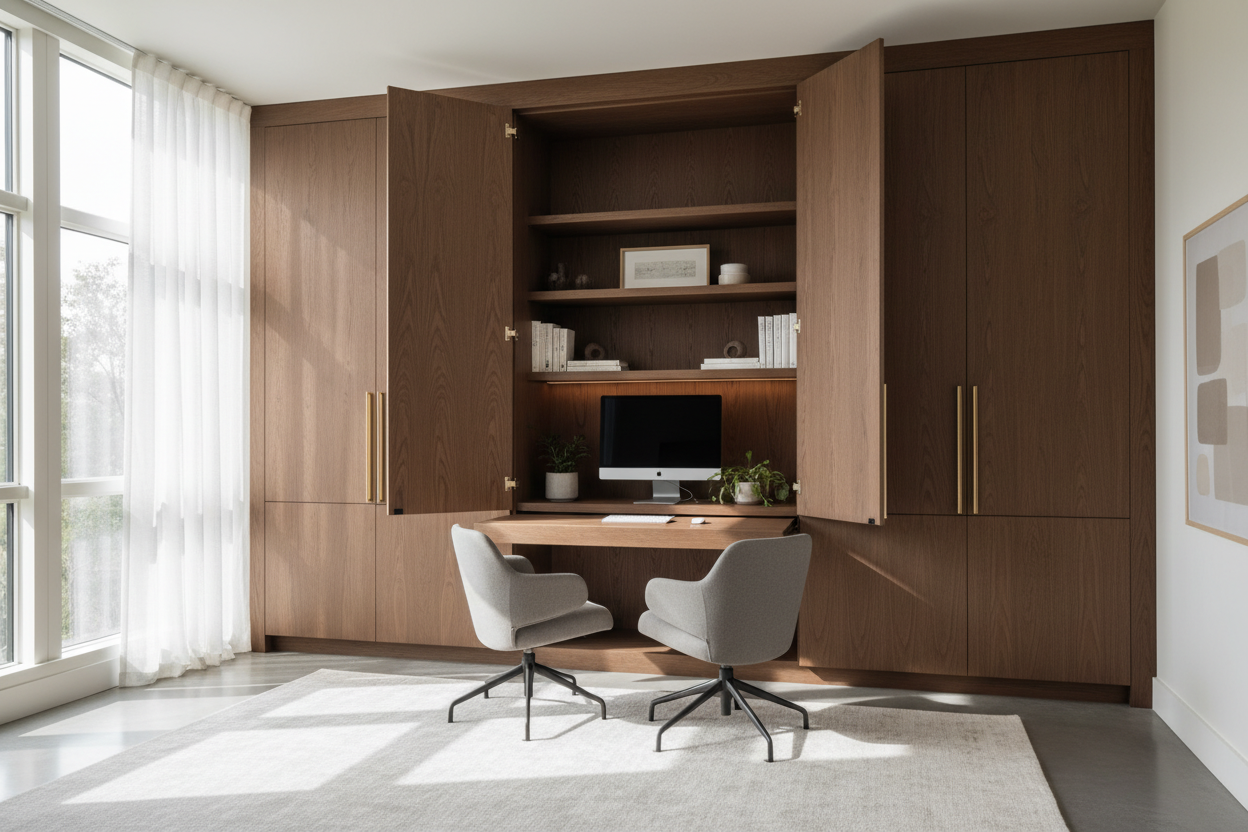
We have all been there: the workday ends, but your stress lingers because your dual monitors are glaring at you from the corner of the living room. When your workspace bleeds into your relaxation space, a cabinet desk becomes less of a luxury and more of a sanity-saver. By hiding your workstation behind handsome doors, you reclaim your home's visual calm.
But buying furniture that pulls double duty requires careful planning. Buy the wrong piece, and you are stuck with cramped legs and a monitor that doesn't fit. I will walk you through exactly what to look for—from structural integrity to ergonomics—so you can confidently close the doors on your workday.
Quick Decision Guide
- Measure internal depth: Ensure the closed cabinet can house your specific monitor stand and keyboard without crushing them.
- Check the hinge quality: Look for 270-degree wrap-around hinges so the doors sit flush against the sides when open, preventing a boxed-in feeling.
- Plan for wire management: A solid back panel is a nightmare for electronics; look for pre-drilled grommets or removable backings.
- Verify knee clearance: Many armoire styles feature lower storage that severely limits legroom. Prioritize an open lower cavity if you work full-time.
Space Planning and Layout
Navigating the Footprint
Integrating a desk and cabinet into a multi-use room requires respecting the room's flow. Unlike a standard writing table, this piece carries significant visual weight. If you are placing it in a living room, balance it opposite another heavy element, like a sofa or fireplace, so the room doesn't feel lopsided.
Clearance for Seating
When dealing with desks in cupboards, people often forget the chair footprint. You need a minimum of 36 inches of clearance between the front of the open desk and any other furniture to comfortably pull out a chair. If you are using a standard office chair rather than a dining chair, factor in the width of the armrests to ensure they tuck under the pull-out surface.
Style and Coordination
Blending the Home Office
The main appeal of a home office desk with cabinets is camouflage. To make it work, the piece must match the room's primary function, not its secondary one. If it sits in a transitional living room, opt for wood veneers or painted finishes that echo your media console or bookshelves.
Be mindful of hardware. Swapping out generic factory knobs for high-quality brass or matte black pulls is an inexpensive way to make an office desk with cabinet look like a bespoke piece of residential furniture rather than a corporate afterthought.
Comfort and Ergonomics
The Keyboard Tray Dilemma
Ergonomics often take a backseat in hidden furniture. The biggest offender in desks with cabinets is the drop-down or pull-out keyboard tray. The standard comfortable typing height is around 28 to 29 inches from the floor. Measure the pull-out tray before buying; if it sits too high, you will experience shoulder fatigue, and if it is too low, it will scrape your thighs.
Designer's Honest Take
A few years ago, I specified a stunning, high-end desk with storage cabinet for a client's guest bedroom. It looked incredible in the space, featuring a gorgeous fluted oak exterior. But I learned a hard lesson about internal dimensions: the client used a heavy-duty ergonomic monitor arm that clamped to the back of the desk surface.
Because the cabinet had a fixed wooden back panel and shallow internal depth, the clamp pushed the monitor too far forward. We couldn't close the cabinet doors without completely dismantling the monitor setup every Friday. We ended up having to hire a carpenter to cut a custom recess into the back panel. The takeaway? Never trust external dimensions alone. Always measure your specific tech gear against the interior usable space.
Frequently Asked Questions
Do I need ventilation for a computer inside a cabinet?
Yes. If you are storing a desktop tower or a laptop that runs hot, heat buildup can damage your electronics. Look for cabinets with slatted backs, breathable mesh panels, or keep the doors open while the computer is running intensive tasks.
Can I use a standard office chair with a cabinet desk?
It depends on the lower storage configuration. Many cabinet styles feature file drawers on the bottom, which severely restricts legroom and prevents a wide office chair from rolling in. Look for designs with an entirely open lower half if you plan to use a rolling ergonomic chair.
How do I light a workspace inside a dark cabinet?
Relying on room lighting will cast harsh shadows from the cabinet doors. Install a slim, hardwired LED strip or a rechargeable magnetic light bar directly under the top interior shelf to wash your work surface in bright, even light.

Leave a comment
This site is protected by hCaptcha and the hCaptcha Privacy Policy and Terms of Service apply.