






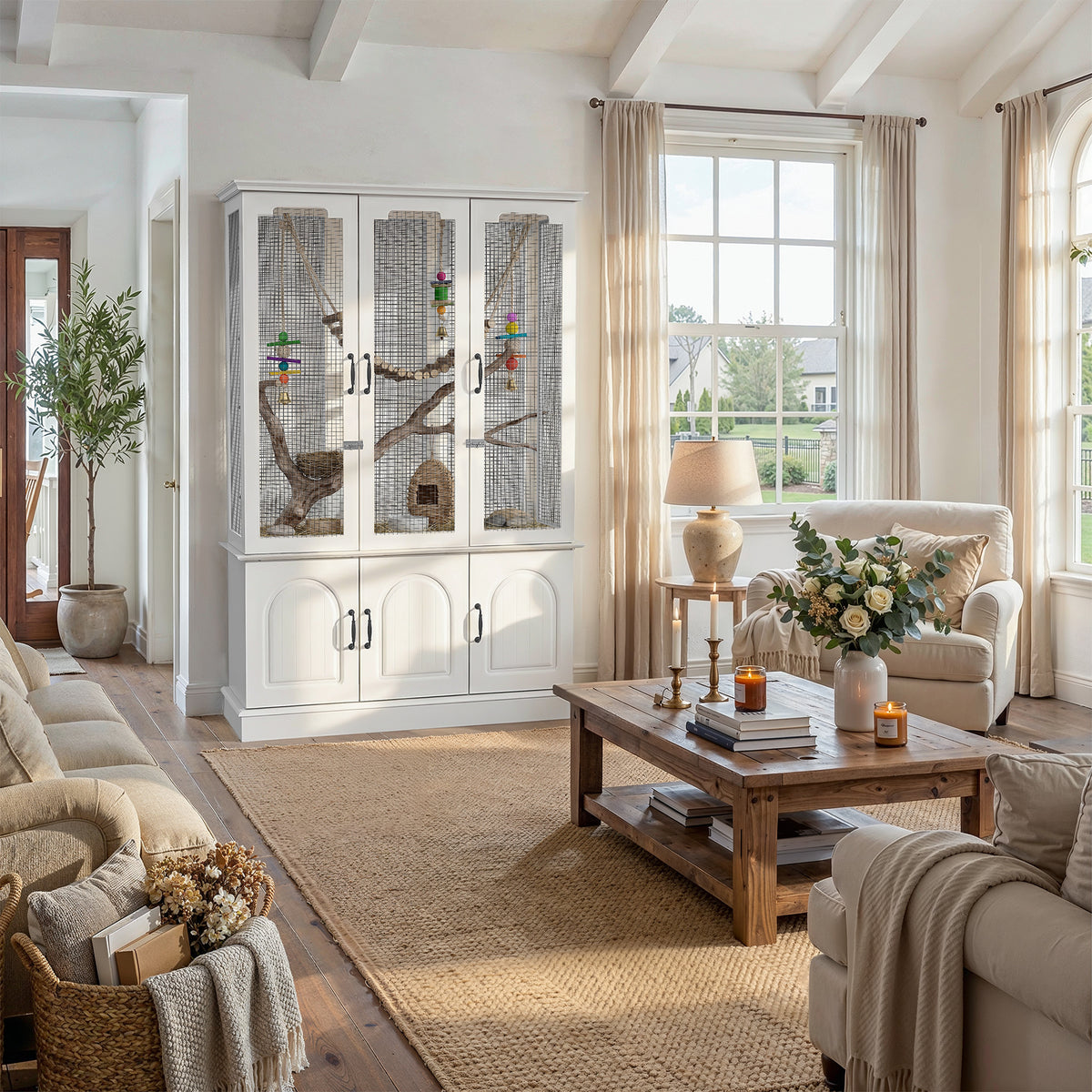
A bird cage cabinet is a cage on top with a closed storage cabinet below, so food, toys and cleaning supplies live with the bird instead of across the room. It suits owners who keep a cage in a living room or study and want it to look like furniture. It still has to meet your bird's needs first: a cage size above the veterinary minimum for your species, bar spacing your bird cannot push its head through, safe materials and a spot away from kitchen fumes.
This guide covers cage size, bar spacing by bird size, shape, materials, placement and cleaning, then compares the two cages in the FUFU&GAGA bird cage cabinet collection and says honestly which birds each one fits.
Key takeaways
- Cage size: Merck Veterinary Manual minimums run from 20 x 20 x 30 in for budgies and cockatiels to 48 x 36 x 66 in for macaws. Bigger is better.
- Bar spacing: 0.5 in for small parrots, 0.75 in for conures and mini macaws, 1.5 in for macaws, per Merck. Your bird must not fit its head through.
- Materials and placement: avoid galvanized wire and lead, keep the cage out of the kitchen and away from fumes, and anchor tall units.
What is a bird cage cabinet, and who is it for?
A bird cage cabinet (also sold as a bird cage with storage cabinet, or a bird cage that looks like furniture) combines two pieces in one footprint. The upper part is a wire or mesh enclosure with doors; the lower part is a bottom cabinet with doors or drawers. Many are styled to read as a display cabinet rather than a pet product.
It is a good fit when the cage stays in a shared room and you want bird supplies within reach. Many furniture-style cages are shaped like a tall cabinet, so check depth as well as height, and remember that wood framing matters for chewers. Start with your bird's species and size, then check the cage dimensions and bar spacing.
What cage size does your bird need?
The Association of Avian Veterinarians (AAV) says the minimum acceptable cage is one that lets a bird fully extend its wings, and that more is better when it comes to space (AAV, Basic Care for Companion Birds). The Merck Veterinary Manual puts numbers on that minimum by bird size (Merck Veterinary Manual table):
| Birds (Merck group) | Minimum cage size, L x W x H | Bar spacing | Floor area, L x W |
|---|---|---|---|
| Budgies (parakeets), cockatiels, lovebirds, parrotlets | 20 x 20 x 30 in | 0.5 in | 400 sq in |
| Conures, Poicephalus parrots such as Senegals, caiques, mini macaws | 36 x 24 x 48 in | 0.75 in | 864 sq in |
| African greys, Amazons, small cockatoos | 40 x 30 x 60 in | At least 0.75 in (see note) | 1,200 sq in |
| Macaws, large cockatoos | 48 x 36 x 66 in | 1.5 in | 1,728 sq in |
Note: Merck prints the African grey spacing as "0.751", likely a formatting error, so only 0.75 in is clear; ask your avian vet. Canaries, finches and doves are not in the table. Floor area is length times width.
The RSPCA gives a second way to check cage size that works for any species: if your bird spends most of its time in the cage, the height, width and depth should each be at least twice its wingspan; if it spends most of its time outside the cage, at least one and a half times (RSPCA, housing and environments for pet birds). For example, a bird with a 12-inch wingspan that lives mainly in its cage needs at least 24 x 24 x 24 in (12 x 2 = 24). Sources and species differ, so treat these as minimums. A shared aviary is a bigger step: the RSPCA asks for at least four times the largest bird's wingspan in each direction.
When you compare listings, use the interior cage dimensions, not the overall dimensions. On a bird cage cabinet the overall height includes the bottom cabinet, which adds furniture height but no living space.
How far apart should cage bars be?
The AAV rule is simple: bar spacing should be such that your bird cannot fit its head through the bars. That is the core safety test, so treat bar spacing as a fit requirement, not a style choice. Merck's figures by bird size are in the table above.
For a parakeet (budgie) cage, Merck lists 0.5 inch, the same as for cockatiels, lovebirds and parrotlets. Wider bar spacing is meant for larger species. If a listing's spacing looks off for the birds it names, ask the seller to confirm the actual opening before you buy: one cage cannot be right for both finches and macaws, even if its "suitable for" list names both.
Do birds prefer tall or wide cages?
The sources in this guide do not rank tall against wide: RSPCA's wingspan rule covers height, width and depth alike, and Merck's minimums grow in all three. The AAV does say that species that fly or hop, such as finches and toucans, need widely spaced perches on opposite sides of the cage, while agile climbers such as parrots can use more perches. So flyers like finches and canaries benefit most from horizontal length, parrots use height with perches at several levels, and a shallow cage limits wing room for everyone.
Materials, coatings and chewing
Birds chew. The AAV says cages should be built from materials the bird cannot damage or eat, that every material should be nontoxic, and that galvanized wire should ideally not be used because its zinc poses a toxicity risk if ingested. RSPCA Australia lists lead and zinc as heavy-metal poisons and notes that zinc galvanizing is used especially on cage wire (RSPCA Knowledgebase).
For a furniture-style cage, that means three checks:
- Wire and mesh coating: ask what the mesh is and how it is finished. If the listing does not say, do not assume it.
- Wood inside the cage: strong chewers such as cockatoos can chew any wood framing they can reach, so for heavy chewers choose a cage with little exposed wood inside.
- Toys and hardware: the AAV lists toys containing lead and soft plastics as unsafe, and VCA Animal Hospitals names lead-weighted toys, bells with lead clappers, lead solder and old lead-based paint as lead sources (VCA, Lead Poisoning in Birds).
Where should a bird cage cabinet go?
Birds have far more sensitive respiratory systems than people. The AAV warns that overheated non-stick (PTFE, sold as Teflon) cookware, drip pans, irons and self-cleaning ovens can give off odorless fumes that are rapidly fatal to birds, and lists smoke, sprays, air fresheners, scented candles, paints and cleaning products as other hazards. RSPCA Australia adds that these fumes spread through a home quickly, so a bird outside the kitchen is not automatically safe: run the exhaust fan or open a window when cooking. The AAV also stresses fresh air and good ventilation, and suggests a HEPA air filter when windows must stay shut, especially for dusty birds such as cockatoos and African greys.
- Back against a solid wall. The RSPCA suggests placing the back of the cage against a solid wall and covering the top so the bird feels safe from behind and above.
- Not in full sun all day. RSPCA Australia points out that a caged bird cannot move into the shade on its own. Make sure part of the cage stays shaded.
- Away from heat sources and drafts. The RSPCA says not to place the cage near a radiator, fire or stove, or in a draught. The AAV says healthy birds tolerate drafts and need fresh air. The sources differ, so a sensible middle ground is to keep the cage out of a vent's direct airflow.
- A quiet, dark night. The AAV says most birds need 10 to 12 hours of sleep and that late lights and TV can cause sleep deprivation. Covering the cage or using a sleeping cage in a quieter room helps.
Cleaning: trays, grates and what to put in the bottom
The AAV recommends a grate on the bottom so droppings and dropped food fall through, with the floor far enough below that the bird cannot reach the waste. For the cage bottom, plain newspaper, paper towels or cage liner paper are preferred over wood chips, corn cob or kitty litter, and the paper should be changed daily so you can check your bird's droppings. Water dishes should be washed every day with soap and hot water.
That makes a slide-out tray the most useful cleaning feature on a bird cage cabinet. Check that the tray comes out without opening the main cage door, and that the doors are wide enough to reach every corner.
What the storage cabinet is good for
The bottom cabinet keeps pellets and seed in sealed containers, spare toys, perches, cage liners and paper towels below the bird. A few points:
- Weight limits: use the figures the listing gives for the cage and shelves, and keep heavy bags of food on the floor of the cabinet.
- Cleaning sprays: store them closed, and use them away from the bird, since the AAV lists cleaning products among fume hazards.
- Stability: a tall, narrow unit can tip if it is pulled or climbed on, so anchor it to the wall; our guide on anchoring tall furniture to the wall walks through studs, brackets and straps.
Should you build a DIY bird cage from a cabinet?
Turning an old media or curio cabinet into a DIY bird cage can work, but the risks are in the materials. Old furniture may carry lead-based paint (VCA names paint made before 1978), RSPCA Australia notes that zinc galvanizing is used especially on cage wire, and the AAV says every material a bird can chew should be nontoxic. If you build your own, use wire you know is not galvanized or lead-based, keep exposed wood out of beak reach, make the bar spacing right for your species, and plan a removable tray.
Bird cage cabinet buying checklist
- Interior dimensions meet or beat the Merck minimum for your species (20 x 20 x 30 in for budgies, cockatiels, lovebirds and parrotlets).
- Every interior dimension is at least twice your bird's wingspan if it spends most of the day inside.
- Bar spacing matches your bird: 0.5 in for small parrots, 0.75 in for conures and mini macaws, 1.5 in for macaws and large cockatoos.
- Mesh and wire are not galvanized, or the seller can tell you what the coating is.
- Little or no chewable wood is reachable from inside, especially for large parrots.
- A slide-out tray, ideally under a grate, removable without opening the cage.
- Stated weight limits for the cage and shelves, and a plan to anchor a tall unit.
Our picks: two bird cage cabinets compared
The two bird cage cabinets below suit different homes, and each has a limit you should know before you buy.
47.2" White All-In-One Bird Cage with Bottom Storage Cabinet
This is the large cage of the two, and the one with the most horizontal room. The listing gives the cage as 45" H x 43.7" W x 15" D and the whole unit as 70" H x 47" W x 15.7" D, 114 lb. Three full-height mesh doors open across the front (the door opening is listed as 45" H x 14" W), and a three-door bottom cabinet holds bird supplies. The listing says the cage section holds up to 33 lb and the bottom shelf up to 22 lb, that the doors lock, and that an anti-tip device is included. Assembly takes about 1.5 hours with two people, per the listing.
The cage interior is set up by you; the listing calls it a DIY layout, so plan to buy perches, branches and toys. Measured against Merck, its 43.7 in length and 45 in height exceed the 20 x 20 x 30 in minimum for small parrots, and its floor area is 43.7 x 15 = 655.5 sq in, more than the 400 sq in minimum. Its 15 in depth, though, is shallower than the 20 in Merck lists. The listing does not state a usable bar spacing (the spec field reads 0"), and it does not mention a pull-out tray, so ask customer service about both before choosing it for small birds.

Best for: small birds that fly from perch to perch, such as canaries or finches, which use horizontal length, in a living room with a long wall, once you have confirmed the mesh opening with the store.
Skip it if: you need a confirmed bar spacing or a slide-out tray before you buy, or you want a cage that meets Merck's minimum on every side: its 15 in depth is under the 20 in listed for budgies and cockatiels, 24 in for conures and 30 in for African greys and Amazons. Also skip it for a strong chewer if you want no wood near the cage.
19.7" White Modern Tall Bird Cage with Storage Cabinet
This slim tower fits where a large cage will not: the footprint is 19.7" x 19.7" and the overall height is 79", 79 lb. The cage is 46" H x 17" W x 17" D, with a 46.1" H x 15.7" W door, and the listing names a removable pull-out tray. Below the cage are a drawer and a cabinet for food, toys and bird supplies. It is made of manufactured wood (MDF) with metal mesh, and the listing says assembly takes about an hour. For tips, see our flat-pack assembly guide.
Check the fit carefully. The listing describes it for small to medium birds with 1" bar spacing. By Merck's figures, 1 inch is wider than the 0.5 in listed for budgies, cockatiels, lovebirds and parrotlets and the 0.75 in for conures, so on the listed spacing it does not suit those birds. The birds Merck pairs with wider spacing are African greys and larger parrots, and its 17 x 17 in floor (289 sq in) is far below Merck's minimum footprint for them, and below the 20 x 20 in for small parrots. The listing does not mention an anti-tip kit, and a 79-inch unit on a 19.7-inch base should be anchored to the wall.

Best for: owners with a narrow wall or corner who want a tray and closed storage in one slim piece, and who have checked with customer service and their avian vet that its mesh opening and floor size suit their bird.
Skip it if: you keep budgies, lovebirds, parrotlets, cockatiels, canaries or finches (the listed 1 in spacing is wider than Merck's 0.5 in for small parrots), or a bird that needs more than a 17 x 17 in floor, or you cannot anchor it to a wall.
The two picks side by side
| Cage cabinet | Cage (H x W x D) | Overall (H x W x D) | Listed bar spacing | Tray | Storage | Best for |
|---|---|---|---|---|---|---|
| 47.2" all-in-one | 45 x 43.7 x 15 in | 70 x 47 x 15.7 in | Not stated (data error) | Not listed | 3-door cabinet | Long wall, small birds that fly, after confirming the mesh |
| 19.7" tall | 46 x 17 x 17 in | 79 x 19.7 x 19.7 in | 1 in | Removable tray | Drawer plus cabinet | Narrow spaces, after confirming fit for your bird |
Neither listing claims the mesh is bird-safe, non-toxic or chew-proof, so ask customer service about the mesh finish if your bird is a heavy chewer.
FAQ
What is the recommended bar spacing for a budgie cage?
The Merck Veterinary Manual lists 0.5 inch for budgies (parakeets), cockatiels, lovebirds and parrotlets. The basic test from the Association of Avian Veterinarians is that your bird must not be able to fit its head through the bars. Wider spacing is for larger species only.
Can a cage be too big for a bird?
For a pet bird cage, the AAV says confined birds appreciate as much room as you can provide and more is better. The limits are your room, your budget and bar spacing: a large cage built with wide bars for big parrots is not safe for small birds, because they can get their heads through.
What is best to put in the bottom of a bird cage?
The AAV prefers newspaper, paper towels or plain cage liner paper over wood chips, corn cob or kitty litter, changed daily so you can check droppings. Ideally a grate sits above the paper so the bird cannot walk in its waste. A slide-out tray makes the daily change quick.
Why should you cover a bird cage at night?
Most pet birds need 10 to 12 hours of sleep, according to the AAV, and room lights or a TV late into the evening can cut that short. A cover darkens the cage, and the RSPCA notes a covered top helps a bird feel safe from above. A separate sleeping cage in a quiet room is the other option.
Ready to compare sizes? See every model in our bird cage and display cabinet collection, and check the interior dimensions against your bird's species before you choose.

Leave a comment
This site is protected by hCaptcha and the hCaptcha Privacy Policy and Terms of Service apply.