

















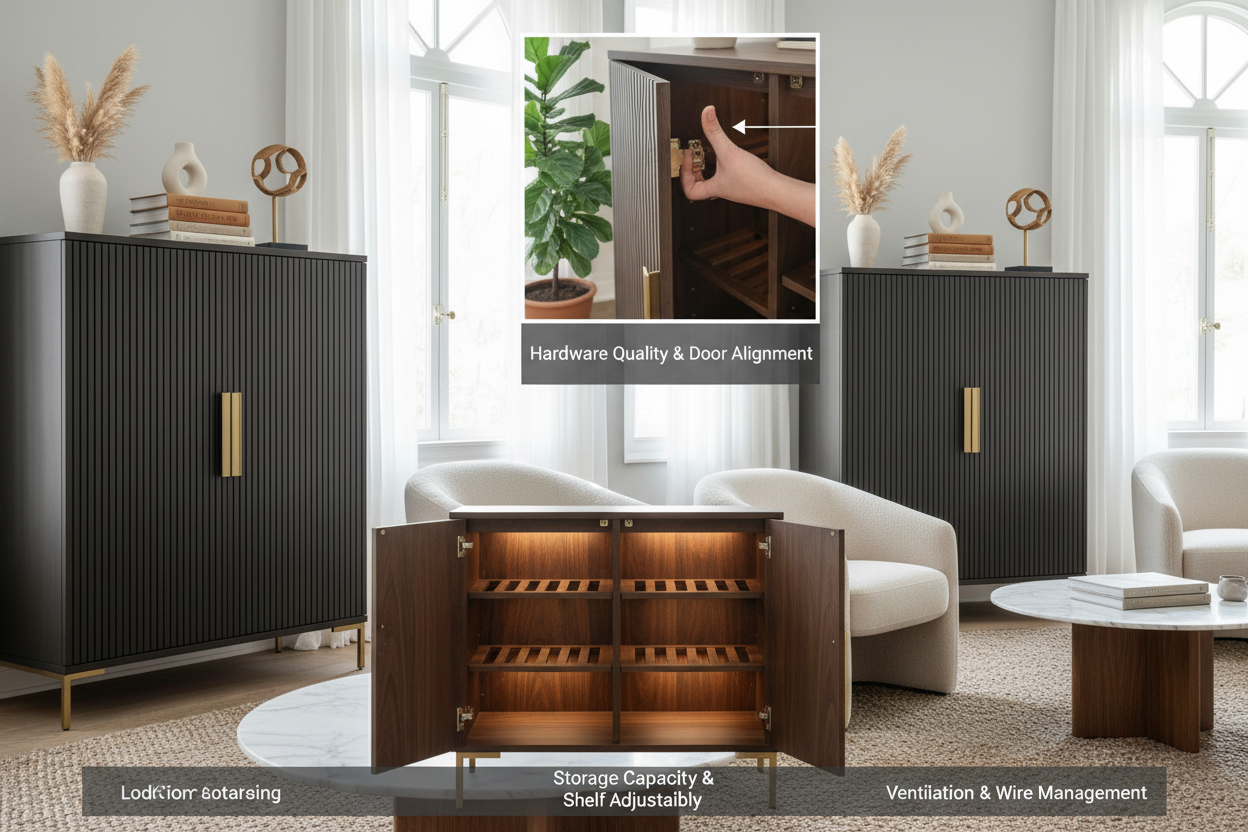
We’ve all been lied to by the 'shelfie' industrial complex. You know the look: perfectly spaced ceramic vases, exactly three art books stacked by color, and a single trailing plant that somehow never drops dead leaves. It looks great on a screen, but in reality, your open shelving is likely a graveyard for tangled HDMI cables, half-finished board games, and that one weird remote nobody knows how to use.
I finally hit my breaking point last year when I spent forty minutes dusting a collection of vintage cameras I don't even use. I realized that unless I wanted to spend my weekends as a full-time curator, I needed a cabinet with doors for living room sanity. Transitioning to concealed storage is the single best move I’ve made for my home, but it’s easy to mess up. Buy the wrong piece, and your living room suddenly feels like a dentist’s waiting room or a corporate cubicle.
The Quick Takeaways
- Measure your deepest item (usually a router or a game console) before looking at depth specs.
- Solid doors hide the mess; glass doors require you to actually be organized.
- Look for adjustable shelving—fixed shelves are the enemy of large coffee table books.
- Avoid the 'office' look by styling the top with organic shapes and varied heights.
Why We're Finally Admitting Open Shelves Are Exhausting
Open shelving is a part-time job. If you aren't constantly tidying, it looks like a cluttered mess. If you are tidying, you're wasting time you could spend actually enjoying your home. This is why a storage cabinet with doors for living room life is the ultimate hack. It allows you to be a 'messy person' behind closed doors while presenting a calm, curated face to the world.
When I swapped my open rack for a proper cabinet, my visual anxiety dropped by half. No more staring at the neon orange box of a board game while trying to watch a movie. You want a piece that anchors the room, provides a surface for a lamp or a drink, and swallows the chaos of daily life. But before you click 'add to cart' on the first pretty thing you see, you need to check the specs.
Thing 1: The 'Visual Weight' of the Piece
In a room that’s, say, 12x15 feet, a massive, dark oak cabinet can feel like it’s slowly encroaching on your sofa. This is what designers call 'visual weight.' It’s not just about the literal inches; it’s about how much space the piece 'eats' with your eyes. A heavy, floor-to-ceiling unit can make a small room feel like a closet.
If you're working with a tighter floor plan, you need to be strategic about choosing the perfect small cabinet with doors. Look for pieces with legs—seeing the floor underneath the cabinet tricks your brain into thinking the room is larger than it is. I once bought a solid-base plinth cabinet for my tiny apartment and it felt like a boulder in the corner. I replaced it with something on tapered legs, and the room instantly breathed again.
Thing 2: The Transparency Test (Solid Wood vs. Glass)
This is where you have to be honest with yourself. Are you a 'curator' or a 'hider'? If your goal is to shove a mountain of plastic toys and mismatched coasters out of sight, you need solid living room cabinet doors. An elegant solid wood modern sideboard is the gold standard here. It’s opaque, it’s sturdy, and it hides the 'crime scene' of your junk drawer perfectly.
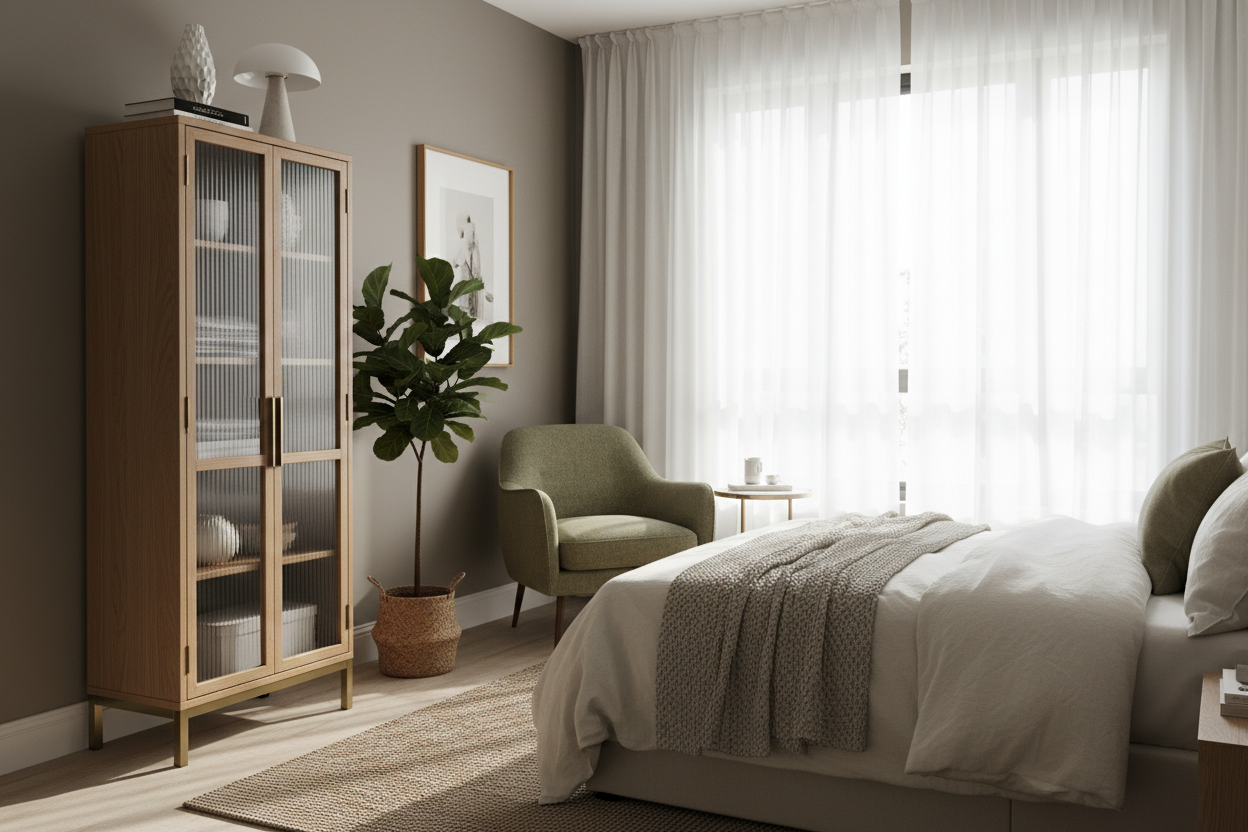
On the flip side, if you have a collection of beautiful glassware or books that you actually want to see—but you're tired of them getting dusty—go for a black cabinet with glass doors. It offers a sophisticated, framed look that feels more like a gallery and less like a storage locker. Just remember: if you can see through it, the interior styling matters. Don't put the router in the glass one.
Thing 3: The Internal Adjustability Factor
There is nothing more frustrating than buying a beautiful living room storage cabinet with doors only to realize the shelves are fixed 10 inches apart, and your favorite vase is 11 inches tall. I’ve made this mistake. I ended up having to store my oversized art books horizontally, which made getting the bottom one out a total nightmare.
Always look for living room shelves with doors that feature adjustable peg holes. You want the flexibility to move things around as your 'stuff' changes. If you’re storing tech, check for cord management holes in the back. If they aren't there, you'll end up having to drill your own, and trust me, doing DIY carpentry on a finished piece of furniture is a recipe for a splintery disaster.
How to Style the Top So It Doesn't Look Like an Office Credenza
The biggest risk with a large cabinet is that it starts looking like it belongs in a law firm. To avoid the 'office' vibe, you need to break up the hard, rectangular lines of the cabinet with softer, organic shapes. Think of the top of your cabinet as a stage.
Instead of centering everything, try the 'rule of thirds.' Put a tall, statement lamp on one side, a stack of books and a small bowl in the middle, and maybe a trailing ivy on the other. If you want something that feels light and airy from the jump, a boho white storage cabinet is a great choice because the color and texture naturally lean more 'home' and less 'headquarters.' Lean a piece of oversized art against the wall instead of hanging it perfectly level—it creates a relaxed, lived-in feel that softens the whole look.
FAQ
Will a cabinet make my small living room look cluttered?
Actually, the opposite. One larger cabinet with doors usually looks cleaner than five small baskets or a cluttered open shelf. It’s about reducing visual noise. Just make sure it’s proportional to your sofa.
How deep should a living room cabinet be?
Standard depth is usually 15 to 18 inches. If you’re hiding a modern receiver or a PlayStation, measure it first—some of those units are surprisingly deep once you plug the cables into the back.
Can I use a dining sideboard in the living room?
Absolutely. I do this all the time. Sideboards are often the perfect height (around 30-34 inches) to sit under a window or act as a base for a gallery wall. Labels like 'dining' or 'living' are mostly just suggestions.

Leave a comment
This site is protected by hCaptcha and the hCaptcha Privacy Policy and Terms of Service apply.